Close Menu
GeekBlog

    Subscribe to Updates

    Get the latest creative news from FooBar about art, design and business.

    What's Hot

    A Toddler Needed a $20,000 Wheelchair. A High School Robotics Team Built Him One Instead.

    August 5, 2026

    AI’s Memory Boom Is Quietly Crushing the Budget Smartphone

    August 5, 2026

    Scientists Didn’t Say Earth Is Becoming Uninhabitable. Here’s What the “Hothouse Earth” Study Actually Says

    August 5, 2026
    Facebook X (Twitter) Instagram Threads
    GeekBlog
    • Home
    • Mobile
    • Tech News
    • Blog
    • How-To Guides
    • AI & Software
    Facebook
    GeekBlog
    Home»Tech News»Everything You Need to Know About the Full Moon Lunar Eclipse Tonight
    Tech News

    Everything You Need to Know About the Full Moon Lunar Eclipse Tonight

    Michael ComaousBy Michael ComaousSeptember 7, 20253 Mins Read
    Share Facebook Twitter Pinterest LinkedIn Tumblr Email Copy Link
    Moon,red,red,moon,the,full,moon,is,very,dark
    Share
    Facebook Twitter LinkedIn Pinterest Email Copy Link

    Recommended for you:

    Bluesky finally has a private bookmarking feature
    Tech News·Sep 9, 2025

    Bluesky finally has a private bookmarking feature

    Much of the world will get to witness the spectacle of a total lunar eclipse on Sunday night.

    A total lunar eclipse happens when the Earth passes between the Moon and the Sun, briefly aligning in a way that completely shadows the Moon.

    A full moon lunar eclipse happens in three phases. The first phase is the penumbral phase when the Moon starts to enter Earth’s shadow. Then the partial phase begins, when a part of the moon enters the deep part of Earth’s shadow called the umbra.

    Next is totality, when the Moon is completely submerged in the Earth’s shadow. Then the phases end in order too. First totality ends, then the partial eclipse and finally the penumbral eclipse ends.

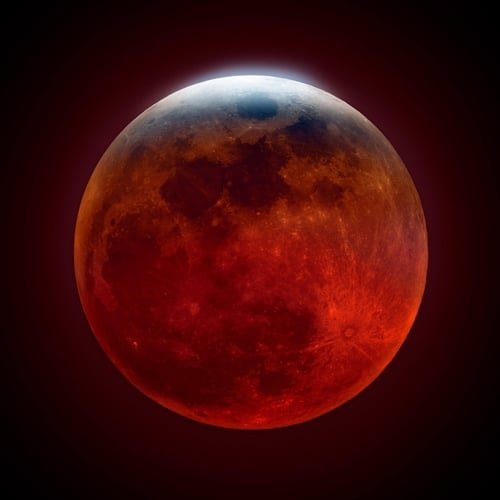
    When the Moon is totally submerged in the Earth’s shadow, the light that does reach the moon’s surface has to pass through Earth’s atmosphere. During this, shorter wavelengths of light, like blue, scatter and only the longer wavelengths, like red, reach the surface.

    This creates a dark, rusty red hue around the moon during the totality phase, which is why people often refer to total lunar eclipses as the “blood moon.” This blood moon effect is expected to be visible during this eclipse.

    The totality phase of Sunday’s lunar eclipse will last an unusually long 83 minutes, one of the longest we will get to experience in decades, according to National Geographic.

    Here’s everything you need to know about Sunday’s total lunar eclipse.

    How rare is a total lunar eclipse?

    The Moon has a tilted orbit, so we don’t get a total lunar eclipse every lunar cycle, which is roughly every month.

    Instead, it happens only a few times a year and is only visible on either the Eastern or the Western part of the world each time.

    Approximately 29% of lunar eclipses are total lunar eclipses, according to TimeandDate.com.

    This year we will only get two. The first one took place earlier this year, on the night bridging March 13 to March 14.

    Where will it be visible?

    Sadly, the Moon will enter Earth’s shadow during daytime hours for most of the Americas, roughly between 11 a.m. and 5 p.m. ET. So that means American skywatchers will not be able to see Sunday’s eclipse, except for Hawaiians.

    Some parts of the archipelago will be able to witness the beginning of the lunar eclipse starting at 5:28 a.m. until 6:15 a.m. local time, but won’t get to watch the full eclipse.

    The eclipse will be visible from Europe, Africa, Asia, and Australia, with the latter two getting the best views.

    During the 83-minute total eclipse will start at around 8:30 p.m. in Turkey and Egypt, 11 p.m. in India, 2:30 a.m. in Japan, and 3:30 a.m. in Australian cities like Sydney and Melbourne, all in local time.

    How to watch it

    Solar eclipses require special glasses to watch, but lunar eclipses don’t require that. All you need is a clear night sky and minimal light pollution for an even better view.

    The next one will be visible in the U.S.

    The next total lunar eclipse will be on March 3, 2026, according to NASA. It will be visible in all of the Americas, Pacific, and parts of Australia and Eastern Asia.

    It’s estimated to be a shorter one than Sunday’s eclipse, with the totality phase to last about 58 minutes.

    Recommended for you:

    Software packages with more than 2 billion weekly downloads hit in supply-chain attack
    Tech News·Sep 9, 2025

    Software packages with more than 2 billion weekly downloads hit in supply-chain attack

    Share. Facebook Twitter Pinterest LinkedIn Tumblr Telegram Email Copy Link
    Previous ArticleTexans vs. Rams Livestream: How to Watch NFL Week 1 Online Today
    Next Article Google finally details Gemini usage limits
    Michael Comaous
    • Website

    Michael Comaous is a dedicated professional with a passion for technology, innovation, and creative problem-solving. Over the years, he has built experience across multiple industries, combining strategic thinking with hands-on expertise to deliver meaningful results. Michael is known for his curiosity, attention to detail, and ability to explain complex topics in a clear and approachable way. Whether he’s working on new projects, writing, or collaborating with others, he brings energy and a forward-thinking mindset to everything he does.

    Related Posts

    6 Mins Read

    AI’s Memory Boom Is Quietly Crushing the Budget Smartphone

    6 Mins Read

    Meta Wants an AI Agent Managing Your Life. Wall Street Isn’t So Sure

    6 Mins Read

    MakuluLinux’s New AI-OS Wants to Run Your Whole Desktop, Not Just Answer Questions

    7 Mins Read

    AI Tokens Got 98% Cheaper. Corporate AI Bills Are Exploding Anyway

    7 Mins Read

    Hackers Are Hijacking Hotel Wi-Fi to Steal Microsoft 365 Logins Without a Single Phishing Email

    5 Mins Read

    Microsoft’s Biggest Patch Tuesday Ever Just Showed Us Where Cybersecurity Is Heading

    Top Posts

    Best Stores for Buying MP3 and Digital Music You Can Keep Forever (2026)

    August 2, 202530 Views

    Every iPhone Camera Ranked in 2026 (Best to Worst)

    July 6, 202613 Views

    How to Fix PS5 Controller Stick Drift (2026): 7 Working Methods

    July 10, 20268 Views
    Stay In Touch
    • Facebook

    Subscribe to Updates

    Get the latest tech news from FooBar about tech, design and biz.

    Most Popular

    Best Stores for Buying MP3 and Digital Music You Can Keep Forever (2026)

    August 2, 2025930 Views

    Discord will require a face scan or ID for full access next month

    February 9, 2026770 Views

    Trade in your old phone and get up to $1,100 off a new iPhone 17 at AT&T – here’s how

    September 10, 2025383 Views
    Our Picks

    A Toddler Needed a $20,000 Wheelchair. A High School Robotics Team Built Him One Instead.

    August 5, 2026

    AI’s Memory Boom Is Quietly Crushing the Budget Smartphone

    August 5, 2026

    Scientists Didn’t Say Earth Is Becoming Uninhabitable. Here’s What the “Hothouse Earth” Study Actually Says

    August 5, 2026

    Subscribe to Updates

    Get the latest creative news from FooBar about art, design and business.

    Facebook
    • About Us
    • Contact us
    • Privacy Policy
    • Disclaimer
    • Terms and Conditions
    © 2026 GeekBlog

    Type above and press Enter to search. Press Esc to cancel.