

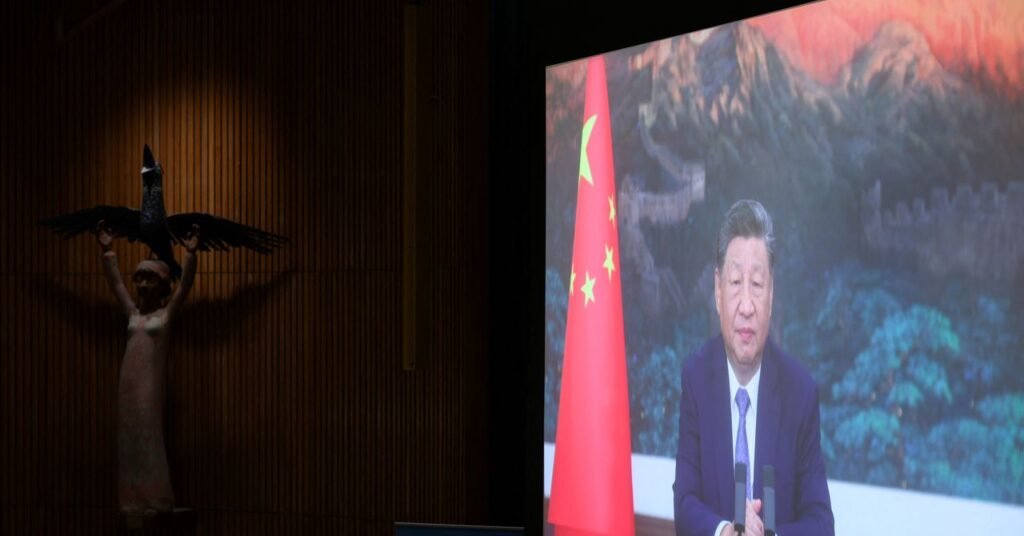
Speaking by video at the UN Climate Summit in New York last week, China’s president Xi Jinping laid out his country’s climate ambitions. While the stated goals may not have been aggressive as some environmentalists would like, Xi at least reaffirmed China’s green commitment.
“Despite some countries going against the trend, the international community should stay on the right track, maintain unwavering confidence, unwavering action, and undiminished efforts,” he said. Any reference to Donald Trump and the United States was surely intended (though not explicit).
The march of the energy transition is a long one, but it has to start somewhere. And with this approach, China has already taken quite a few steps.
Beijing Stands (Mostly) Alone
Today, there is no race to be a climate leader. The world is a far fry from the COP26 conference in November 2021, when tackling the threat of climate change seemed like a global priority. A few months later, Russia invaded Ukraine; the ensuing energy crisis and inflation kicked climate off of many political agendas.
While Joe Biden and the United States responded to soaring prices with the Inflation Reduction Act, which prioritized investment in renewable energy, Donald Trump subsequently withdrew the US from the Paris Agreement—an international accord to limit global warming—for the second time. The European Union has also stuttered: Too internally divided, it did not go beyond a drab declaration of intent at the UN Climate Summit. There hasn’t been much movement from India, a country of nearly 1.5 billion people. And other nations’ emissions are simply too small to matter.
Given this background, it becomes easy to understand how, in this scenario, China has become a global leader in the clean energy transition. Xi’s speech did not go into much detail, but it did mention all the main points of China’s strategy.
Cut Emissions Between 7 Percent and 10 Percent by 2035
In New York, Xi acknowledged the importance of the transition, and for the first time, agreed to reduce greenhouse gas emissions rather than simply promise to slow them down. China’s stated goal is between 7 percent and 10 percent reduction by 2035.
How do you evaluate these pledges? While the commitment is vague, it’s still significant; previously the regime had merely promised to reach peak emissions by 2030, tying the cuts to economic growth. In Xi’s speech you can seen China transition from a developing country approach to a role more akin to that of industrialized countries, whose emissions have been declining for decades.
Slow Going?
It should be pointed out that reducing emissions at the pace promised by Beijing means a decline of about 1 percent a year. According to an analysis by William Lamb of the Potsdam Institute for Climate Impact Research, this is a slower pace than that held by most industrialized nations. Italy, for example, has reduced them by an average of 3.2 percent every 12 months since their peak in 2006; the United Kingdom by an average of 2.8 percent since 2004; France by 2.3 percent.
“China has often promised little and achieved much,” notes Andreas Sieber, associate director for policy and campaigns for the global climate nonprofit 350.org, suggesting that China might overdeliver. The country’s lack of democracy also means its policies are not at risk of reversal every election cycle.
On Renewables
Xi Jinping’s speech included a commitment to reach 3,600 gigawatts (GW) of installed wind and solar capacity by 2035, six times the country’s 2020 figures. This is already the leading country in terms of installed renewable power, and a giant on the technology front as well, with universities churning out environmental and climate tech research at full speed, and attracting scientists from abroad across numerous fields. He also announced a commitment to an energy mix with more than 30 percent renewables.
On Electric Vehicles
Mobility has long been an issue for China, which has moved from bicycles, ubiquitous until the 1990s, to the mass automobile. The images of the 2008 Beijing Olympics are unforgettable: A blanket of smog buried the city. The government has in recent years given a strong boost to electric mobility: At the Climate Summit it announced plans to make EVs “mainstream,” that is, prevalent in sales. It helps that it has ready access to rare earth minerals that are essential for building batteries. And for that matter, the country hosts giant automotive companies like BYD and Catl, which supplies batteries to some 50 global brands including Tesla and Volkswagen.
On the carbon market
Xi has declared his intention to expand the national carbon emission trading market to more emission-intensive sectors than today.
On forests
China made additional commitments on forests, which it says will reach an extent of 34 billion cubic meters.
China has reshaped the market for green technologies.
To skeptics expecting broader measures and the mantle of true global leadership from China, well, that’s not a particularly coveted title these days—especially if the US continues to reverse course on climate science. As senior advisor Bernice Lee of the think tank Chatham House notes, China invested $625 billion in the clean energy transition last year alone; that’s nearly a third of the gobal total.
Not only that: Research and massive adoption of renewable technologies have led to the dramatic drop in prices, and China’s very large domestic market is a formidable driver in this regard. “The rise of Chinese renewables is reshaping the global economy and replacing coal in the domestic market,” Lee says.
The hope is that other countries, reassured by that commitment, will follow China’s example rather than America’s.
