Close Menu
GeekBlog

    Subscribe to Updates

    Get the latest creative news from FooBar about art, design and business.

    What's Hot

    Super Bowl LX ads: all AI everything

    February 8, 2026

    YouTube now lets you watch content auto-dubbed in your own language

    February 8, 2026

    Charli XCX Is a Demonic Brat in Takashi Miike’s ‘Untitled Tokyo’

    February 8, 2026
    Facebook X (Twitter) Instagram Threads
    GeekBlog
    • Home
    • Mobile
    • Tech News
    • Blog
    • How-To Guides
    • AI & Software
    Facebook
    GeekBlog
    Home»Tech News»Enormous Pair of Deep-Earth Hot ‘Blobs’ Shape Earth’s Magnetic Field, Scientists Say
    Tech News

    Enormous Pair of Deep-Earth Hot ‘Blobs’ Shape Earth’s Magnetic Field, Scientists Say

    Michael ComaousBy Michael ComaousFebruary 4, 20263 Mins Read
    Share Facebook Twitter Pinterest LinkedIn Tumblr Email Copy Link
    Enormous Pair of Deep-Earth Hot 'Blobs' Shape Earth’s Magnetic Field, Scientists Say
    Share
    Facebook Twitter LinkedIn Pinterest Email Copy Link

    For all we’ve learned about places far away in outer space, we may have barely scratched the surface of the places lying deep within Earth. As a result, there’s a lot of information we seem to be missing out on—for example, the influence of two huge rock blobs on Earth’s magnetic field.

    In a Nature Geoscience paper published yesterday, researchers announced that they’ve found evidence of two enormous blobs of solid, superheated material that appear to have shaped Earth’s magnetic field for millions of years. These big lower-mantle basal structures—blobs for short—lie at the base of Earth’s mantle, roughly 1,864 miles (3,000 kilometers) beneath Africa and the Pacific Ocean, study lead author Andrew Biggin explained in a commentary about the paper for The Conversation.

    A diagram showing the Earth’s internal structure. Credit: USGS

    The continent-sized blobs are much hotter than the lower mantle, creating a significant temperature gradient in the rocky mantle. According to Biggin, a geologist at the University of Liverpool in the United Kingdom, this sharp contrast helps sustain the flow of Earth’s fluid outer core, referred to as the geodynamo.

    “Without this massive internal heat transfer from core to mantle and ultimately through the crust to the surface,” Biggin wrote, “Earth would be like our nearest neighbors Mars and Venus: magnetically dead.”

    The history of Earth’s magnetism

    Earth’s magnetic field runs on electric currents generated by the motion of extremely hot iron and nickel—the geodynamo. To study historical trends in Earth’s magnetism, researchers look to the magnetic records contained in rocks and other natural materials. For instance, igneous rocks borne of cooled magma acquire a permanent magnetism that captures the direction of Earth’s magnetic field at the time and place of cooling.

    While studying such rocks, Biggin and his colleagues noticed distinct patterns in the magnetic records of rocks up to 250 million years old. Specifically, the magnetic directions displayed strong correlations with the longitude and latitude of where the rocks presumably formed.

    Meanwhile, geologists and seismologists in recent decades had increasingly focused on blobs, which appear to be closely related to volcanic eruptions. But Biggin’s team wondered whether the different puzzle pieces—magnetic records in volcanic rocks or blobs and volcanic eruptions—could help explain the role of blobs in Earth’s magnetic field.

    Exploring Earth, bottom-side-up

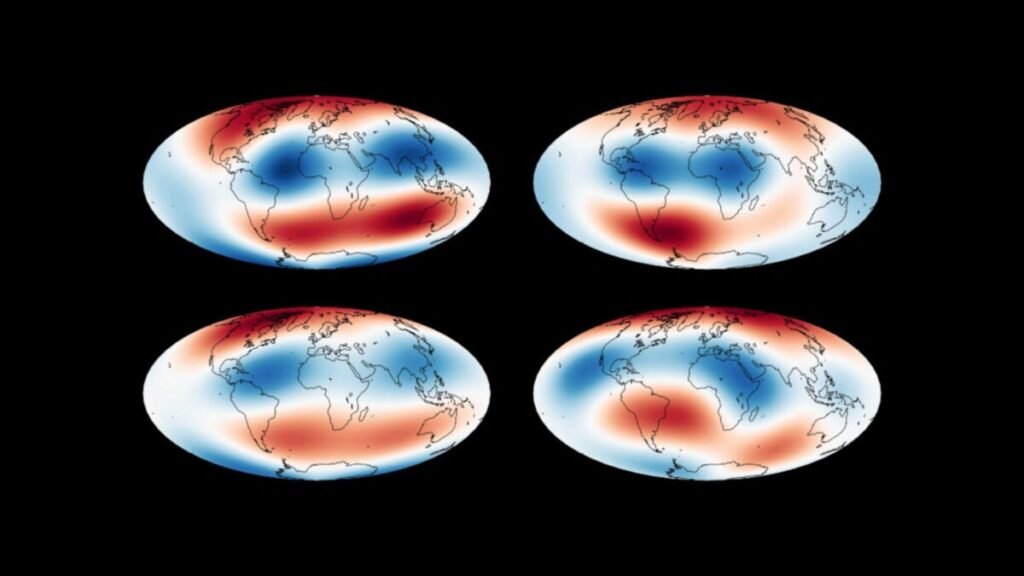
    For the new research, the team developed advanced simulations that mapped out Earth’s magnetic field based on different heat profiles for the core, mantle, and blob. After several trials, the map that most accurately depicted Earth’s actual magnetic field represented the model that included strong variations in heat transfers—something that would be the case if the blobs were actively churning between the outer core and the lower mantle.

    What’s more, the team found that the presence of blobs contributed to the overall stability of the magnetic field, with certain sections of the field remaining stagnant for hundreds of millions of years.

    “What seems to be happening is that the two hot blobs are insulating the liquid metal beneath them, preventing heat loss that would otherwise cause the fluid to thermally contract and sink down into the core,” Biggin explained.

    That said, blobs are still a general enigma for scientists; researchers have yet to properly characterize their true origin and identity. If the simulations are correct, however, blobs appear to be a big part of ensuring the Earth keeps things together—so “we have much to thank them for,” Biggin noted.

    Source: gizmodo.com

    Blobs DeepEarth Earths Enormous field Hot magnetic pair Scientists shape
    Share. Facebook Twitter Pinterest LinkedIn Tumblr Telegram Email Copy Link
    Previous ArticleWant Alexa+ today? Everyone in the US can finally try it now – here’s how
    Next Article Google quietly makes the Pixel 10A official
    Michael Comaous
    • Website

    Michael Comaous is a dedicated professional with a passion for technology, innovation, and creative problem-solving. Over the years, he has built experience across multiple industries, combining strategic thinking with hands-on expertise to deliver meaningful results. Michael is known for his curiosity, attention to detail, and ability to explain complex topics in a clear and approachable way. Whether he’s working on new projects, writing, or collaborating with others, he brings energy and a forward-thinking mindset to everything he does.

    Related Posts

    1 Min Read

    Super Bowl LX ads: all AI everything

    2 Mins Read

    YouTube now lets you watch content auto-dubbed in your own language

    2 Mins Read

    Charli XCX Is a Demonic Brat in Takashi Miike’s ‘Untitled Tokyo’

    6 Mins Read

    Watching football? Change these 5 settings on your TV for better performance instantly

    2 Mins Read

    Sony’s Biggest QLED Screens See Big Discounts This Weekend

    2 Mins Read

    Malicious packages for dYdX cryptocurrency exchange empties user wallets

    Top Posts

    The Mesh Router Placement Strategy That Finally Gave Me Full Home Coverage

    August 4, 2025412 Views

    Past Wordle answers – all solutions so far, alphabetical and by date

    August 1, 2025203 Views

    Buying a projector is useless until you know throw

    August 4, 2025145 Views
    Stay In Touch
    • Facebook

    Subscribe to Updates

    Get the latest tech news from FooBar about tech, design and biz.

    Most Popular

    The Mesh Router Placement Strategy That Finally Gave Me Full Home Coverage

    August 4, 2025412 Views

    Past Wordle answers – all solutions so far, alphabetical and by date

    August 1, 2025203 Views

    Buying a projector is useless until you know throw

    August 4, 2025145 Views
    Our Picks

    Super Bowl LX ads: all AI everything

    February 8, 2026

    YouTube now lets you watch content auto-dubbed in your own language

    February 8, 2026

    Charli XCX Is a Demonic Brat in Takashi Miike’s ‘Untitled Tokyo’

    February 8, 2026

    Subscribe to Updates

    Get the latest creative news from FooBar about art, design and business.

    Facebook
    • About Us
    • Contact us
    • Privacy Policy
    • Disclaimer
    • Terms and Conditions
    © 2026 GeekBlog

    Type above and press Enter to search. Press Esc to cancel.

    Ad Blocker Enabled!
    Ad Blocker Enabled!
    Our website is made possible by displaying online advertisements to our visitors. Please support us by disabling your Ad Blocker.