Close Menu
GeekBlog

    Subscribe to Updates

    Get the latest creative news from FooBar about art, design and business.

    What's Hot

    TerraPower gets OK to start construction of its first nuclear plant

    March 5, 2026

    Jensen Huang says Nvidia is pulling back from OpenAI and Anthropic, but his explanation raises more questions than it answers

    March 5, 2026

    A new video from the White House mixes Call of Duty footage with actual video of Iran strikes

    March 5, 2026
    Facebook X (Twitter) Instagram Threads
    GeekBlog
    • Home
    • Mobile
    • Tech News
    • Blog
    • How-To Guides
    • AI & Software
    Facebook
    GeekBlog
    Home»Tech News»Extreme Closeup of the ‘Eye of God’ Reveals Fiery Pillars in Stunning Detail
    Tech News

    Extreme Closeup of the ‘Eye of God’ Reveals Fiery Pillars in Stunning Detail

    Michael ComaousBy Michael ComaousJanuary 20, 20263 Mins Read
    Share Facebook Twitter Pinterest LinkedIn Tumblr Email Copy Link
    Extreme Closeup of the ‘Eye of God’ Reveals Fiery Pillars in Stunning Detail
    Share
    Facebook Twitter LinkedIn Pinterest Email Copy Link

    The Webb space telescope has stared deep into the darkness of the Helix Nebula, revealing layers of gas shed by a dying star to seed the cosmos with future generations of stars and planets.

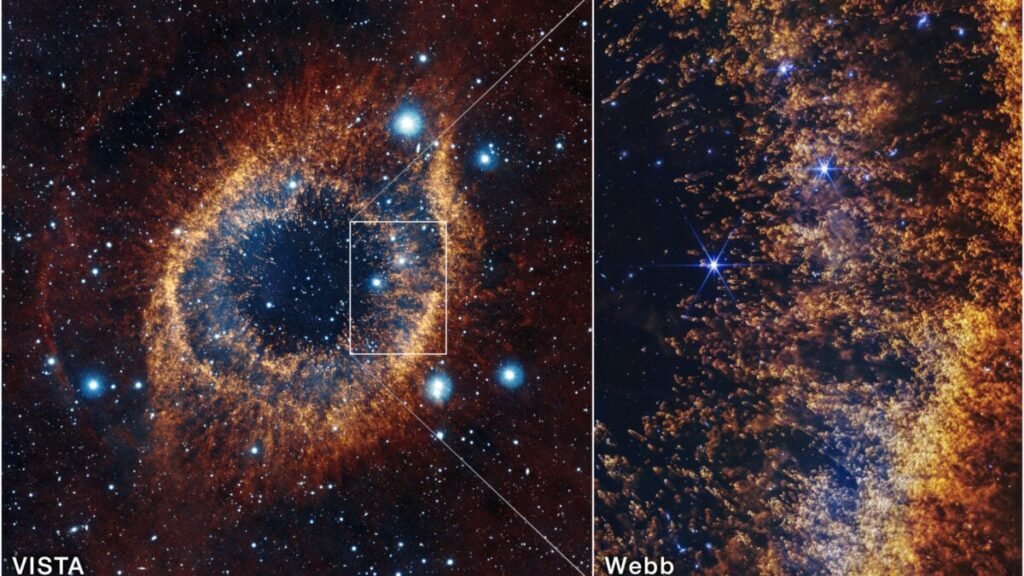
    A new Webb image captures a zoomed-in view of the iconic nebula, also known as the Eye of Sauron or Eye of God for its piercing, eye-shaped appearance. At its center is a blazing white dwarf—the leftover core of a dying star—releasing an avalanche of material that crashes into a colder surrounding shell of gas and dust.

    A new image from NASA’s James Webb Space Telescope of a portion of the Helix Nebula highlights comet-like knots, fierce stellar winds, and layers of gas shed off by a dying star interacting with its surrounding environment. Webb’s image also shows the stark transition between the hottest gas and the coolest gas as the shell expands out from the central white dwarf. Image: NASA, ESA, CSA, STScI; Image Processing: Alyssa Pagan (STScI)

    The image provides a glimpse into the future of stars like the Sun once they’ve reached the end of their life cycle, recycling material of their own to birth new planetary systems.

    Clear vision

    Using Webb’s NIRCam (Near-Infrared Camera), the small portion of the Helix Nebula comes into full view to reveal comet-like knots, blazing stellar winds, and layers of gas.

    The high-resolution image shows cloudy pillars that resemble flames surrounding the inner region of an expanding shell of gas. Winds of fast-moving, hot gas from the dying star crash into slower, colder shells of gas and dust shed by the star at an earlier point in its life, creating the nebula’s unique shape.

    The white dwarf, out of the frame of Webb’s zoomed-in image, lies at the heart of the nebula. Radiation from the dying star lights up the surrounding gas, creating layers of material like a cosmic lasagna. Closest to the white dwarf is hot ionized gas, with cooler molecular hydrogen farther out and protective pockets within dust clouds where more complex molecules can start to form. This is the raw material that could eventually mold itself into planets and star systems.

    In the Webb image, the temperature and chemistry of the material are represented by different colors. The blue hue marks the hottest gas in this field, energized by intense ultraviolet light from the white dwarf. Farther out, the gas cools into the yellow regions where hydrogen atoms join into molecules. At the nebula’s outer edges, reddish tones mark the coolest material, where thinning gas gives way to dust formation, according to NASA.

    A dying star

    The nebula was first spotted in the 1800s and has since become one of the most iconic features of our night skies for its striking shape and proximity. Located just 650 light-years away from Earth in the constellation Aquarius, the eye-shaped nebula is one of the closest of all bright planetary nebulae to our planet’s view.

    Astronomers have used ground-based and space observatories to stare into the Eye of Sauron, observing the final moments of a dying star in great detail.

    Source: gizmodo.com

    CloseUp Detail Extreme Eye Fiery God Pillars reveals stunning
    Share. Facebook Twitter Pinterest LinkedIn Tumblr Telegram Email Copy Link
    Previous ArticleI asked six popular AIs the same trick questions, and every one of them hallucinated
    Next Article iPhone 18 Pro might not feature a punch-hole display after all
    Michael Comaous
    • Website

    Michael Comaous is a dedicated professional with a passion for technology, innovation, and creative problem-solving. Over the years, he has built experience across multiple industries, combining strategic thinking with hands-on expertise to deliver meaningful results. Michael is known for his curiosity, attention to detail, and ability to explain complex topics in a clear and approachable way. Whether he’s working on new projects, writing, or collaborating with others, he brings energy and a forward-thinking mindset to everything he does.

    Related Posts

    2 Mins Read

    TerraPower gets OK to start construction of its first nuclear plant

    3 Mins Read

    Jensen Huang says Nvidia is pulling back from OpenAI and Anthropic, but his explanation raises more questions than it answers

    1 Min Read

    A new video from the White House mixes Call of Duty footage with actual video of Iran strikes

    6 Mins Read

    I was planning to get the Galaxy S26 Ultra, but these downgrades made me rethink

    2 Mins Read

    The New United Airlines Policy That Could Get You Kicked Off a Flight

    4 Mins Read

    I tried Tecno’s modular phone concept at MWC – and it quickly got weird

    Top Posts

    Discord will require a face scan or ID for full access next month

    February 9, 2026761 Views

    The Mesh Router Placement Strategy That Finally Gave Me Full Home Coverage

    August 4, 2025565 Views

    Past Wordle answers – all solutions so far, alphabetical and by date

    August 1, 2025230 Views
    Stay In Touch
    • Facebook

    Subscribe to Updates

    Get the latest tech news from FooBar about tech, design and biz.

    Most Popular

    Discord will require a face scan or ID for full access next month

    February 9, 2026761 Views

    The Mesh Router Placement Strategy That Finally Gave Me Full Home Coverage

    August 4, 2025565 Views

    Past Wordle answers – all solutions so far, alphabetical and by date

    August 1, 2025230 Views
    Our Picks

    TerraPower gets OK to start construction of its first nuclear plant

    March 5, 2026

    Jensen Huang says Nvidia is pulling back from OpenAI and Anthropic, but his explanation raises more questions than it answers

    March 5, 2026

    A new video from the White House mixes Call of Duty footage with actual video of Iran strikes

    March 5, 2026

    Subscribe to Updates

    Get the latest creative news from FooBar about art, design and business.

    Facebook
    • About Us
    • Contact us
    • Privacy Policy
    • Disclaimer
    • Terms and Conditions
    © 2026 GeekBlog

    Type above and press Enter to search. Press Esc to cancel.

    Ad Blocker Enabled!
    Ad Blocker Enabled!
    Our website is made possible by displaying online advertisements to our visitors. Please support us by disabling your Ad Blocker.