

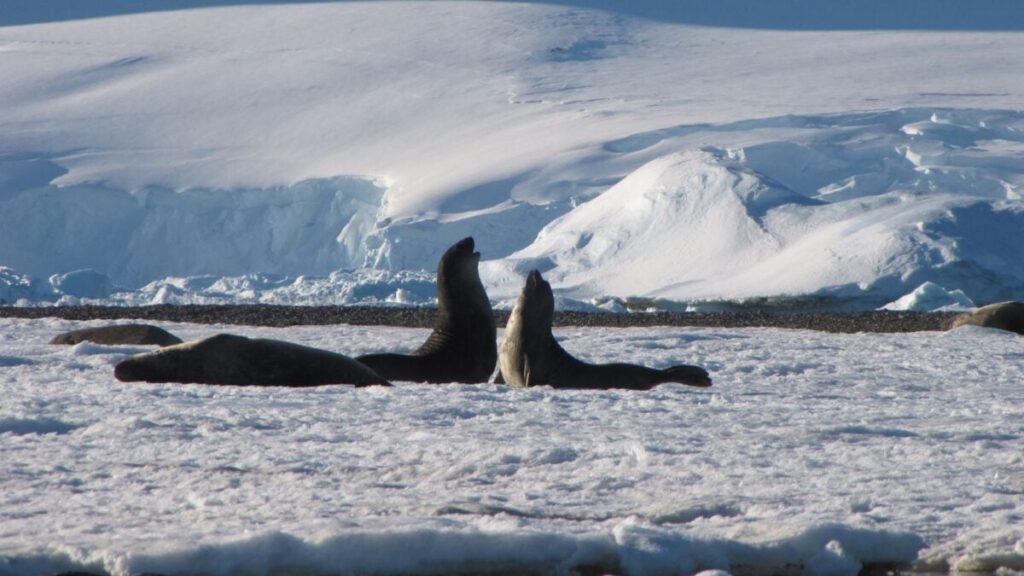
As carbon emissions push Earth’s temperature higher and higher, Antarctica is taking the brunt of the impact. This frozen continent is warming nearly twice as fast as the rest of the world, threatening its ecosystems, driving sea level rise, and destabilizing global food chains.
Humanity’s choices over the next decade will determine Antarctica’s fate, according to a study published Friday in the journal Frontiers in Environmental Science. The researchers, led by Newcastle University glaciology professor Bethan Davies, modeled the best- and worst-case scenarios for the Antarctic Peninsula, the warmest part of the continent. To avoid the worst outcomes, the world needs to advance toward net-zero emissions as quickly as possible.
“It is definitely possible—we can definitely do this,” Davies told Gizmodo. “It means thinking logically about how we power our countries, how we heat our homes, [making] policy decisions about how we live our lifestyles. All of this is manageable and is doable.”
Antarctica’s alarming future
For their study, Davies and her colleagues analyzed CMIP6 climate data. CMIP6 is a coordinated set of standardized simulations from dozens of climate models that allows scientists to predict how Earth’s systems will respond to different rates of greenhouse gas emissions while minimizing uncertainty.
The study considers three different scenarios: low emissions, medium-high emissions, and very high emissions. The low-emissions (or best-case) scenario would result in no more than 3.24 degrees Fahrenheit (1.8 degrees Celsius) of global warming above pre-industrial levels by 2100.
This future would spare the Antarctic Peninsula from the worst environmental damage and avoid the most severe global consequences of that damage. Winter sea ice extent would only be slightly less than it is today, and the Peninsula’s contributions to sea level rise would amount to just a few millimeters. Glaciers and their supporting ice shelves would remain largely intact.
Unfortunately, that’s not the path humanity is currently on. The world is on track for a medium- to medium-high emissions future, in which the global average temperature rises 6.5 degrees F (3.6 degrees C) above pre-industrial levels by 2100.
Under that scenario, temperatures on the Antarctic Peninsula would be 6.12 degrees F (3.4 degrees C) warmer than they are today. There would be roughly 19 more days above 32 degrees F (0 degrees C) per year, and more precipitation would fall as rain than snow.
Increased ocean temperatures and upwelling would also accelerate glacial retreat. The Peninsula would also experience more extreme weather events, and native species—such as the Adélie penguin—would be displaced by inhospitable climate conditions.
“The Adélie penguin is a hardy little animal, but it can’t tolerate its chicks getting wet,” Davies explained. “What happens when we get rain on the Antarctic Peninsula is you can lose the whole breeding colony—you can lose all the chicks.” She said researchers are already seeing the Peninsula’s Adélie population contract as other penguin species move in.

Then there’s the very high emissions scenario, in which the global average temperature rises nearly 8 degrees F (4.4 degrees C) above pre-industrial levels by 2100. This would be catastrophic for the Antarctic Peninsula, triggering ice shelf collapse, major sea ice loss, more frequent and severe extreme weather events, and dramatic declines in native species.
The damage would be irreversible, Davies said. While the world isn’t currently headed toward that worst-case scenario, it describes what could happen if humanity overshoots emissions targets and fails to curb emissions in the coming decades.
“The risk of that is that even if we then bury all the carbon in the ground and come up with a magic technology to do that, we’ve already crossed key tipping points on the Antarctic ice sheet, as well as other tipping points globally,” Davies said.
No time like the present
To researchers like Davies who conduct fieldwork on the Antarctic Peninsula, the impact of global warming is already starkly apparent. She has seen ice shelves smattered with meltwater puddles and rainstorms even during the dark winter months. In some cases, researchers have had to abandon field sites because melting has made them too dangerous to access, she said.
“We can think of the Antarctic Peninsula, specifically, as that canary in the coal mine,” Davies said. “It’s the warmest part of Antarctica [and] the place where you’re seeing the changes happen first.” What happens there will trigger changes across the rest of the continent and the world, she added.
The key takeaway from her team’s findings is that it’s not too late to change course. If the world acts quickly to curb carbon emissions, Antarctica’s future could look very different from the most likely scenario outlined in this study. Humanity’s choices over the next decade will be critical to stabilizing this vital region.
Source: gizmodo.com
