

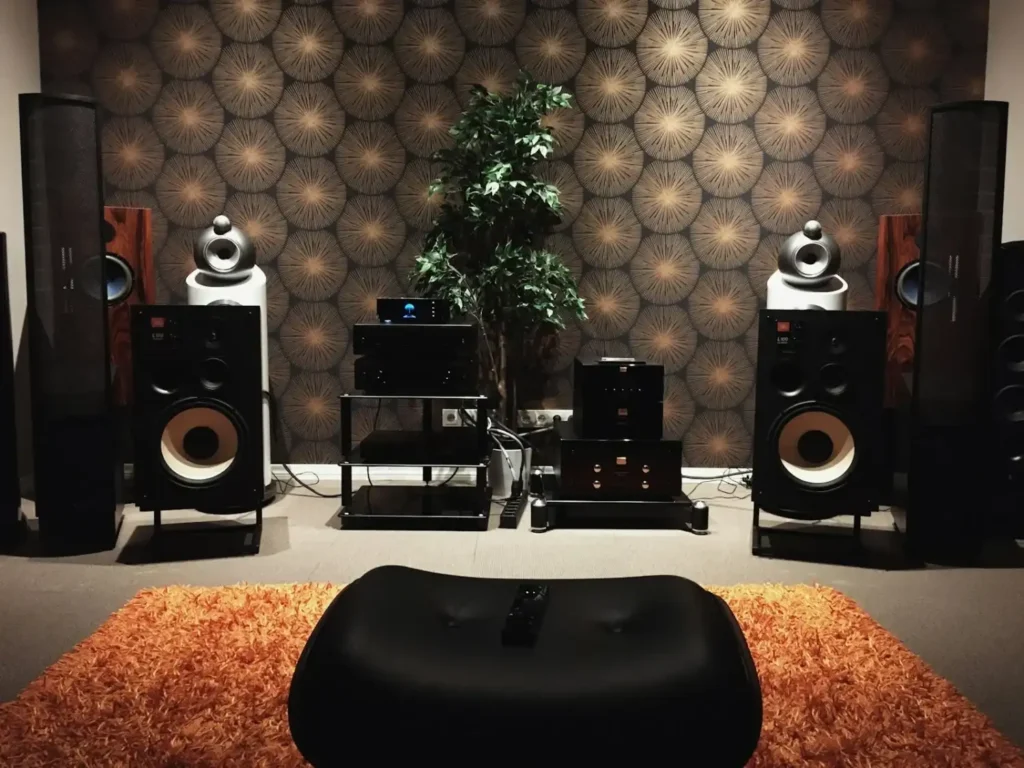
German speaker maker Ascendo and French audio processor specialist Trinnov teamed up for one of the most talked about home theater demos of 2025, built around an 11.13.8 channel speaker layout and a subwoofer with a 32 inch driver designed to reach infrasonic bass. Systems like that are far beyond a typical budget, but the ideas behind them apply to any living room. Here is what those numbers mean, what infrasonic bass actually is, and what a realistic bass upgrade looks like for a normal US home.
What 11.13.8 channels means
Surround sound layouts are written as three numbers. The first counts the main speakers at ear level, the second counts subwoofers, and the third counts overhead or height speakers used for formats such as Dolby Atmos and DTS:X.
Left, center and right up front, plus a wide ring of surround speakers around the seats.
Twelve 16 inch subs split between the front and rear of the room, plus one 32 inch infrasonic sub.
Overhead speakers that place sounds like rain, aircraft and echoes above the audience.
For comparison, a typical living room Atmos system is 5.1.2 or 7.1.4: five or seven ear level speakers, one subwoofer and two or four height channels. The demo system was simply that idea scaled up for a large dedicated theater room.
What infrasonic bass is
Human hearing is usually described as covering about 20 Hz to 20,000 Hz. Sound below roughly 20 Hz is called infrasonic. You do not hear it as a clear tone. Instead, you sense it as pressure, a rumble in your chest or a slight shake in the seat and floor. Movie soundtracks use these frequencies for explosions, earthquakes, starship engines and big musical moments.
Reproducing infrasonic bass at high volume is hard because very low frequencies have extremely long wavelengths. Moving enough air takes a large driver, a lot of amplifier power and a sturdy cabinet. That is why most consumer subwoofers roll off in the 20 to 30 Hz range.
The gear behind the demo
Trinnov processing and amplification
Trinnov is a French company known for high end surround processors and room correction. Its Altitude32 is one of the brand’s top home theater processors and can be configured with up to 36 channels. The demo paired it with Trinnov Amplitude16 multichannel amplifiers.
The key feature on display was Trinnov WaveForming, an active bass correction technology. It controls the timing and level of every subwoofer so that subs at the front of the room create a clean bass wave, while subs at the rear absorb reflections coming back off the back wall. The goal is smooth, even bass across every seat rather than booming spots and dead zones. WaveForming originally needed at least four subwoofers, two front and two rear, and Trinnov has since added a free software update that enables a two subwoofer version on the Altitude16, Altitude32 and AltitudeCI.
Ascendo speakers and subwoofers
Ascendo was founded in 1999 and builds its products in Stuttgart, Germany. Its lineup is named by driver size. The demo leaned on The16 Sub Active Sealed, a powered sealed subwoofer with a 16 inch driver and a 1,000 watt RMS amplifier, used in large numbers around the room.
The headliner was The32 Sub Pro Passive Sealed Infrasonic Subwoofer. The numbers listed by its US dealer show why it drew attention:
| Spec | Ascendo The32 Sub |
|---|---|
| Driver | 32 inch woofer with dual 6.5 inch voice coils |
| Rated peak output | 109 dB at 10 Hz, 125 dB at 20 Hz, 140 dB from 32 Hz up |
| Size | About 37 x 47 x 22 inches |
| Weight | About 340 pounds |
| Amplification | Passive, at least 3,000 watts per channel on two channels recommended |
Ascendo also offers even larger infrasonic models, including The50 Sub and The80 Sub, built for very large custom theaters.
A realistic bass upgrade for a normal home
You do not need thirteen subwoofers to get much better bass. The same principles behind the demo scale down nicely:
- Add a second subwoofer. Two subs, placed at different spots in the room, smooth out peaks and nulls far better than one larger sub. Front corners or the midpoints of opposite walls are common starting points.
- Use room correction. Most AV receivers include automatic calibration such as Audyssey, Dirac Live or YPAO. Run it with the microphone at several seats, not just the main chair.
- Choose sealed or ported for your goals. Sealed subs tend to sound tight and controlled and roll off gently at the very bottom. Ported subs often play louder in the 20 to 30 Hz range for the same size.
- Try the subwoofer crawl. Put the sub at your seat, play a bass heavy scene, crawl around the room and listen for where the bass sounds smoothest, then place the sub there.
- Consider tactile transducers. Small shakers bolted to a couch or riser add the physical sensation of deep bass without rattling the whole house.
FAQ
Can people hear infrasonic bass?
Not as a normal tone. Below about 20 Hz, most people perceive bass as pressure or vibration rather than pitch, especially at high levels.
Is one big subwoofer better than two smaller ones?
In most rooms, two subs give smoother bass across more seats. One very large sub can play deeper and louder, but placement and room effects still shape what you hear.
Do I need a Trinnov processor for good bass?
No. Trinnov targets high end dedicated theaters. Mainstream AV receivers with built in room correction and dual subwoofer outputs get most living rooms a long way.
Where can these systems be heard in person?
High end retailers and shows such as Audio Advice Live in Raleigh, North Carolina, which took place August 7 to 9 in 2026, regularly host demos from brands like Trinnov and Ascendo.
The verdict
The Ascendo and Trinnov demo shows what is possible when cost and space are no object: 13 subwoofers, smart bass control and a 32 inch driver reaching into infrasonic territory. For a normal home, the lesson is simpler. Add a second sub, place it thoughtfully, run room correction and you will feel a bigger difference than any spec sheet suggests.
Updated October 2026: rewritten as an explainer on the 11.13.8 Ascendo and Trinnov demo, infrasonic bass, the gear involved and practical bass upgrades for US homes.
Featured photo: Vaido on Unsplash.
About this article: GeekBlog covers U.S. technology news, AI, phones, smartwatches and gaming. Every story is written and checked under our Editorial Policy. Spotted a mistake or have a story tip? Contact our editors.
