

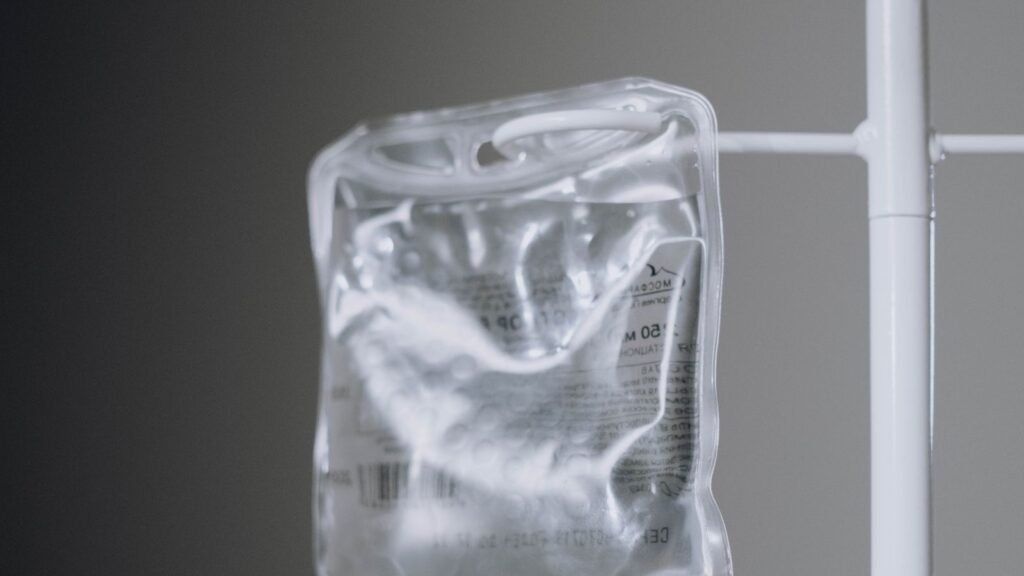
The nurse was about to connect a large, refrigerated bag to the port in Philipp Dettmer’s chest when a single drop of the liquid escaped. She panicked and checked whether any of it had touched her gloves or skin. Dettmer, who was about to have the entire bag pumped into his bloodstream, found the moment pretty funny.
Dettmer is the founder of Kurzgesagt, the YouTube channel known for its bird-filled science animations and its tens of millions of subscribers. In 2018, he was treated for stage 3B testicular cancer that had already spread to several lymph nodes and one of his lungs. The drug in that bag was cisplatin, and as UNILAD Tech reported, he now credits it with saving his life. His new video tells the story of how a heavy metal that most experts thought was too poisonous to use became one of the most effective cancer drugs ever made.
The short version
- Cisplatin is a small molecule built around a single platinum atom. It kills cells by jamming their DNA.
- It was discovered by accident in the 1960s by physicist Barnett Rosenberg, who was testing what electricity does to bacteria.
- Early human trials were brutal, with up to 75% of patients suffering severe kidney damage.
- A tiny trial in 11 men with advanced testicular cancer changed everything: three went into complete remission.
- Testicular cancer now has an overall survival rate of about 95%. Dettmer’s chemo cleared his cancer in about six weeks.
An experiment that failed in the best way
In the mid-1960s, Barnett Rosenberg, a physicist at Michigan State University, wanted to know whether an electric field could affect how cells divide. He ran a current through a solution of E. coli bacteria using platinum electrodes. The electricity itself did nothing interesting. But the bacteria stopped dividing and kept growing, stretching into filaments up to 300 times their normal length.
It turned out the culprit wasn’t the current. Tiny amounts of platinum from the electrodes were reacting with the solution and forming new compounds, and one of them, cis-diamminedichloroplatinum(II), was blocking cell division. Rosenberg published the finding in Nature in 1965.
At the time, any chemical that stopped cells from dividing was a candidate cancer drug, so Rosenberg tried it on mice with tumors. High doses killed the animals. Lower doses shrank the tumors, and in some mice they vanished completely. Plenty of experts were still skeptical, because heavy metals have a long reputation as poisons. According to Dettmer, Rosenberg kept lobbying drug developers, at one point calling every week, until human testing began.
From near-failure to breakthrough
The first human trials were hard to watch. Cisplatin was given to patients with many different cancers. It helped few of them, and up to 75% of patients in early studies suffered severe kidney damage. Dettmer points out that it’s hard to prove the drug caused deaths, since these patients were already terminally ill, but the toxicity was impossible to ignore.
Then came a study of just 11 men with advanced testicular cancer, the most common cancer in young men. Six responded to the drug, and three went into complete remission. That doesn’t sound like much until you know the baseline: back then, the vast majority of men whose testicular cancer had spread died from it. In Dettmer’s words, “3 out of 11 recoveries, from the very late stage no less, was a medical breakthrough.”
Two more advances turned that spark into a standard treatment. In 1974, oncologist Lawrence Einhorn at Indiana University combined cisplatin with two other drugs, vinblastine and bleomycin, and saw dramatic results in metastatic testicular cancer. And in 1977, researchers found that flooding patients with large volumes of fluid before and after each dose protected their kidneys by flushing the drug out quickly. The side effect is exactly what you’d expect: you spend day and night running to the bathroom.
How cisplatin went from lab accident to cure
1965
Rosenberg reports that platinum compounds stop E. coli from dividing.
1969
Low doses shrink and clear tumors in mice.
Early 1970s
First human trials. Severe kidney damage in up to 75% of patients.
1974
Einhorn’s three-drug combination transforms results in metastatic testicular cancer.
1977
Aggressive hydration protects the kidneys and makes the drug tolerable.
1978
The FDA approves cisplatin.
2018
Philipp Dettmer’s stage 3B cancer is cleared after about six weeks of chemo.
Sources: Kurzgesagt, Nature, US National Cancer Institute. Compiled by GeekBlog.
How a platinum “quadcopter” kills cancer cells
Dettmer describes the cisplatin molecule as looking like a tiny quadcopter: a platinum atom in the middle, with four arms sticking out. It’s delivered through a central line straight toward the heart, so it spreads through the body almost instantly. Because the bag is ice-cold, he says it feels like being cooled from the inside.
Here’s what happens next, step by step:
- Most of it parks itself. In the first hours, about 90% of the drug binds to proteins in the blood plasma and goes inactive, then trickles back out over the following days.
- The rest gets inside cells. The free 10% slips through cell membranes, which can’t keep it out.
- It activates. Inside the cell, where there’s much less chloride than in blood, the molecule swaps its chloride arms for water and becomes highly reactive.
- It grabs DNA. The activated drug latches onto DNA bases, mostly guanine, and links neighboring strands together. That kinks the double helix like a zipper with a stuck tooth.
- The cell gives up. A cell that can’t copy or repair its DNA triggers its own self-destruct program, called apoptosis.
The problem is that this hits healthy cells too, which is why the side effects are so rough. Cisplatin is known for severe nausea, kidney damage, hearing loss and nerve damage in the hands and feet. Dettmer summed up the experience with dark humor, saying it would have been nice if the drug could have cured him “without kicking me in the face repeatedly.” Then he added: “But oh well. It did save my life.”
Why testicular cancer is so vulnerable
Cisplatin is used against many cancers, including ovarian, lung, bladder and head and neck cancers. But nothing responds to it quite like testicular cancer. The reason comes down to how these cells are built. They come from germ cells, the cells that make sperm, and germ cells are wired to be extremely careful with DNA. If their genetic code gets damaged, they’re far more likely to destroy themselves than to try a risky repair. Testicular cancer cells keep that instinct, and they’re also relatively poor at fixing the exact type of DNA damage cisplatin causes.
That’s the reason the survival numbers look the way they do today, even for cancer that has spread.
Testicular cancer survival today
5-year relative survival by stage at diagnosis, US
Localized (only in the testicle)
Regional (nearby lymph nodes)
Distant (spread to organs like the lungs)
All stages combined
Source: US National Cancer Institute SEER data via the American Cancer Society, rounded. Before platinum chemotherapy, most men with spread disease did not survive.
Dettmer’s cancer had reached his lung, which puts it in the “distant” group, the hardest one on that chart. Before cisplatin, that diagnosis was usually fatal. Today, roughly three in four men in that group are alive five years later, and the odds are much better when the cancer is caught early. The most famous example is probably cyclist Lance Armstrong, whose testicular cancer had spread to his lungs and brain in 1996 and was treated with platinum-based chemo by doctors at Indiana University, where Einhorn did his pioneering work.
Know the signs
Testicular cancer is most common in men aged roughly 15 to 45. The usual first sign is a painless lump or swelling in a testicle, or a feeling of heaviness. A quick monthly self-check takes less than a minute, and anything new is worth showing to a doctor. Early stage disease is almost always curable.
Why a 60-year-old drug still matters
Cancer headlines today are full of targeted therapies, immunotherapy and AI drug discovery. Yet platinum drugs like cisplatin, and its gentler cousins carboplatin and oxaliplatin, are still the backbone of a huge share of chemotherapy treatments worldwide. Cisplatin is on the World Health Organization’s list of essential medicines.
Its story is also a good reminder of how messy drug development really is. A physics experiment went sideways, a compound nearly got abandoned for being too toxic, and one stubborn researcher kept picking up the phone. That kind of luck and persistence is still hard to automate. Even with AI now working in drug labs, nine out of ten experimental drugs still fail before they reach patients.
The takeaway
Cisplatin is genuinely toxic, which is why a nurse panicked over a single drop. It’s also one of the biggest success stories in cancer medicine, turning a disease that killed most young men once it spread into one that about 95% of patients survive. Dettmer’s video is worth watching, and if it gets even a few viewers to do a self-check, it’ll have done more good than most science content ever does.
About this article: GeekBlog covers U.S. technology news, AI, phones, smartwatches and gaming. Every story is written and checked under our Editorial Policy. Spotted a mistake or have a story tip? Contact our editors.
