

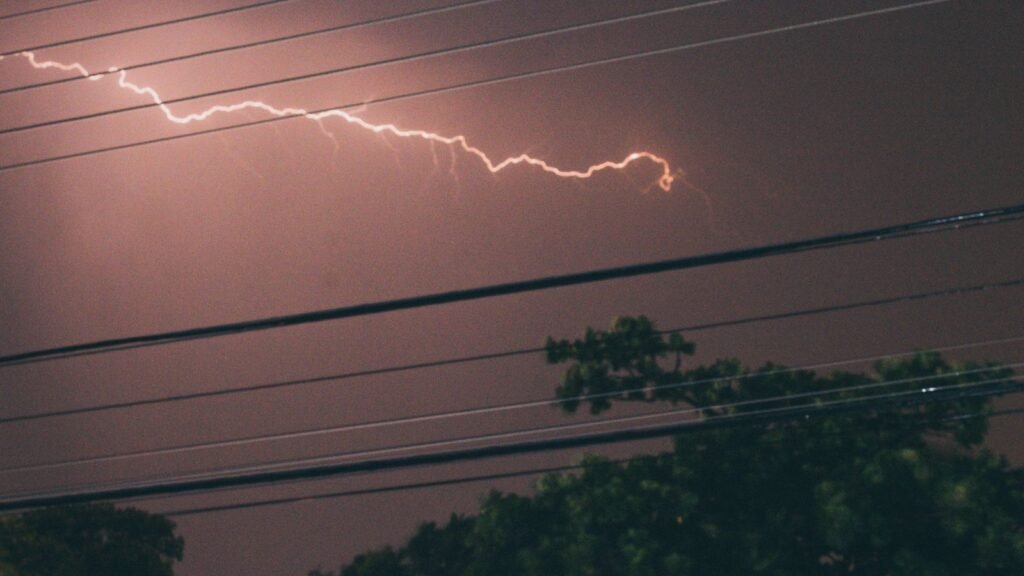
Most people’s blackout plan is simple: keep your phone charged. According to the UK’s own emergency planning, that plan falls apart in the scenario officials call “Black Sky.” Your phone can sit at 100% and still be close to useless, because the cell tower it needs to reach runs on the same grid that just went down.
The warning is doing the rounds again after UNILAD Tech highlighted the government’s guidance, which says that during a national outage “phone, internet and television services would be disrupted” and emergency advice would go out over the radio instead. We looked at what Black Sky actually means, why your phone stops working and which bits of tech you can still count on.
The short version
- A Black Sky event is a total, wide-area power failure across Great Britain. Officials call it very unlikely, and it has never happened.
- If it did, mobile masts, broadband and digital landlines would fail as backup power runs out, so a charged phone wouldn’t get a signal.
- Emergency health advice is already scripted for BBC Radio 2 and Radio 4, written by the UK’s four Chief Medical Officers.
- The government’s Be Ready campaign asks households to keep three days of essentials, including a battery or wind-up FM radio, a torch and some cash.
What “Black Sky” actually means
Black Sky is the planning term for a prolonged blackout covering the whole country, or most of it, severe enough to knock out other essential services too. That means water pumps, sewage, card payments, fuel stations and telecoms, all at once.
It’s worth being clear about the odds. The official health guidance describes the scenario as “very unlikely.” Professor Simone Abram, Executive Director of the Durham Energy Institute, told LADbible that a full national grid failure “is actually very unlikely” and “is also unlikely to be something that lasts a long time because the grid can be segregated into sections to be restored.”
So why is it in the news? Three things lined up. The government published emergency broadcast scripts on GOV.UK on December 16, 2025. It launched its Be Ready campaign on October 22, 2026, asking people to keep three days of supplies at home. And on November 7, the BBC detailed how it would keep broadcasting through a national blackout, with around 100 staff running a special radio service with enough food, water and fuel to go at least three days without resupply.
Why a charged phone isn’t enough
Your phone is only one end of the connection. The other end is a mobile mast, then a chain of exchanges, fiber links and data centers behind it. All of them need electricity.
Some masts have battery backup, but it’s designed to cover short cuts, not days. Once those batteries run down, the mast goes silent, and your phone shows “No Service” no matter how full its battery is. That’s what happened in stages during the Iberian blackout on April 28, 2025, when mobile networks across Spain and Portugal degraded as the grid stayed down. Closer to home, when floods knocked out a substation in Lancaster in December 2015, about 61,000 properties lost power, and mobile and internet connections failed widely along with card machines and petrol pumps.
There’s a newer wrinkle too. The UK is moving every landline from the old copper network to digital lines that run through your broadband router, with the switch-off deadline set for January 31, 2027. Old copper phones drew power from the line itself and often kept working in a power cut. Digital landlines don’t. When your router loses power, so does your home phone. Ofcom requires providers to offer at-risk customers, like people who rely on a landline or a telecare alarm, a backup solution that lasts at least one hour.
What still works when the grid goes down
Assuming a long, nationwide outage, after backup power runs out
✕ Mobile calls, texts and data
Masts need grid power. Backup batteries cover hours, not days.
✕ Home broadband and Wi-Fi
No power to your router, and none to the network behind it.
✕ Digital landlines
They run through the router. Ofcom backup only has to last 1 hour.
✕ Card and phone payments
Terminals and cash machines go offline. Keep some cash.
~ Your phone itself
Still a torch, camera, offline maps and saved documents.
~ Satellite messaging
Works on some phones without masts, but it’s slow and built for emergencies.
✓ Battery or wind-up FM radio
The official channel for emergency advice. BBC transmitters run on generators.
✓ Car radio
Picks up the same broadcasts, as long as you’ve got fuel or battery.
Sources: GOV.UK emergency health scripts, BBC, Ofcom. Compiled by GeekBlog.
Why the government is betting on FM radio
A cheap FM radio doesn’t need a mast, a router or a login. It just needs a transmitter somewhere that’s still on air, and the BBC’s plan covers exactly that. Its transmitters would be backed by diesel generators, its journalists would file from emergency centers using satellite-equipped vehicles, and its teams would rely on satellite phones and pre-agreed meeting points if even those failed.
The scripts that would be read out are already written. The UK’s four Chief Medical Officers prepared them with input from the UK Health Security Agency, and they cover drinking water, food safety, sanitation and coping with extreme temperatures. Short broadcasts cover the first day, with longer guidance for the days after. Some lines are blunt. One reads: “You will not be able to flush the toilet.” Another warns never to use camping stoves or barbecues indoors because of the risk of fatal carbon monoxide poisoning.
The stations named in the guidance are BBC Radio 2 and BBC Radio 4. If you buy a radio for your kit, tune it to both and write the frequencies on a sticker on the back. In a real outage, you won’t be able to look them up.
How long would the lights stay off?
Nobody can promise a number, but the grid operator has targets. The National Energy System Operator (NESO) has until December 31, 2026, to have the capability in place to hit the Electricity System Restoration Standard.
Great Britain’s restoration targets
Within 24 hours: 60% of demand restored in every region
Within 5 days: 100% of demand restored across Great Britain
Household guidance: keep supplies for 3 days
Targets are for restoration capability, not a guarantee for any single home. Sources: NESO, GOV.UK Be Ready.
Restarting a dead grid is called a “black start.” Power stations need electricity to run their own pumps and controls, so operators start with plants that can fire up on their own, often using diesel generators or hydro. They then energize the network in small islands and join them together. Spain and Portugal did exactly that in 2025, with help from links to France and Morocco, and had their transmission grids back within about a day.
There’s one less comforting detail. A national outage exercise called Mighty Oak was run in 2023, and a September 2026 audit found that many of the response plans tested weren’t adequate to keep essential services like food and water going.
What to keep at home, tech edition
The official Be Ready list is short. Here’s how it looks if you translate it into gadgets and add a few tech-specific tips.
| Item | Why it matters | Tip |
|---|---|---|
| Battery or wind-up FM radio | Your only reliable source of official advice | Pick one that also charges a phone by USB |
| Torch and spare batteries | Saves your phone battery for later | Store batteries outside the torch |
| Charged power bank | Keeps your phone alive for offline use | Top it up every few months |
| Cash in small notes | Card machines and ATMs go down | Enough for a few days of basics |
| Water, food, medicines | Pumps and shops may stop working | Three days is the official target |
| Written contact list | Your phone’s contacts may be out of reach | Include radio frequencies too |
If you’re shopping for that power bank, read how to read power bank specs first, because the capacity printed on the box isn’t what reaches your phone. And while you’re in your settings, it’s worth checking that emergency alerts are switched on, since they’re the first warning you’d get before the networks go quiet.
A few phone settings help too. Download offline maps for your area, switch on Low Power Mode or Battery Saver early, and turn off mobile data when there’s no signal, because a phone searching for a mast drains its battery fast.
The takeaway
A Black Sky blackout is very unlikely, but the advice around it is useful for any long power cut. Your phone depends on infrastructure you can’t charge. A £20 FM radio, a torch, a power bank and some cash cover most of the gap, and the BBC will be on Radio 2 and Radio 4 if you ever need it.
About this article: GeekBlog covers U.S. technology news, AI, phones, smartwatches and gaming. Every story is written and checked under our Editorial Policy. Spotted a mistake or have a story tip? Contact our editors.
