

In December 2017, a NOAA crew in the Gulf of Mexico steered a robot toward what looked like a shipwreck on sonar. Nearly a mile down, the lights picked out something else: a ripped-open shipping container and a field of washing machines, dryers, refrigerators and chest freezers spread across the seabed. The dive video has been doing the rounds again this year, and UNILAD Tech picked it up on November 27 under the headline that the find “sends worrying message to humanity.”
Underneath the viral framing there’s a more interesting story. It’s about how ocean explorers find things in the dark, how much of our cargo ends up on the sea floor, and what happens to it once it gets there. Here’s what the robot actually found, how the team worked out the appliances’ age, and what the latest data says about containers lost at sea.
The short version
- What: a 40-foot shipping container and its cargo of household appliances, found on December 14, 2017.
- Where: the Gulf of Mexico, at roughly 1,564 meters (about 5,130 feet) below the surface.
- How: NOAA Ship Okeanos Explorer spotted a sonar target, then sent its remotely operated vehicle Deep Discoverer down for a look.
- The age: a serial number pointed to appliances built as early as 1993, so some may have sat there for decades.
- The bigger picture: 1,478 containers were lost at sea in 2025, up from 576 in 2024, according to the World Shipping Council.
A shipwreck that wasn’t
The dive was part of NOAA’s 23-day Gulf of Mexico 2017 expedition, led by marine biologist Diva Amon and echinoderm specialist Charles Messing. While mapping the seafloor, the ship’s sonar flagged an unidentified target that had all the hallmarks of a wreck: one large structure surrounded by a scatter of smaller objects. In the team’s records it was simply “Wreck 15725.”
“Today is truly a day of exploration as we send the ROV over to this unknown sonar target,” one crew member said on the live feed. What came out of the gloom was a sandy plain dotted with rusted white boxes, some burst open so their wiring and plastic insides were exposed. Then the robot found the source: a crumpled red container with more appliances spilling out of its torn side. One metal plate, encrusted with sediment, still showed the words “To Operate” and “For Personal Safety.” They were laundry instructions.
“I don’t think the spin cycle is going to be working on it,” someone joked. The team nicknamed the site “Deep Clean.”
How the robot read the evidence
The find is a good example of how deep-sea detective work actually happens. Deep Discoverer is a tethered ROV rated to 6,000 meters. It’s connected to the ship by a long cable that carries commands down and high-definition video and sensor data back up. Because NOAA streams these dives live, scientists on shore can join in through telepresence, and everything said in the control room ends up on the recording.
Using the ROV’s cameras, the crew zoomed in on markings and labels:
- The container ID (ITLU733016) and other identifying codes were still readable on the steel.
- Brand names such as GE and RCA appeared on the cargo, and a sticker on one unit suggested it came from GE’s Appliance Park in Louisville, Kentucky.
- No packaging was visible, which led the team to suspect the appliances were headed for recycling.
- A serial number on one washing machine was looked up to estimate when it was built. The official dive summary gives an earliest manufacture date of February 1993, and later coverage puts the range between 1993 and 2002.
The serial number lookup had a homespun twist. According to NOAA’s dive summary, the mother of ROV pilot Levi Unema, who had once run a laundromat, helped decode it. Nobody knows exactly when the container went over the side, but the team’s best guess was a ship caught in rough weather.
Life moves in fast
The appliances weren’t just sitting there. The ROV filmed corals and hydroids growing on the metal, colony-forming organisms coating the container, and a large fish sheltering in its shadow. A bamboo coral (family Isididae) had taken root on one of the washing machines. Hard surfaces are scarce on a muddy seabed, so anything solid that falls from above becomes prime real estate.
That might sound like a happy ending, but researchers are cautious. The best long-term data comes from a container lost by the cargo ship Med Taipei in a February 2004 storm off California. MBARI scientists found it at about 1,281 meters in the Monterey Bay National Marine Sanctuary and went back with ROVs in 2011, 2013, 2014 and 2021. The animals on that container were different from those on the surrounding seafloor, some species common on natural rocks were missing or rare, and the effects reached roughly 10 meters around it. One NOAA crew member on the 2017 dive noted that research suggests lost containers could take hundreds of years or more to fully degrade at these depths.
How many containers fall off ships?
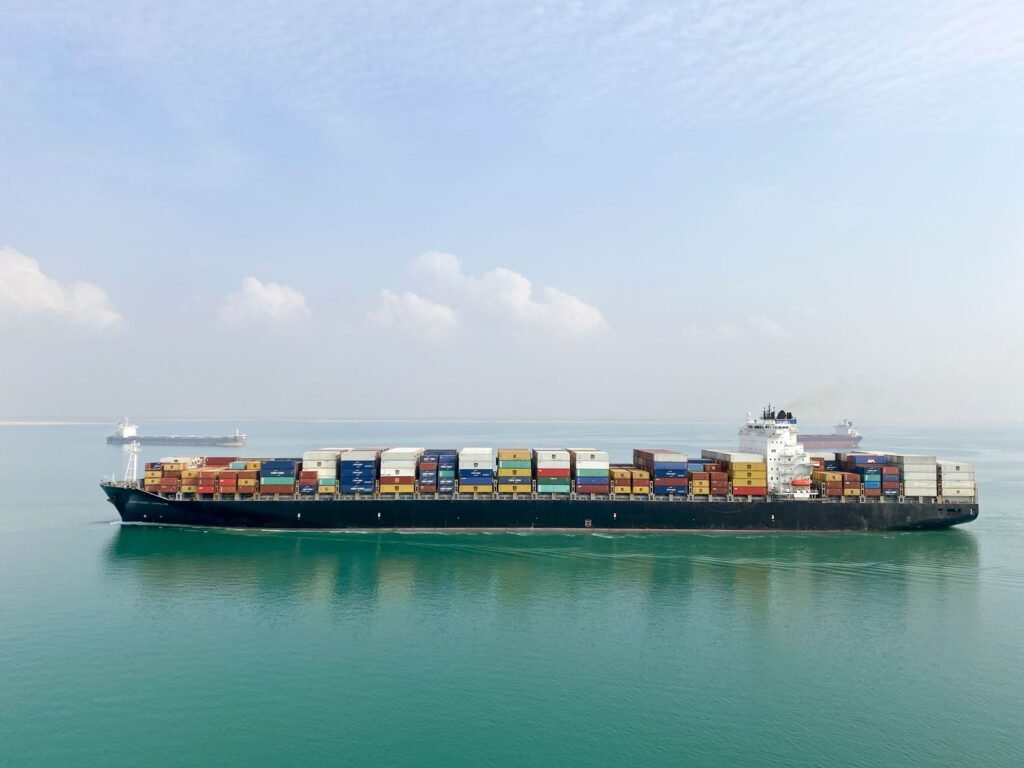
Far fewer than in the past, but the number just jumped. The World Shipping Council’s 2026 update counted 1,478 containers lost at sea in 2025, compared with 576 in 2024. One disaster did most of the damage: the May 2025 sinking of the MSC Elsa 3 off India accounted for 640 containers, about 43% of the year’s total.
Containers lost at sea per year
Selected years from World Shipping Council reports. Bars scaled to the 2013 record.
The MSC Elsa 3 sinking alone accounted for 640 of the 1,478 containers lost in 2025.
Put in context, that’s a tiny share of global trade. The industry moves around 280 million containers a year, so even 2025’s spike works out to roughly 0.0005%. The WSC blames bad weather in the North Atlantic and North Pacific, fires, cargo shifts and stack collapses. There’s some good news too: 128 containers were recovered in 2025, the most since the council began tracking recoveries in 2023. And since January 1, 2026, updated SOLAS rules require ships to report every container lost or seen drifting at sea, which should make future counts more complete.
The appliances aren’t the deepest trash we’ve found
A container nearly a mile down feels remote, but human debris has turned up much deeper. Japan’s marine science agency JAMSTEC built a public Deep-sea Debris Database from photos and video gathered by submersibles and ROVs since 1983. Across 5,010 dives it logged 3,425 pieces of human-made debris. More than a third were large plastic items, and 89% of those were single-use products. The deepest record is a plastic bag at 10,898 meters in the Mariana Trench.
| Find | Location | Depth |
|---|---|---|
| Med Taipei container (1,000+ tires) | Monterey Bay, California | About 1,281 m |
| “Deep Clean” appliance container | Gulf of Mexico | About 1,564 m |
| JAMSTEC debris records (52% large plastic) | Ocean trenches | 6,000 m and deeper |
| Plastic bag, first seen in 1998 | Mariana Trench | 10,898 m |
The same database found deep-sea animals in 17% of the images showing plastic, including bags tangled around creatures at cold seep communities. The washing machines are bulky and strange, but scientists tend to worry more about the plastic that fragments and spreads.
Why we keep stumbling onto things like this
Part of the reason a “shipwreck” can turn out to be a laundromat is that we still know so little about the seafloor. The Nippon Foundation GEBCO Seabed 2030 project said in April 2026 that 28.7% of the global ocean floor has now been mapped to modern standards.
How much of the seafloor is mapped?
Seabed 2030 progress, April 2026 update.
The 2025 update stood at 27.3%. Roughly five million square kilometers were added in a year.
Every new multibeam survey turns up more targets, and each one has to be checked by a camera before anyone knows what it is. Expeditions like the recent survey of two of Earth’s last “untouched” atolls show how much wild ocean is still out there, while finds like “Deep Clean” show how far our stuff has already traveled. The Gulf of Mexico in particular sits between busy shipping lanes and fragile habitats, which is why groups there are also experimenting with putting the right kind of hard material back on the seafloor.
So is it a “worrying message”?
A little, yes, though not in a doomsday way. One lost container of old appliances won’t wreck an ecosystem, and the coral growing on a washing machine is genuinely fascinating to biologists studying how life colonizes new surfaces. But the dive is a vivid reminder of a quieter problem: thousands of containers have gone overboard over the years, most will never be found, and they’ll outlast everyone who shipped them.
As one of the crew said while the ROV drifted past the freezers, “Most people out there probably don’t realize how much stuff ends up in the ocean.” Thanks to a robot, a sonar blip and a laundromat owner’s know-how, a few more people do now.
About this article: GeekBlog covers U.S. technology news, AI, phones, smartwatches and gaming. Every story is written and checked under our Editorial Policy. Spotted a mistake or have a story tip? Contact our editors.
