

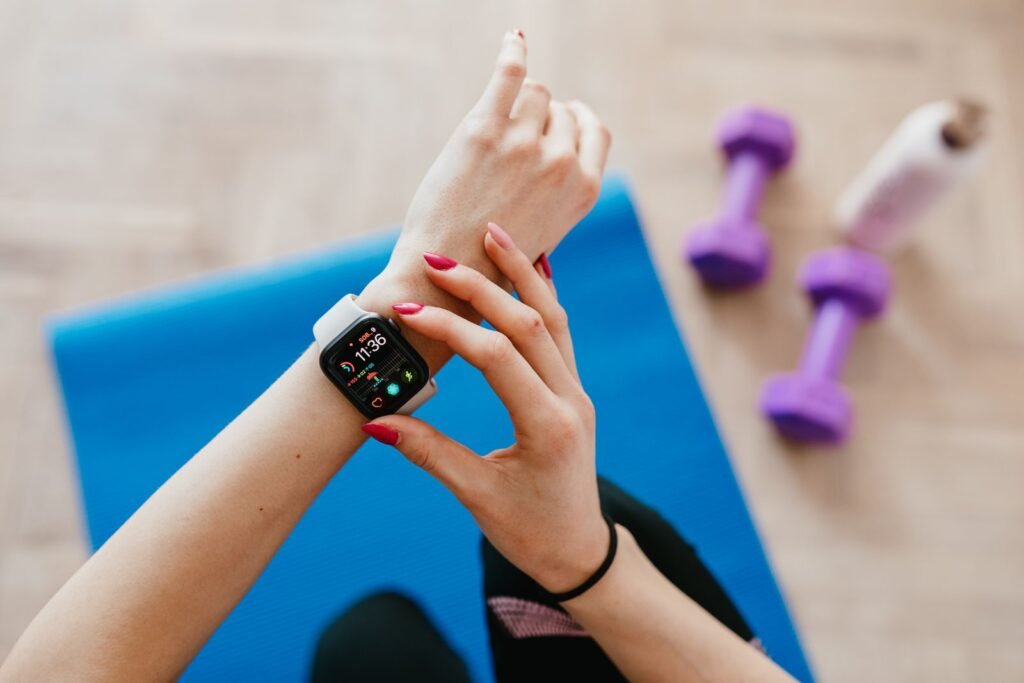
Your smartwatch knows a lot about your wrist. It knows how fast it is moving, how it is tilted and how often your heart beats underneath it. What it has never known is what the rest of your body is doing. Is your back straight during that squat? Are your knees caving in on the lunge? Until now, answering that took a camera, a phone propped on the floor or a suit full of sensors.
A team at Cornell University thinks the watch you already own can do it alone, using nothing but its speaker and microphone. Their system, called EchoMotion, turns the watch into a tiny sonar unit. It sends out sound you can’t hear, listens to the echoes bouncing off your arms, legs and torso, and uses a small AI model to work out where 12 of your joints are, from your head down to your ankles. The best part: it ran on an unmodified Samsung Galaxy Watch 6, with no extra hardware at all.
Quick answer
EchoMotion is a research system from Cornell’s SciFi Lab that tracks full-body pose with a single smartwatch. It uses the watch’s built-in speaker to emit inaudible ultrasound and its microphone to read the echoes. On a stock Galaxy Watch 6 it located 12 joints with an average error under 4 inches for brand-new users, and about 2.4 inches after a one-time 12-minute calibration. The same model worked on the Galaxy Watch 7 and Pixel Watch 3 without retraining, and a 30-minute session used only 5% to 6% of the battery. It is not a product you can download yet.
Who Built It and Where It Was Shown
EchoMotion comes out of the Smart Computer Interfaces for Future Interactions Lab at Cornell, better known as the SciFi Lab. It is run by Cheng Zhang, an associate professor of information science. The lead author is Saif Mahmud, a doctoral student in the same department. The paper, titled “EchoMotion: Towards Full-Body Pose Tracking with a Single Smartwatch Using Active Acoustic Sensing,” was presented on October 13 at UbiComp/ISWC 2026 in Shanghai, one of the main academic conferences for wearable computing. Cornell publicized the work on November 11, and the National Science Foundation helped fund it.
If the lab’s name rings a bell, that’s because it has a habit of teaching wearables to listen. Its earlier projects include EchoSpeech, a pair of glasses that reads silent lip movements through sound, and PoseSonic, which tracked upper-body pose from speakers and mics tucked into eyeglass hinges. Mahmud led PoseSonic too. EchoMotion is the same idea pushed much further: the full body, from one wrist, on hardware millions of people already wear.
“This is a very important jump for body tracking,” Mahmud said in Cornell’s announcement.
How a Watch Becomes a Sonar
Every modern smartwatch has a small speaker for alarms and calls, and a microphone for voice commands. EchoMotion repurposes both. The speaker plays ultrasonic signals above the range of human hearing. Those signals spread out, hit your body and bounce back. As your arms swing, your torso bends and your legs move, the pattern of returning echoes changes. The microphone records those changes, and a lightweight deep learning model translates them into the position of 12 joints.
It is the same principle bats and submarines use, just at a scale of a few feet. And because the system works with sound rather than pictures, it never records images of you or anyone standing nearby. It also produces far less data to crunch than video does.
How the Team Tested It
The researchers didn’t start with a retail watch. They first built a 3D-printed watch replica with two speaker and microphone pairs, which gave them a richer signal to learn from. Ten volunteers wore it on their nondominant wrist and ran through 18 exercises while cameras recorded their true body positions. That camera data became the answer key the AI model learned from.
Then came the hard part. Commercial watches have just one speaker and one microphone, so the team moved the system onto an off-the-shelf Galaxy Watch 6 and tested it on 15 people the model had never seen. Finally, ten more participants tried it outside a clean lab setting.
| Test phase | Hardware | People | What it showed |
|---|---|---|---|
| Prototype | 3D-printed watch, two speaker/mic pairs | 10 | Trained the model on 18 exercises, checked against cameras |
| Retail watch | Stock Galaxy Watch 6, one speaker/mic pair | 15 new users | Under 4 in. average joint error, about 2.4 in. after calibration |
| Other watches | Galaxy Watch 7, Pixel Watch 3 | n/a | Same model worked without retraining |
| Real rooms | Small room, narrow hallway, next to a noisy road | 10 | Furniture and street noise didn’t hurt; other people’s echoes in the hallway did, slightly |
How Accurate Is “Accurate Enough”?
For people who had never used it, EchoMotion placed each joint within an average of less than 4 inches of where it really was. That is rough, but already enough to tell a squat from a lunge. The bigger story is calibration. After a single 12-minute session, which you’d only do once, the average error dropped by more than a third, to about 2.4 inches. The paper puts the calibrated figure at 5.99 cm of mean per-joint position error, with joint rotation off by about 12 degrees on average.
Is that good? It depends on the job. It won’t replace a motion capture studio, and it wouldn’t satisfy a physical therapist measuring a knee’s range of motion to the degree. But for counting reps, flagging that your hips sagged on a plank or confirming you actually did your home rehab routine, a couple of inches is plenty. And remember this comes from a single wrist. The model has to infer what your opposite ankle is doing from echoes that bounce off it at an angle.
The Battery Question, Answered
Anything that keeps a speaker and microphone running sounds like a battery killer. Here the numbers are pleasantly boring. The sensing itself drew about 12 milliwatts on the prototype, which Cornell says is roughly 40 times less than a wearable camera. On the Galaxy Watch 6, a 30-minute tracking session used 5% to 6% of the battery. In other words, you could track a full workout and barely notice it on your daily charge.
12 mW
Sensing power on the prototype
~40x
Less power than a wearable camera
5 to 6%
Battery used in a 30-minute session
12 min
One-time calibration
That efficiency is why the lab keeps choosing sound over cameras. Zhang has pointed out in past projects that acoustic sensing can run for hours where a camera lasts minutes, and it fits into smaller, cheaper hardware. As watch chips get more efficient, like Qualcomm’s new Snapdragon Wear Elite platform for smartwatches, running a model like this on the wrist only gets easier.
Why This Matters for Your Workouts
Smartwatches are already moving deeper into strength training and guided workouts. Google just rolled out step-by-step workouts on the Pixel Watch, and Samsung, Apple and Garmin all try to auto-detect reps. The weak spot is that they only feel the wrist. A bicep curl is easy to count. A squat, where your wrists barely move, is much harder, and form is basically invisible.
| Approach | Extra gear | Sees full body? | Privacy |
|---|---|---|---|
| Today’s watch motion sensors | None | No, wrist only | High |
| Phone or TV camera apps | Camera pointed at you | Yes, when in frame | Low, records video |
| Multi-sensor suits or several trackers | Many devices on the body | Yes | High |
| EchoMotion | None, the watch you own | Yes, 12 joints | High, no images |
The team says it is already working on fitness apps that count reps and help you fix your form. That’s the obvious first use. Rehabilitation is the more meaningful one. Patients recovering from surgery or a stroke are often sent home with exercises and no way for anyone to check if they are doing them, or doing them right. A watch that can log those sessions quietly, without a camera in the living room, solves a real problem. The researchers are also exploring pairing EchoMotion with smart glasses cameras so a system could know both how you move and what object you’re holding.
What Could Hold It Back
The fine print
- It’s research, not a release. Cornell hasn’t announced a consumer app, and no watchmaker has said it will adopt the technique.
- Crowds confuse it. Accuracy dipped slightly in a hallway with other people moving nearby. Mahmud expects training on many more users to help, but that hasn’t been shown yet.
- Small test groups. The studies involved 10 to 15 people per phase. Body types, clothing and gym environments vary far more than that in the real world.
- Platform access. All tested watches run Wear OS, which lets developers drive the speaker and mic this way. Apple’s rules for the Apple Watch are stricter, so an Apple Watch version is less certain.
- Pets and hearing. The signals are inaudible to people, but Cornell’s report doesn’t say how dogs or cats, which hear higher frequencies, might react.
Could Your Watch Get This?
Technically, maybe. The fact that one model ran on three different watches from two brands without retraining is the most important detail in the paper. It suggests EchoMotion could arrive as a plain software update or a third-party app rather than a feature that needs a new sensor. “We have made significant efforts in making EchoMotion work on commercial devices, so that the adoption can be very easy,” Mahmud said.
If you own a Galaxy Watch 6, 7 or a Pixel Watch 3, you’re holding hardware that has already run it. Whether you’ll ever get to use it depends on Samsung, Google or an app developer picking it up, and on how platform updates like One UI 9 Watch and Wear OS 7 handle access to the speaker and microphone in the background. Don’t buy a watch for this today. But the next time someone says smartwatches have run out of new tricks, remember that the most interesting sensor on yours might be the one that plays your alarm.
About this article: GeekBlog covers U.S. technology news, AI, phones, smartwatches and gaming. Every story is written and checked under our Editorial Policy. Spotted a mistake or have a story tip? Contact our editors.
