

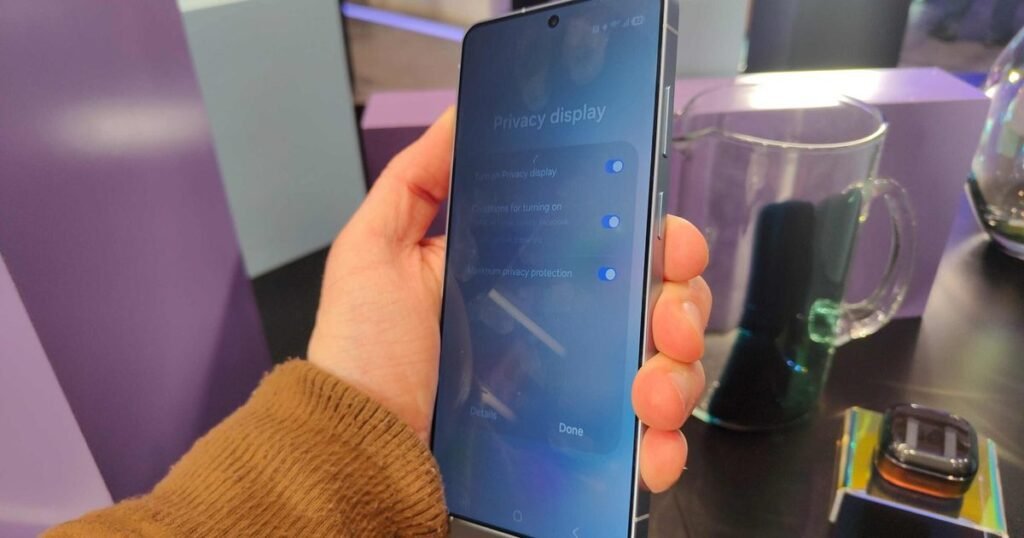
In a smartphone world often driven by megapixels, battery capacity, and raw performance benchmarks, one feature on the Samsung Galaxy S26 Ultra is quietly stealing the spotlight: Privacy Display. Designed to protect what’s on your screen from wandering eyes, it’s one of the most tangible advances in visual privacy we’ve seen from a major smartphone maker in years.
Samsung didn’t make a huge splash about Privacy Display during the S26 Ultra launch – unlike its camera enhancements or AI boosts – but early impressions suggest it may be one of the most meaningful real-world additions to the handset. This feature marks a shift in how manufacturers think about privacy, pushing the concept beyond encryption and authentication to actually control who can see what’s on your display.
Privacy Display: Hiding your screen from prying eyes
Privacy Display is a hardware-level innovation that makes the Galaxy S26 Ultra’s screen readable only when viewed straight on. Tilt the phone slightly, and the display content becomes obscured or unreadable – a capability especially valuable in public or crowded spaces.
Unlike conventional privacy screen protectors that physically dim or mask the display, Samsung’s solution taps into the display’s own pixels. By controlling how light is emitted and perceived from certain angles, the display makes it significantly more difficult for bystanders to interpret what’s on your screen unless they’re directly in front of it. And because the technology is implemented at the pixel level, it doesn’t require external layers or accessories that can reduce brightness or sharpness. But how does this work exactly?
Basically, Samsung’s new Privacy Display uses two types of pixels – narrow pixels and regular (wide) pixels – to control what you see on your phone screen. In normal mode, regular pixels emit light broadly so the display is clear from many angles. When Privacy Display is activated, narrow pixels limit the path of light so that only someone looking straight on sees the content clearly; viewers from side angles see a blurred or obscured screen. By combining both pixel types, Samsung keeps direct visibility sharp while narrowing off-angle viewing, eliminating the need for third-party privacy filters.
The result is a cleaner, more integrated version of visual privacy that doesn’t compromise much on visual clarity for the person holding the device – a significant improvement over screen films or filters that often make the display appear dim or grainy even to the main viewer.
Testing in real conditions – such as on trains, buses, or in busy offices – shows that Privacy Display can effectively blur out sensitive content to onlookers without handicapping your own view. Whether reading emails, browsing bank apps, or responding to private messages, users can enjoy a measure of peace of mind that their information won’t be casually visible to people nearby.
Why this feature matters now
Visual privacy isn’t a fringe concern. With more people using smartphones for sensitive tasks – from mobile banking and business communications to health apps and personal journals – there are countless moments when shoulder surfing can lead to unintentional exposure of private information.
Traditional privacy solutions – aftermarket screen protectors or simple pin codes – have long been imperfect. Physical privacy films can be cumbersome, reduce touch sensitivity, and dim the screen. And while software safeguards can lock apps or require authentication, they don’t prevent someone from simply glancing at a device left unlocked or mid-use.
Samsung’s Privacy Display arrives at a moment when users are more privacy-aware than ever. People carry their entire lives on their devices, and that content is increasingly viewed in public spaces. Restaurants, public transportation, airports, and even shared workspaces are all settings where visual snooping is a genuine risk. Hardware-based visual privacy is therefore not just a convenience – it’s a practical security layer.
Why you should care
Whether you’re a professional handling emails on the go, a student checking sensitive information in public spaces, or simply someone who wants more control over your personal data, Privacy Display adds a new dimension of privacy that software alone can’t provide.

For frequent travelers or commuters, the difference can feel immediate and meaningful. You no longer need to awkwardly shield your screen with your hand or body just to check a message. The display itself acts as a gatekeeper, protecting your content from side angles while keeping the main view bright and clear.
Unlike traditional privacy films that have to be bought, applied, and replaced, this feature is built into the phone’s hardware and can be toggled on or off instantly. There’s no visual penalty when you’re viewing content directly, making it a discrete but powerful addition to everyday usage.
But there are limitations
That said, Privacy Display isn’t perfect. Its effectiveness depends on lighting conditions, screen brightness, and viewing angles. In very bright environments, the difference between the primary view and side angles can be less distinct. Some critics also point out that people sitting directly beside or slightly behind you may still catch glimpses of information, meaning that this isn’t an impenetrable privacy shield, but rather an enhancement on top of existing practices.

There’s also the question of adoption across Samsung’s broader lineup. Currently, Privacy Display is limited to the S26 Ultra. If this technology proves popular, Samsung may expand it to more affordable models – and that could redefine visual privacy expectations across Android devices. Competitors will surely take notice; once a flagship manufacturer demonstrates a practical privacy innovation, others often follow.
Samsung could also refine the feature further through software tweaks or future hardware iterations. Enhanced angle control, adaptive privacy based on context (e.g., in public vs. private spaces), or even integration with face recognition could make future implementations even more compelling.
Verdict: Promising privacy tech with room to grow
Having used Privacy Display in real scenarios, it’s easy to see why some reviewers have hailed it as one of Samsung’s most forward-thinking technologies in years. It addresses a real and often overlooked aspect of privacy – visual exposure – with a solution that feels intuitive and integrated.
On the positive side, it enhances everyday privacy without sacrificing screen quality. It’s seamless to use, doesn’t require additional accessories, and feels surprisingly effective in real-world conditions. For users increasingly concerned about digital privacy in crowded spaces, it’s a welcome addition.

Yet it’s not a silver bullet. Its effectiveness can vary with lighting and angle, and privacy purists may still prefer physical shields for absolute discretion. And because it’s currently exclusive to a premium device, its reach is limited.
In sum, Samsung’s Privacy Display is a smart, thoughtful innovation that brings real value to the Galaxy S26 Ultra. It points toward a future where our devices protect not just data access, but also data visibility. For privacy-minded users – and really, for anyone who values personal space in a public world – it’s a feature worth appreciating and watching as it evolves.
Source: www.digitaltrends.com
