

Aliro has officially arrived. The smart lock standard, first announced in 2023, finally has a 1.0 spec, meaning companies can now get hardware certified and roll out support.
Aliro is an open standard designed to let any smart lock be unlocked by any smartphone, regardless of manufacturer. It stores a digital key in your phone’s wallet that you can tap to a compatible lock — just like you tap to pay.
If you’ve used Apple’s Home Key, you already understand the idea — but instead of being locked into Apple’s ecosystem, Aliro is cross-platform, working on both Android and iOS, and with the major mobile wallet ecosystems — Apple, Google, and Samsung. So, if you have an iPhone and your roommate has an Android, you’ll both be able to tap-to-unlock your smart lock.
The digital key will live in your phone’s wallet and can also be used on your smartwatch. A local protocol, Aliro doesn’t require a cloud connection, an app, or proprietary software; your phone connects directly to the lock.
Apple, Google, and Samsung have been involved in developing Aliro, and have committed to supporting Aliro “out of the gate,” Nelson Henry of Last Lock and chair of the Aliro Working Group, told The Verge in an interview this week. He added that he believes Aliro support will roll out on all platforms within the next couple of months.
Aliro promises to fix the fragmentation of smart locks, where digital keys only work with specific apps or phones, and make them universal. Eventually, with widespread adoption of Aliro, a digital key in your phone or watch could unlock your front door, office, and apartment building, no matter who made the lock.
Aliro defines both the credentials needed to confirm the right device is accessing the right lock and the radio technologies used between key and lock. The protocol requires near-field communication (NFC) and Bluetooth low energy (BLE), and also supports ultra-wideband (UWB).
Just like you can tap to pay with a smartphone or a watch … with Aliro, you can tap to unlock a door
NFC is the same tech that supports tap-to-pay in your smartphone or watch. So, just like you can tap to pay with a smartphone or a watch that supports NFC, with Aliro, you can tap to unlock a door.
UWB enables a newer feature, hands-free unlocking, where the door unlocks as you approach, something Apple’s Home Key recently added support for. Bluetooth is used to establish a connection between the lock and the phone when using UWB and to enable remote control via an app from a greater distance (most smart locks today already use Bluetooth for unlocking).
There’s no requirement for Wi-Fi or cellular connectivity, so you should be able to unlock in dead zones like basements, parking garages, and elevators.
According to Henry, Aliro uses asymmetric cryptography for security and controls the entire unlocking process, creating a direct, secure communication between devices.

Aliro is managed by the Connectivity Standards Alliance, the group behind the smart home standard Matter. It’s a separate but complementary technology; Aliro connects your lock to the digital wallet in your smartphone, whereas Matter connects it to your smart home platform — such as Apple Home, Amazon Alexa, or Home Assistant.
The CSA says Aliro has been developed by over 220 companies, including Apple, Google, and Samsung; major lock manufacturers such as Assa Abloy (Kwikset and Yale), Allegion (Schlage), and Fortune Brands (Yale US and August); and chip manufacturers such as Infineon, Nordic, and NXP.
The broad industry support suggests Aliro has a real chance at wide deployment — from front doors to apartment buildings, offices, and hotels. But adoption will take time and will most likely require new hardware.
Henry said it may be technically possible to bring Aliro tap-to-unlock to some existing locks with NFC chips via over-the-air updates, but only for hardware with newer chips. “Anything in the last five years shouldn’t be an issue,” he said.
You’ll probably need a new lock
I reached out to several smart lock makers ahead of the spec launch, and it’s not looking good for backwards compatibility. While most confirmed their intent to release Aliro-supported devices, few shared specific timelines or promised to support existing devices.
Kwikset’s first Apple Home Key-compatible smart lock, the Halo Select Plus, supports NFC and launched after Aliro was announced. While it seems like a good candidate for an over-the-air upgrade, Kwikset told me it won’t get upgraded. The company confirmed it will adopt Aliro, but said support will be in future hardware.
Apple, Google, and Samsung have committed to supporting Aliro
Garrett Lovejoy is head of connected products at Fortune Brands and oversees Yale and August. He said that Yale’s current NFC lock, the Apple Home Key-compatible Assure Lock 2 Plus, isn’t upgradable to Aliro. Lovejoy said the first Yale locks to get support will likely be its multifamily products for apartment buildings and similar. This will be a major area for Aliro adoption, as it’s even more fragmented than single-family home solutions.
He confirmed Yale is exploring ways to bring Aliro to their existing customers. And while he didn’t specify, it could be enabled through a stand-alone NFC-enabled keypad for its retrofit locks, including the August lock. That’s how Yale retroactively enabled fingerprint access for August.
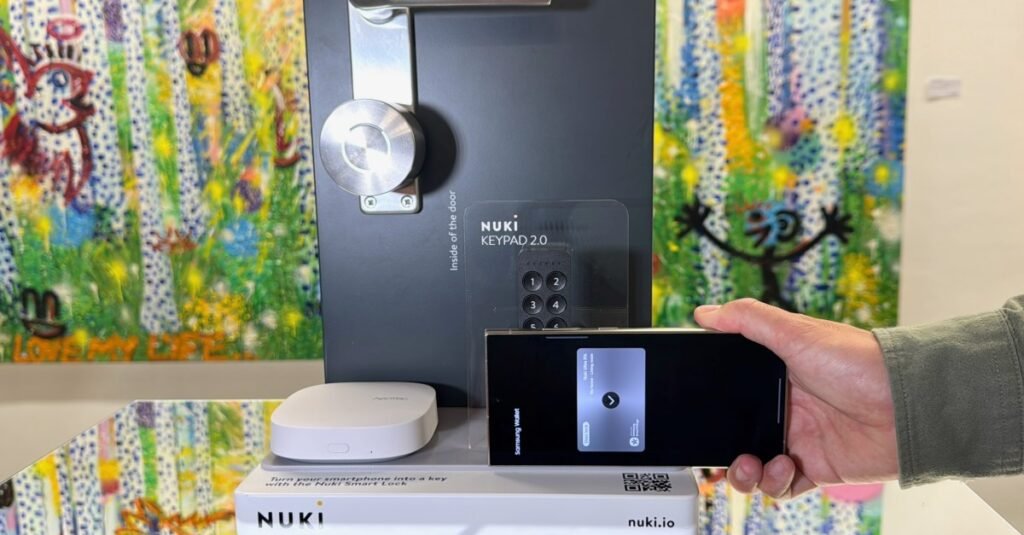
European smart lock maker Nuki just announced an NFC-compatible keypad for its retrofit lock, which will support Aliro. I tested a prototype of this last year at the IFA tech show in Berlin, unlocking it with a Samsung Galaxy phone via tap-to-unlock.
Nuki cofounder and CEO Martin Pansy said his company has been instrumental in developing Aliro, and while he thinks it will take some time to roll out, he believes the standard is key for smart lock adoption. “It will do what Matter has done for the smart home — make it easier to support all the different phone manufacturers.”
Here, I demo UWB hands-free unlocking with Apple’s Home Key and the Aqara U400 lock. UWB with Aliro should be a similar experience, and Aqara has said the U400 is Aliro-ready.
It’s likely that Aliro NFC, with its tap-to-unlock feature, will see the fastest adoption among lock makers. NFC is fairly standard on most smartphones and smartwatches. But with its hands-free auto-unlocking capability, Aliro UWB could be the game-changer.
UWB is a short-range, positioning-based technology that can measure location, distance, and direction. It’s already used in digital car keys, and, with residential locks it’s precise enough to know which angle you are approaching from and to only unlock if you are walking toward the door from the outside.
However, UWB is a bigger lift for lock manufacturers than NFC and is unlikely to be backward-compatible, as it requires a UWB antenna in the lock. It also requires a UWB-compatible phone, which currently includes the iPhone 11 and newer (excluding iPhone SE), the Google Pixel 6 Pro and newer, and the Galaxy S21 Plus and newer.
Schlage announced a UWB lock, the Sense Pro, at CES last year, and said it would be compatible with Aliro. But it has yet to launch. Ryan Kincaid, director of global technology at Schlage’s parent company, Allegion, said that the company is “embedding Aliro into our product roadmap,” but didn’t have an update on when the Sense Pro would launch.
Aqara’s new U400 lock has UWB and NFC unlocking and is already available for $270 (UWB locks are likely to be expensive). I tested its hands-free unlocking through Apple Home and was impressed, but it doesn’t yet support Aliro. The company did say the lock was “Aliro-ready” when it launched at CES this year, so it looks like it could be the first on the market to support Aliro.

At CES, Xthing’s Ultraloq showed off the new Latch 7 Pro lock, which it says will be Aliro NFC-compatible, but it’s not clear if its existing Bolt Pro (NFC) and Bolt Mission (UWB) will support Aliro or if the company will launch new models.
Smart home company Eufy confirmed to me that it doesn’t plan to upgrade any existing locks but will launch two new NFC-capable models with Aliro support in the second half of 2026, according to spokesperson Brett White. He said UWB models will come “at a later stage.”
Kwikset has said it is working on a UWB lock, but didn’t share when it would launch. Jeff Sandoval, director of electronics marketing at Assa Abloy, which owns Kwikset, sees the hands-free unlocking experience as something that could finally drive mass market adoption of smart locks. “This type of passive authentication is that Nirvana we’ve been trying to get to for some time,” he says. “Everyone has a cellphone, the major providers are supporting the standard, so I do think this could be a paradigm shift.”
Yale’s Lovejoy agrees. “The goal for smart locks in general needs to move towards what feels like a Jetsons door,” he said. “If you’re not coming up to the door and having it magically unlock in front of you without interactions, without touching, we’re really not moving in the right direction.”
Aliro will let you unlock your door in multiple ways. Tap-to-unlock will be standard; hands-free UWB unlocking will work with supported hardware; and Bluetooth control via an app will also be an option. Compared to keypads or biometric unlocking, tapping your phone or watch is often faster and easier — and is something everyone can feel comfortable doing. Hands-free unlocking is even better.
Hands-free, auto-unlocking technology has been around since the August lock launched in 2014, but its reliability depends on many factors coming together perfectly — GPS, Wi-Fi, Bluetooth. Aliro’s auto-unlocking uses a direct local connection between the phone and the lock, making it faster and more reliable.
“If you’re not coming up to the door and having it magically unlock in front of you … we’re really not moving in the right direction.”
— Garrett Lovejoy
In the smart home, Aliro will initially work alongside Matter and require a Matter smart home platform, such as Apple Home, Google Home, Amazon Alexa, or Home Assistant, and a Matter controller for that platform. This is because the Aliro spec only defines communication between the lock and the key, not how credentials are created or managed. For that, you need an “administrative infrastructure,” says Henry.
Currently, that infrastructure is Matter, which added support for Aliro in its 1.4 spec. This means the smart home platform you use must support both Aliro and Matter. Importantly, that platform, not the lockmaker, will also be in charge of the key.
You can use multiple platforms with one lock, so you’ll be able to unlock with both an Android phone and an iPhone — but exactly how Aliro will work with each service is still unclear. Additionally, lock manufacturers may not be inclined to give away all that control, so I expect we’ll see some develop their own Aliro “administrative infrastructure.”
However support for Aliro rolls out, the promise that it will make smart locks simpler to own and use is compelling. The open standard could mean fewer proprietary apps, fewer compatibility concerns, and a future where your phone just works as a key — regardless of which lock or platform you choose. It won’t happen overnight, but there is now a clearer path toward making digital keys, and their many benefits, as universal and simple to use as physical ones.
Photos and videos by Jennifer Pattison Tuohy / The Verge
Source: www.theverge.com
