Close Menu
GeekBlog

    Subscribe to Updates

    Get the latest creative news from FooBar about art, design and business.

    What's Hot

    Meta is secretly working on an AI detection tool after unleashing AI slop avalanche

    March 16, 2026

    This Alien Planet Might Be the Stinkiest Place in the Galaxy

    March 16, 2026

    Amazon is clearing out these popular DeWalt power tools by up to $190 off

    March 16, 2026
    Facebook X (Twitter) Instagram Threads
    GeekBlog
    • Home
    • Mobile
    • Tech News
    • Blog
    • How-To Guides
    • AI & Software
    Facebook
    GeekBlog
    Home»Tech News»This Alien Planet Might Be the Stinkiest Place in the Galaxy
    Tech News

    This Alien Planet Might Be the Stinkiest Place in the Galaxy

    Michael ComaousBy Michael ComaousMarch 16, 20264 Mins Read
    Share Facebook Twitter Pinterest LinkedIn Tumblr Email Copy Link
    This Alien Planet Might Be the Stinkiest Place in the Galaxy
    Share
    Facebook Twitter LinkedIn Pinterest Email Copy Link

    Planets orbiting stars beyond the solar system come in all shapes and sizes but mostly fit into a few categories: large and hot gas giants, super-Earths that are slightly larger than our planet, Neptunian planets with gassy atmospheres and rocky cores, and small terrestrial planets made up of silicate or water. New observations of a nearby exoplanet, however, suggest that it cannot be mixed in with the regular types and instead belongs to a previously unknown class of planets.

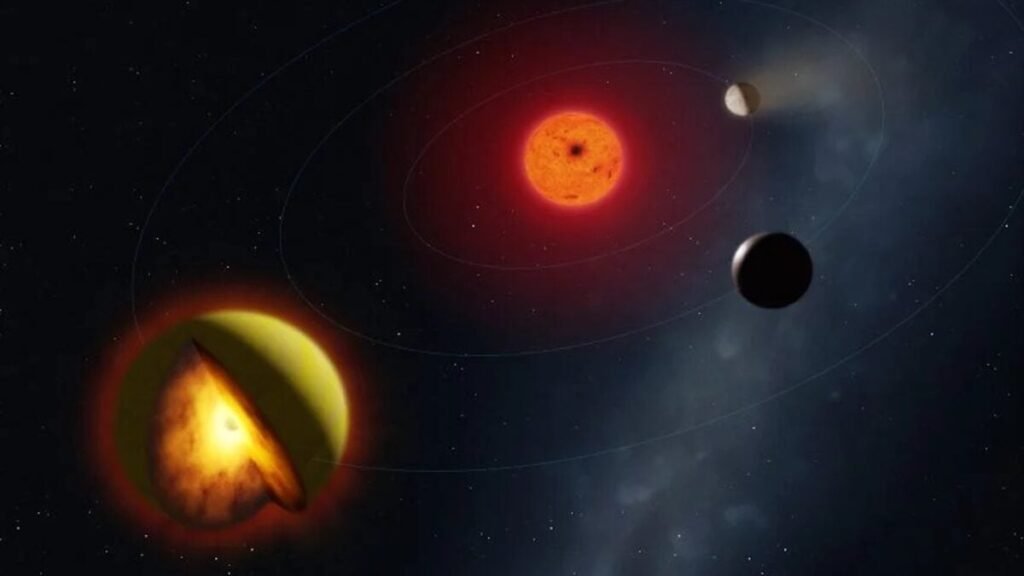
    Using the Webb space telescope, astronomers believe they have identified a new type of molten exoplanet with volatile gases in its atmosphere and a permanent magma ocean. The exoplanet, known as L 98-59 d, was previously classified as a super-Earth or a sub-Neptune, but this would appear to be wrong.

    “This discovery suggests that the categories astronomers currently use to describe small planets may be too simple,” Harrison Nicholls, a researcher at the University of Oxford’s physics department and lead author of a new study published in Nature Astronomy, said in a statement. “While this molten planet is unlikely to support life, it reflects the wide diversity of the worlds which exist beyond the Solar System. We may then ask: what other types of planet are waiting to be uncovered?”

    A whole new world

    L 98-59 d orbits a small, cool star along with four other planets. It’s around twice the mass of Earth and is located around 35 light-years away from our planet.

    The planet’s discovery was first announced in 2019, but follow-up observations by Webb in 2024 revealed an abundance of sulfur dioxide and other sulfur gases in its atmosphere. The team of researchers behind the study sought to reconstruct the planet’s history, tracing its evolution from shortly after its birth until today.

    Using computer simulations to recreate what’s likely been happening inside the planet over the past five billion years, the researchers discovered that the mantle of L 98-59 d is likely molten silicate (similar to the lava found on Earth) with a global magma ocean that extends thousands of miles below.

    The simulations revealed that ultraviolet light from the host star triggers chemical exchange reactions between the planet’s molten interior and atmosphere, while the magma ocean acts as a massive reservoir for storing and releasing sulfur dioxide into the upper atmosphere. Sulfur is famously stinky—think of rotten eggs and farts.

    The combination of volatile gases stored within its interior and ultraviolet-driven atmospheric chemistry explains the planet’s odd properties, which differentiate it from other types of planets.

    “What’s exciting is that we can use computer models to uncover the hidden interior of a planet we will never visit,” Raymond Pierrehumbert, physics professor at the University of Oxford and co-author of the study, said in a statement. “Although astronomers can only measure a planet’s size, mass and atmospheric composition from afar, this research shows that it is possible to reconstruct the deep past of these alien worlds—and discover types of planets with no equivalent in our own Solar System.”

    New planet category just dropped

    Based on the computer simulations, L 98-59 d may have started off as a larger sub-Neptune planet. It later evolved over billions of years, gradually shrinking and cooling as it lost some of its atmosphere.

    Normally, its entire atmosphere would have been lost over time due to radiation from its host star. The planet’s magma ocean, however, has helped it retain its thick hydrogen-rich atmosphere with sulfur-bearing gases, producing the oddball planet we see today.

    The researchers behind the study suggest L 98-59 d may be the first recognized member of a broader population of gas-rich sulfurous planets, and that there may be more planets like it out there in the cosmos. “More observations are needed to understand this planet and others like it,” Richard Chatterjee, a researcher at the University of Oxford and co-author of the study, said in a statement. “Further investigation may yet show that rather pungent planets are surprisingly common.”

    Source: gizmodo.com

    Alien Galaxy place Planet Stinkiest
    Share. Facebook Twitter Pinterest LinkedIn Tumblr Telegram Email Copy Link
    Previous ArticleAmazon is clearing out these popular DeWalt power tools by up to $190 off
    Next Article Meta is secretly working on an AI detection tool after unleashing AI slop avalanche
    Michael Comaous
    • Website

    Michael Comaous is a dedicated professional with a passion for technology, innovation, and creative problem-solving. Over the years, he has built experience across multiple industries, combining strategic thinking with hands-on expertise to deliver meaningful results. Michael is known for his curiosity, attention to detail, and ability to explain complex topics in a clear and approachable way. Whether he’s working on new projects, writing, or collaborating with others, he brings energy and a forward-thinking mindset to everything he does.

    Related Posts

    2 Mins Read

    Meta is secretly working on an AI detection tool after unleashing AI slop avalanche

    1 Min Read

    Amazon is clearing out these popular DeWalt power tools by up to $190 off

    1 Min Read

    WIRED Article Production automation page/Only for QA/Do not click/Do not publish

    2 Mins Read

    Apple’s AirPods Max 2 bring H2 chip, boosted ANC in April for $549

    3 Mins Read

    Antonio Gracias says he’s longing for ‘proentropic’ startups — those that are built to survive chaos

    68 Mins Read

    Yahoo CEO Jim Lanzone on AI, gambling, and the open web

    Top Posts

    Discord will require a face scan or ID for full access next month

    February 9, 2026762 Views

    The Mesh Router Placement Strategy That Finally Gave Me Full Home Coverage

    August 4, 2025624 Views

    Trade in your old phone and get up to $1,100 off a new iPhone 17 at AT&T – here’s how

    September 10, 2025311 Views
    Stay In Touch
    • Facebook

    Subscribe to Updates

    Get the latest tech news from FooBar about tech, design and biz.

    Most Popular

    Discord will require a face scan or ID for full access next month

    February 9, 2026762 Views

    The Mesh Router Placement Strategy That Finally Gave Me Full Home Coverage

    August 4, 2025624 Views

    Trade in your old phone and get up to $1,100 off a new iPhone 17 at AT&T – here’s how

    September 10, 2025311 Views
    Our Picks

    Meta is secretly working on an AI detection tool after unleashing AI slop avalanche

    March 16, 2026

    This Alien Planet Might Be the Stinkiest Place in the Galaxy

    March 16, 2026

    Amazon is clearing out these popular DeWalt power tools by up to $190 off

    March 16, 2026

    Subscribe to Updates

    Get the latest creative news from FooBar about art, design and business.

    Facebook
    • About Us
    • Contact us
    • Privacy Policy
    • Disclaimer
    • Terms and Conditions
    © 2026 GeekBlog

    Type above and press Enter to search. Press Esc to cancel.

    Ad Blocker Enabled!
    Ad Blocker Enabled!
    Our website is made possible by displaying online advertisements to our visitors. Please support us by disabling your Ad Blocker.