

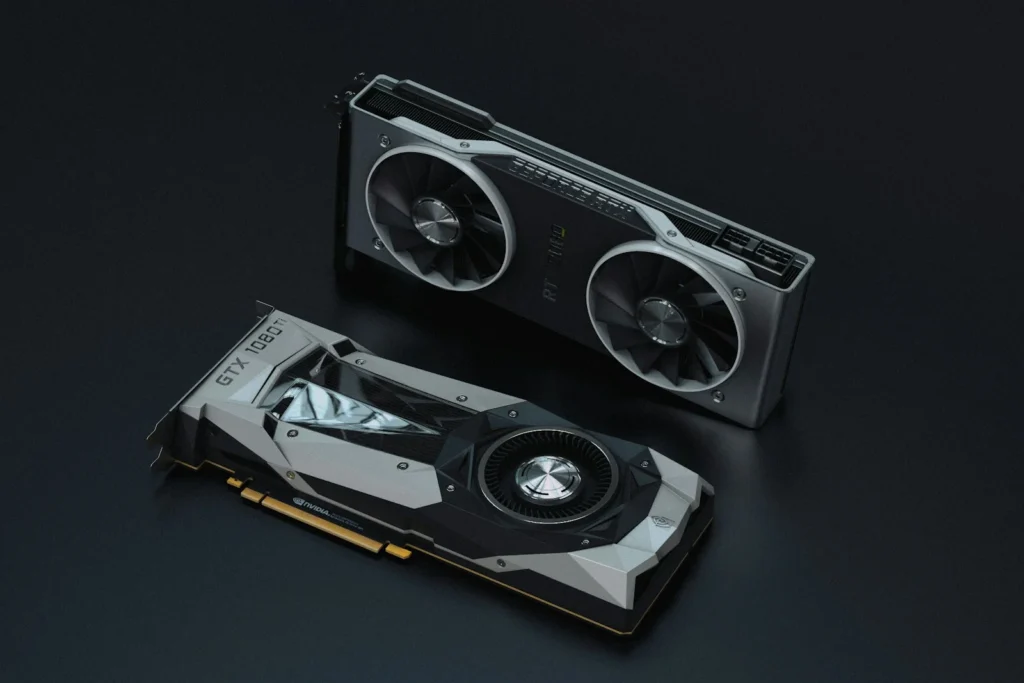
The AMD Radeon AI Pro R9700 is a workstation graphics card built on RDNA 4 with 32GB of GDDR6 memory, aimed at people who want to run AI models locally rather than in the cloud. Several board partners, including ASRock, ASUS, Gigabyte, PowerColor, Sapphire and XFX, sell their own versions, and almost all of them use a blower cooler. Here is what the card offers, why it looks the way it does and how it compares in October 2026.
Radeon AI Pro R9700 specs
AMD first showed the card at Computex in May 2025. Prebuilt workstations with the R9700 arrived from system builders in July 2025, and standalone cards from board partners followed later that year. The core is the same RDNA 4 silicon that powers the gaming RX 9070 XT, but with twice the memory and features tuned for professional work.
| Specification | Radeon AI Pro R9700 |
|---|---|
| Architecture | RDNA 4 |
| Compute units and stream processors | 64 CUs, 4,096 stream processors |
| AI and ray accelerators | 128 AI accelerators, 64 ray accelerators |
| Clocks | 2,350 MHz game, up to 2,920 MHz boost |
| Memory | 32GB GDDR6, 256 bit bus, 640 GB/s, ECC on Linux |
| Infinity Cache | 64MB |
| Peak AI throughput | 191 TFLOPS FP16, 383 TOPS INT8, 766 TOPS INT4 (dense) |
| Board power | 300W, 12V 2×6 connector, 750W PSU recommended |
| Interface and size | PCIe 5.0 x16, dual slot |
| Outputs | Up to four DisplayPort outputs, depending on partner design |
The headline number is the memory. For local AI, how large a model you can load is usually limited by video memory before raw speed. With 32GB on a single card, you can run larger language models, or higher precision versions of mid size models, than a 16GB gaming card allows.
Why almost every R9700 uses a blower cooler
Most gaming cards use two or three open air fans that blow heat around inside the case. That works fine for one card, but it falls apart when you stack two, three or four cards next to each other, because each card breathes the hot air of its neighbor.
A blower uses a single radial fan inside a closed shroud that pulls air in and pushes it straight out through the bracket at the back of the PC. AMD describes this as front to back airflow designed for multi GPU deployments. Combined with the dual slot width and PCIe 5.0, it lets workstation builders pack several R9700 cards into one tower to pool memory for bigger models or run parallel inference jobs. The tradeoff is noise: blowers are usually louder than open air coolers under sustained load.
Board partner versions
Radeon AI Pro R9700 Creator with a metal shroud.
Turbo Radeon AI Pro R9700 with a blower fan.
Blower card built for dense workstation and server builds.
Close to AMD’s reference layout and clocks.
Listed by AMD as an add in board partner.
All of them use the same chip and 32GB of memory, so performance differences are small. Pick based on price, warranty, noise and which version your workstation vendor validates.
Who the R9700 is for, and the alternatives
The card makes the most sense for developers, researchers and small studios who want to run language models, image generators and other AI tools on their own hardware for privacy, cost or latency reasons. AMD supports it in ROCm on Linux with PyTorch, ONNX Runtime and TensorFlow, and it also handles traditional professional work such as rendering and simulation. It is not a gaming card, and AMD notes that Radeon AI Pro cards are not designed for datacenter use.
- Nvidia RTX Pro 4500 Blackwell: also 32GB, but with faster GDDR7 memory and the CUDA software ecosystem that most AI tools target first.
- Nvidia RTX Pro 5000 and RTX Pro 6000 Blackwell: 48GB or 72GB, and 96GB respectively, for people who need far larger models on one card, at much higher prices.
- GeForce RTX 5090: a consumer card with 32GB of GDDR7 and strong AI performance, but with a large open air cooler that is harder to stack.
- Two R9700 cards: 64GB of total memory for workloads that can be split across GPUs.
FAQ
How much does the Radeon AI Pro R9700 cost?
AMD lists an MSRP of $1,299 in the US. Partner cards and street prices can be higher or lower depending on the retailer and demand.
Is the R9700 good for gaming?
It uses the same chip as the RX 9070 XT, so it can run games, but drivers and cooling are tuned for professional work. A gaming card is the better value if you mostly play games.
Can I use several R9700 cards together?
Yes. The dual slot blower design and PCIe 5.0 interface are meant for multi GPU workstations, and AMD promotes the card for parallel inference and expanded memory across GPUs.
Does it support CUDA?
No. CUDA is Nvidia only. The R9700 uses AMD’s ROCm platform, which supports popular frameworks such as PyTorch.
The verdict
The Radeon AI Pro R9700 is one of the most affordable ways to get 32GB of video memory in a card designed for workstations, and its blower design makes multi GPU builds practical. If your software runs well on ROCm, it is a strong value for local AI inference. If you depend on CUDA or need more than 32GB on a single card, Nvidia’s RTX Pro line remains the safer choice.
Updated October 2026: rewritten as a full explainer on the Radeon AI Pro R9700 with official specs, partner cards, pricing and alternatives.
Featured photo: Nana Dua on Unsplash.
About this article: GeekBlog covers U.S. technology news, AI, phones, smartwatches and gaming. Every story is written and checked under our Editorial Policy. Spotted a mistake or have a story tip? Contact our editors.
