

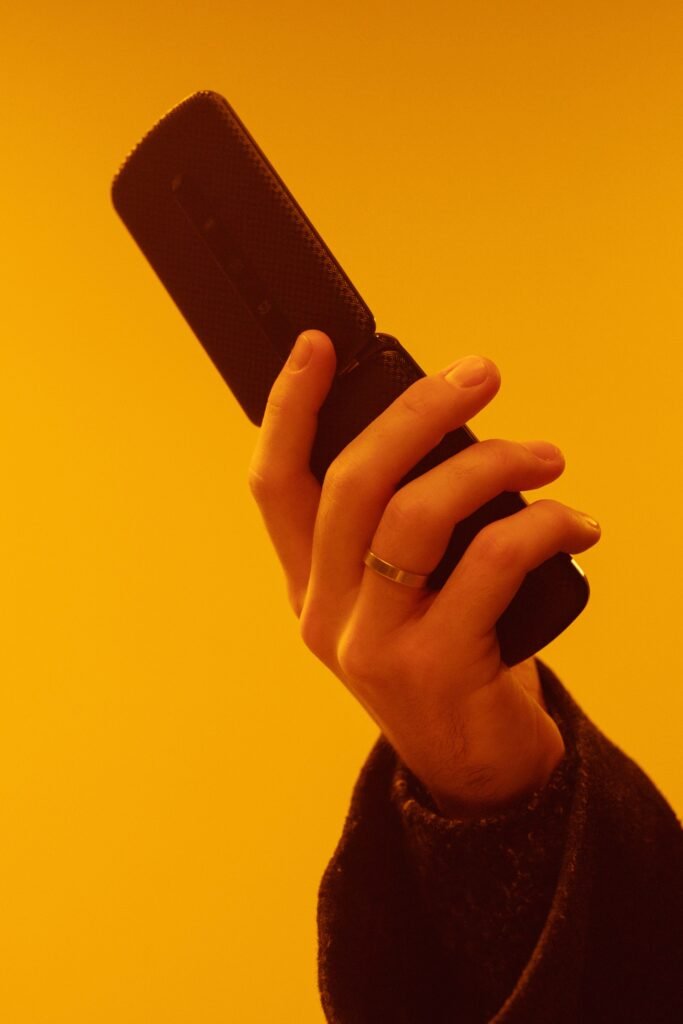
For the past few years, the tech industry has sold us the same story on repeat: bigger screens, more cameras, smarter assistants, and an app for absolutely everything. Commodore, a brand most people associate with a beige computer from the 1980s, just walked into that story and asked a very different question. What if the next phone you bought did less, on purpose, and charged you less for it too?
That question now has a name and a price tag. It is called the Callback 8020, and it is a flip phone built to block the parts of your smartphone that keep pulling your attention, while quietly keeping the parts that actually make your day easier.
A Phone Built Around What It Refuses to Do
The Callback runs a customized build of Sailfish OS, developed in partnership with the Finnish software company Jolla, whose engineering roots trace back to former Nokia staff. That heritage shows up in the phone’s whole approach. Rather than stripping everything down to bare-bones calling and texting the way older dumb phones did, the Callback can run roughly 99 percent of Android apps.
The catch, and the entire point of the device, is what ships missing out of the box. There is no web browser, no email client, and no social media apps preinstalled, and Commodore has built the restriction at a system level rather than relying on willpower or a screen time app you can just delete. Workplace chat tools and AI assistants are left out too. The idea is to let people keep the handful of apps they genuinely rely on, whether that is a banking app, a music service, or a ride-hailing tool, without reopening the door to the endless scroll that comes bundled with a normal smartphone.
What Is Actually Inside It
Underneath the retro shell, the specs are modest but deliberate. The Callback is built around a MediaTek Helio G81 chip with 4GB of RAM and 64GB of storage, paired with passive cooling since there is no need to push heavy workloads. Flip it open and you get a 3.25-inch display running at 480 by 640 resolution, small by modern standards but perfectly sized for texting, calls, and basic navigation.
The camera is where Commodore clearly wanted to earn some enthusiast credibility. A 48-megapixel Sony sensor sits on the back, complete with a retro camcorder mode that leans into the device’s nostalgic styling rather than fighting it. Practical touches round out the hardware: a headphone jack, an FM radio antenna for listening without burning data, dual SIM support, and a removable back cover that lets owners swap the battery themselves instead of sending the phone away when it degrades. That last detail alone sets it apart from nearly every flagship phone sold today.
The Price Cut That Reveals a Bigger Story
When Commodore first announced the Callback in June, the base models, BASIC Beige, ProtoPET White, and SX Silver, were priced at $499, with a translucent Starlight Edition at $549 and a premium Founders Edition featuring a 24-karat gold-plated button priced well above the rest of the lineup.
Two weeks later, ahead of preorders opening on June 30, Commodore cut $100 off the four standard models, bringing them down to $399, with an additional $50 launch-day discount code pushing the effective price as low as $349 for early buyers. How Commodore pulled that off is almost as interesting as the phone itself. The company said it achieved the cut partly by defaulting to recycled memory chips and unbundling the earphones that used to ship in the box.
That single decision is a small window into a much larger squeeze hitting the entire electronics industry right now. Memory chip prices have surged this year as AI data centers absorb most of the world’s memory chip supply, pushing costs up across laptops, consoles, and phones alike. Most manufacturers have responded by raising prices. Commodore, competing in a niche where price sensitivity matters more than raw specs, went looking for a workaround instead, and recycled memory turned out to be it.
Not the Only Minimalist Phone, but a Different Bet
The Callback enters a market that already has some established alternatives. The Light Phone III sells for $699 and strips things down even further, offering a genuinely distraction-free experience but at a steep price and without much app support at all. The Punkt MP02 starts at roughly $340 and leans into being a pure communication tool rather than any kind of smartphone substitute.
Commodore’s wager sits in between those two approaches. Instead of asking people to give up app-based convenience entirely, the Callback tries to keep enough of the smartphone experience that switching feels realistic for someone who is not ready to go fully off the grid, while cutting off the specific apps and features that tend to cause the most compulsive checking.
Why This Is Landing at the Right Moment
The timing is not an accident. Industry researchers have tracked dumbphone and minimalist phone sales climbing roughly 25 percent in 2025, with some analysts projecting that simpler devices could capture around 10 percent of the global mobile market by the middle of 2026, up from about 5 percent just two years earlier. On social media, the hashtag BringBackFlipPhones has racked up close to 60 million views on TikTok, a platform that is, not without irony, one of the biggest reasons people say they want a break from their phones in the first place.
It is a strange moment for the phone industry more broadly. Samsung spent early 2026 pushing in the opposite direction entirely, releasing a $2,899 tri-fold phone that got pulled from shelves after just three months once durability problems and an unworkable price caught up with it. At the other end of the market, brands like Nothing have been racing to fill out their budget lineups, with a new sub-$400 phone launching in early July aimed at buyers who want more phone for less money. The Callback is chasing a third path altogether, less phone, on purpose, for people who have decided that more features stopped meaning more usefulness a while ago.
When You Can Actually Get One
Preorders opened June 30, and Commodore is targeting a fourth-quarter 2026 shipping window, meaning most buyers should expect their phones sometime between October and December. Commodore and Jolla are also set to showcase the partnership publicly in Helsinki on July 8, which should offer a clearer look at how the software has evolved since the original announcement.
Whether the Callback ends up as a genuine category shift or a well-marketed niche product for people already sold on the idea of digital detox is still an open question. What is clear is that Commodore found real demand in the gap between a smartphone that does everything and a dumb phone that does almost nothing, and priced it low enough that curious buyers do not have to fully commit to find out which one it turns out to be.
