

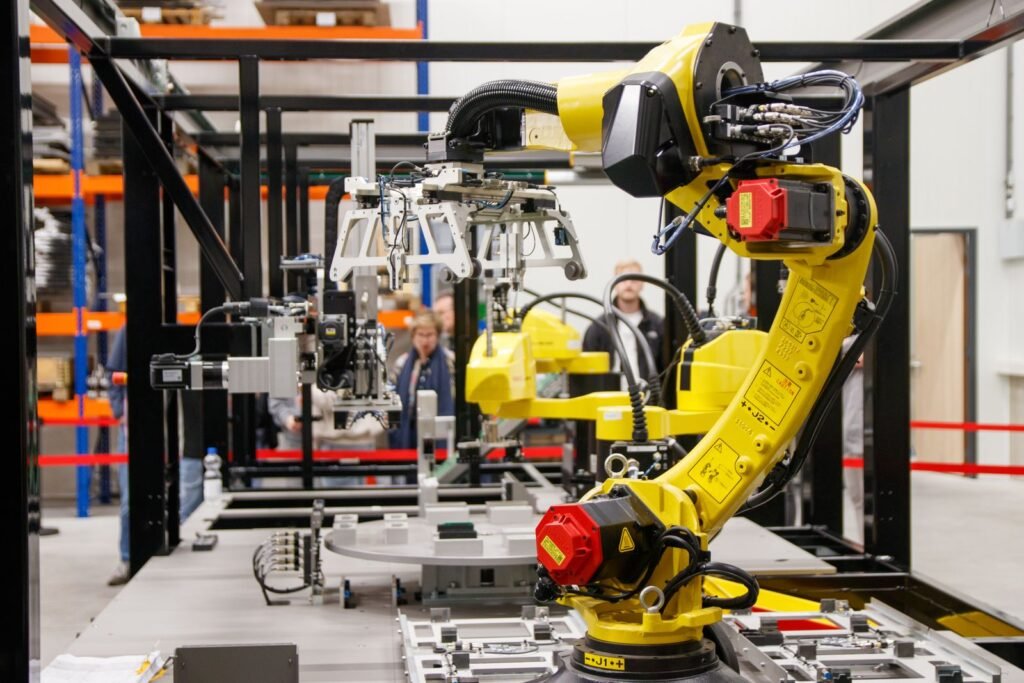
Most car factories still run on a simple idea: build the same vehicle, over and over, as fast as possible. Hyundai’s newest plant in Georgia is built on a different premise entirely. At the Hyundai Motor Group Metaplant America, or HMGMA, a customer’s order can shape the exact sequence of robots and parts that build their car, and the factory reconfigures itself in real time to make it happen.
The plant sits just outside Savannah, and it recently hit a milestone that says a lot about where automotive manufacturing is heading. On June 2, 2026, HMGMA started building the 2027 Kia Sportage Hybrid, the first Kia-branded vehicle to roll off its lines and the first hybrid model the plant has produced. It joins the Hyundai Ioniq 5 and Ioniq 9 as the third nameplate assembled there, all on the same physical line.
One Line, Three Very Different Cars
That last detail is the whole story. Most factories need to be shut down and retooled, sometimes for months, to switch between vehicle platforms or powertrains. HMGMA was designed around what Hyundai calls hyper-flexible manufacturing, meaning the line can absorb a gas-electric hybrid, two different electric vehicles, and eventually Genesis luxury models without a major overhaul between runs.
Behind that flexibility is a layer of agentic AI that coordinates far more than robotic arms. When an order comes in, whether it specifies a particular battery chemistry, a specific interior stitching pattern, or a certain compute module, the system sources the right parts, schedules the exact robotic build sequence for that unit, and slots it into the line without slowing down the vehicles ahead of or behind it. Every car on the line can, in theory, be different from the one in front of it.
The tariff math behind the Sportage Hybrid move is just as telling. Building the car in Georgia instead of importing it from Korea sidesteps a 15 percent import duty, and Hyundai Motor Group has pointed to a looming multibillion-dollar tariff bill on future imports as a direct reason for shifting production stateside. Flexible, AI-coordinated manufacturing is not just a technical flex here. It is also how the company protects its margins while trade policy keeps shifting under it.
The Robots Doing the Work
Inside the plant, additive manufacturing robots print and assemble components as part of that same coordinated system, working alongside human employees rather than replacing the assembly floor outright. Hyundai has also been steadily introducing humanoid robots into the mix. Its Boston Dynamics unit has already begun piloting Atlas humanoid robots at the Metaplant, starting with lower-risk jobs like parts sequencing before expanding into full component assembly by 2030. It is a preview of the same push toward a more capable, more autonomous generation of factory robots that Boston Dynamics has been promising for years, now finally getting a real production floor to prove itself on.
The scale of the investment is hard to overstate. Hyundai Motor Group has committed to roughly 8,500 jobs at the site by 2031, and the adjacent battery cell facility already employs more than 500 people, most of them hired locally. Once fully ramped, HMGMA is expected to build more than 500,000 vehicles a year, spanning Hyundai, Kia, and Genesis models on the same hyper-flexible infrastructure.
What This Means Beyond One Factory
It is worth being honest about the tension sitting underneath all of this. Automakers keep insisting that robots and AI are there to work alongside people, not replace them, and at HMGMA that framing mostly holds up so far, since headcount at the site is still growing. But the broader conversation around AI and employment is getting harder to wave away. Executives across the tech industry are already citing AI as a reason for layoffs even when the cost math does not clearly favor automation, and a factory built from the ground up around agentic AI and robotics is exactly the kind of environment where that debate will keep playing out.
What makes HMGMA worth watching is that it is not a concept car or a lab demo. It is a working factory shipping real vehicles, built around the idea that a car assembly line can be as adaptable as software. If Hyundai’s bet pays off, hyper-flexible, AI-orchestrated manufacturing will not stay a Hyundai story for long. Every automaker watching its tariff exposure and labor costs closely has a reason to pay attention to what is happening outside Savannah right now.
About this article: GeekBlog covers U.S. technology news, AI, phones, smartwatches and gaming. Every story is written and checked under our Editorial Policy. Spotted a mistake or have a story tip? Contact our editors.
