

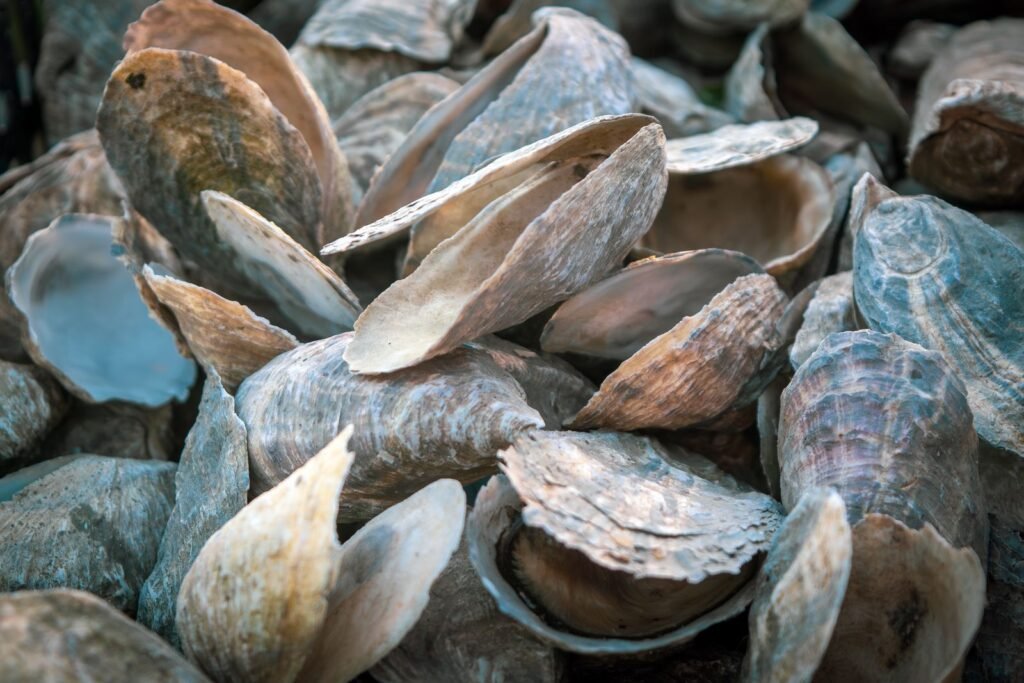
Florida really is putting shucked oyster and clam shells back into the Gulf of Mexico, and the restored reefs really are working — Apalachicola Bay reopened to oyster harvesting on January 1, 2026 after a five-year shutdown, and the only places with enough oysters to harvest were the reefs the state rebuilt. But the number going around social media, “500,000 tons of recycled shell between 2007 and 2024,” is off by roughly two orders of magnitude. The verified total for every documented shell-recycling program in Florida is closer to 5,000 tons. The real story is smaller, slower, and considerably more interesting than the viral one.
Oyster reefs are the most damaged marine habitat on the planet that almost nobody thinks about. A 2011 survey published in BioScience examined 144 bays across 44 ecoregions and concluded that about 85% of the world’s oyster reefs are gone. In many bays the loss exceeds 99%, which the authors classified as functionally extinct. The same paper singled out the Gulf of Mexico as “probably the last opportunity to achieve large-scale oyster reef conservation and sustainable fisheries” anywhere on Earth. That framing is why Gulf states have spent the last fifteen years experimenting with an idea that sounds like a joke: driving to seafood restaurants, collecting the trash, and dumping it in the ocean.
Why empty shells and not concrete blocks
An oyster larva spends about two to three weeks drifting in the water column before it has to make a one-time, irreversible decision: where to cement itself for the rest of its life. Pick wrong — bare sand, soft mud, a spot that silts over — and it dies. Evolution has therefore given oyster larvae an unusually picky sensory system.
Two cues dominate. The first is biofilm: the microbial slime that colonizes any hard surface left in seawater for a few weeks. Larvae settle far more readily on biofilmed surfaces than on sterile ones, and the composition of the bacterial community measurably changes settlement rates. The second is conspecific chemistry. A 2013 study in PLOS ONE identified a specific glycoprotein in oyster shell that triggers larval settlement and metamorphosis — the larva is, in effect, chemically detecting “other oysters lived here successfully” and taking that as a recommendation.
That is the whole trick. Recycled shell is not just a hard surface; it is a hard surface that broadcasts the exact molecular signal larvae are built to look for, with the surface roughness and interstitial gaps that a smooth concrete block does not have. Research published in Restoration Ecology in 2026 confirmed that both biofilm and structural complexity independently drive recruitment. Shell wins on both counts.
What Florida has actually collected
In February 2024, Florida State University’s Coastal and Marine Laboratory published a survey of shell retention and recycling programs across the United States. It documented 29 programs nationwide; 28 of the 29 collect shell directly from restaurants. Large programs had been running an average of about thirteen years. Here is what the Florida entries look like when you line them up.
| Program | Region | Started | Shell collected |
|---|---|---|---|
| Restore Our Shores (Brevard Zoo) | Indian River Lagoon | 2010 | ~8,000,000 lb total |
| Shuck and Share | Indian River Lagoon, 11 counties | 2014 | 926,600 lb (to mid-2023) |
| Apalachicola Bay OYSTER Program | Franklin County | 2020 | ~260,000 lb (~65,000 lb/yr) |
| GCORR | Manatee County | 2017 | ~80,000 lb/yr |
| Tampa Bay CORE | Tampa Bay | 2022 | ~80,000 lb to date |
Add those together and you get roughly 10 million pounds — about 5,000 short tons — accumulated over fifteen years. For comparison, the largest program in the country, the Shell Recycling Alliance in Maryland, Virginia and DC, moves more than 2 million pounds per year from around 200 restaurants. Alabama Coastal Foundation has recovered 22.6 million individual shells since 2016. Galveston Bay Foundation in Texas has passed 2 million pounds since 2011. These are meaningful, hard-won numbers. None of them is anywhere near half a million tons.
Apalachicola Bay: the closest thing to a real result
Apalachicola is the case that matters, because it is the one place where you can point to a policy outcome rather than a press release. The bay historically supplied up to 90% of Florida’s oysters and averaged around 3,000 metric tons a year between 1975 and 1985. Then it collapsed. Drought, upstream water withdrawals in Georgia, the aftermath of Deepwater Horizon, and decades of harvest without adequate shell return left the reefs stripped of the very substrate the next generation needed.
In 2020 the Florida Fish and Wildlife Conservation Commission closed the bay to all wild oyster harvest — a five-year moratorium on a fishery that defined the town. Since 2019, more than $38 million has gone into restoration there, including $10 million from the state’s Framework for Freedom budget specifically for reef construction, on top of about $20 million for data collection, analysis, and pilot reefs.
On January 1, 2026, the bay reopened for a two-month season running through February 28. The restrictions tell you exactly how fragile the recovery is: around 4,700 commercial bags total, shared among endorsement holders, and a single bag for the entire season for recreational harvesters. Critically, FWC stated that the restored reefs are the only locations in the bay with enough oyster abundance to support any harvest at all. The next season is scheduled for October 1, 2026 through February 28, 2027, with harvest levels reset annually based on monitoring.
What the reefs do besides grow oysters
Oysters are what ecologists call a foundation species: the habitat is the animal. A single adult oyster filters up to 50 gallons of water a day, pulling out algae and suspended sediment. Scale that across a reef and you get measurable improvements in water clarity, which lets sunlight reach seagrass, which supports juvenile fish, crabs and shrimp. Reef structure also blunts wave energy — NOAA cites reductions of 76% to 99% depending on reef geometry and wave conditions — which slows shoreline erosion behind them. For anyone weighing coastal property in Florida, that shoreline-protection function is not an abstraction; it is the difference between a marsh edge that holds and one that retreats.
Economists have tried to put a number on this. A 2012 BioScience analysis by Grabowski and colleagues valued oyster reef ecosystem services — excluding the oysters you actually eat — at $5,500 to $99,000 per hectare per year, and found that restored reefs recover their median construction cost within 2 to 14 years. The paper included a sharp caveat that gets ignored in the enthusiasm: reefs subjected to destructive harvest, such as dredging, never recoup their restoration cost. Build a reef and then dredge it and you have lit the money on fire.
What the viral version gets wrong
Three claims deserve flagging, because they are being repeated as fact.
“500,000 tons of shell, 2007 to 2024”
Not supported. No Florida program, and no plausible sum of Florida programs, approaches that figure. The documented total across five programs over fifteen years is roughly 5,000 tons.
“Critics called it reckless dumping”
Shell placement is permitted and regulated work, coordinated with FWC, the Florida Department of Environmental Protection, NOAA, and water management districts. Real debate exists — over shell curing time, disease transfer, placement depth and whether rock outperforms shell — but “reckless dumping” is not a position anyone in the field has held.
“Fish, turtle and dolphin populations returned to 25-year highs”
There is no published Gulf-wide dataset showing this, and no mechanism by which reef restoration on the order of a few hundred acres could move dolphin abundance across an entire sea. Localized increases in reef-associated fish are well documented and genuinely impressive. Gulf-scale megafauna recovery attributed to shell recycling is not.
Where this goes next
The federal money is real and growing. NOAA awarded $5 million to Restore America’s Estuaries for Gulf shell recycling under the Bipartisan Infrastructure Law and Inflation Reduction Act, and a separate $10.9 million to the Pensacola and Perdido Bays Estuary Program for a bay-scale effort targeting 1,482 acres, with 247 acres slated for construction within four years. Comparable programs now operate in Alabama, Mississippi, Louisiana, Texas and California, and the model has been picked up in Europe and Australia.
The bottleneck is not enthusiasm. It is shell. Tampa Bay has gone from roughly 2,000 acres of oyster reef in the 1940s to about 217 acres today — an 85% loss that mirrors the global figure almost exactly. Every restaurant program in the state combined cannot supply the substrate needed to rebuild even one bay at historical scale. That is why the serious projects use limestone, and why shell recycling functions less as the engine of restoration than as its seed layer and its public face — the part a diner can participate in by handing back a plate.
Frequently asked questions
Why can’t you just put shells straight back in the water?
Fresh shell can carry pathogens, parasites and non-native organisms. Programs cure it outdoors for six to twelve months, where sun, rain and time sterilize the surface. State permits generally require a documented curing period before placement, which is also why collected shell sits in visible mountains at staging yards.
Is Apalachicola Bay fully recovered?
No. The 2026 reopening allowed roughly 4,700 commercial bags across a two-month season, against a historical average near 3,000 metric tons a year. Harvest is confined to restored reefs. FWC sets each season based on fresh monitoring, and a poor recruitment year could close it again.
Do recycled shells actually help more than concrete or limestone?
Per unit of surface area, yes — shell carries the conspecific chemical cue that triggers larval settlement and has better structural complexity. Per project, limestone usually wins on availability, cost and durability. Most large restorations use rock as the base and shell as a settlement-enhancing veneer where supply allows.
How can I donate shells from my own oyster roast?
Most Florida programs accept public drop-offs at designated bins. Restore Our Shores in Brevard County, Shuck and Share along the Indian River Lagoon, and Tampa Bay CORE all publish drop-off locations. Keep shells free of foil, lemon, plastic and sauce cups, since contamination forces the whole batch to be discarded.
Does eating oysters hurt or help the reefs?
Farmed oysters are grown on lines or in cages and do not damage wild reefs; their shells are the cleanest recycling input available. Wild dredged oysters are the problem case, because dredging removes both the animal and the substrate. Asking where your oysters came from is the single most useful consumer question.
The bottom line
Florida’s shell recycling programs are a genuinely good idea executed at a genuinely modest scale, and the Gulf’s most watched oyster fishery reopened in 2026 on the strength of reefs that people built by hand. That is worth celebrating without exaggeration. The mechanism is elegant — larvae reading a chemical signature in old shell and deciding to stay — and the economics work, with restored reefs paying back construction costs in 2 to 14 years. What did not happen is half a million tons of restaurant waste reviving an entire sea. Restoration at that scale would be extraordinary. Restoration at the scale that actually occurred is still one of the better environmental bets the Gulf Coast has made, and unlike most of them, it starts with something you were going to throw away anyway. If you enjoy stories where a small policy change produces an outsized result, our piece on Arizona’s overhaul of its animal cruelty statutes covers similar ground, and readers weighing a move to the Gulf Coast may want our comparison of New York versus Florida.
Sources
- Beck, M. W. et al. (2011). Oyster Reefs at Risk and Recommendations for Conservation, Restoration, and Management. BioScience 61(2).
- Grabowski, J. H. et al. (2012). Economic Valuation of Ecosystem Services Provided by Oyster Reefs. BioScience 62(10).
- Florida State University Coastal and Marine Laboratory (2024). Summary of Shell Retention and Recycling Programs.
- Florida Fish and Wildlife Conservation Commission. Apalachicola Bay reopens for recreational and commercial oyster harvesting.
- NOAA Fisheries. Gulf Coast: Oyster Shell Recycling Key to Sustainable Seafood and Coastal Protection.
