

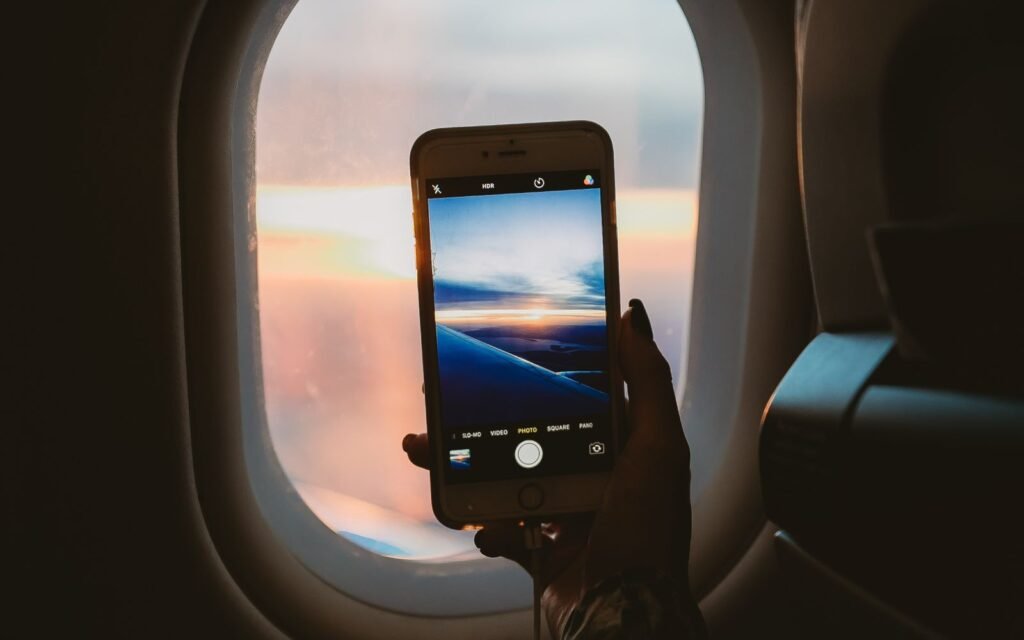
“At 6:45 pm consider this your wheels up. Our phones are being taken away for now for security reasons.”
That was the last line of a pool report sent by Agence France-Presse correspondent Aurélia End as Air Force One left Shenzhen, China, on Thursday evening. It’s not something reporters traveling with the president usually write. As UNILAD Tech reported, President Trump has now explained the move, sort of. Here’s what happened on the plane, what a Faraday bag actually does, and what it tells you about how seriously Washington takes phone security in China.
The short version
- Reporters were asked to seal the phones they had used in China in signal-blocking Faraday bags until landing in the US.
- White House staffers’ temporary burner phones were collected to be wiped or thrown away.
- Phones were returned after landing, as promised.
- Trump didn’t name a specific threat: “We want to be careful.”
- On the May trip to Beijing, reporters kept their phones on the way out.
What happened on the plane
Trump landed in Shenzhen on November 18 for the Asia-Pacific Economic Cooperation (APEC) summit. On November 19 he met Chinese President Xi Jinping, then Russian President Vladimir Putin, then both together in their first formal three-way meeting.
The details of the phone request came from CBS News correspondent Jennifer Jacobs, in an account shared on X by CNN’s Kaitlan Collins. “For cyber security, an AF1 aide collected White House staffers’ burner cellphones for disposal or data wiping as we left Shenzhen and asked that journalists place the phones they’d used in China in a signal-blocking Faraday bag until we landed in the US,” Jacobs wrote.
The catch was who had planned ahead. “Many (but not all) reporters and photographers had placed their regular work phones, personal phones, laptops and smart watches in metal-lined bags to prevent potential spyware, surveillance or data collection,” Jacobs explained. Those devices had stayed sealed on the plane the whole time and weren’t touched. “Those who hadn’t opted for burners were left with no cellphone” for the long flight home.
Timeline: how the phone lockdown played out
Wed, Nov 18
Before landing in Shenzhen, many journalists seal their everyday devices in Faraday bags on board and switch to temporary phones.
Thu, Nov 19
Trump meets Xi, Putin, and both together. A Bloomberg reporter who asked a question is barred by China from the three-way meeting.
6:45 p.m. local
Wheels up. Phones used in China go into Faraday bags. Staff burners are collected for wiping or disposal.
Landing in the US
Reporters get their phones back, as the aide promised.
What Trump said
When NBC News correspondent Gabe Gutierrez reached the president by phone and asked what prompted it, Trump didn’t point to any specific threat. “Well, we want to be careful, and we didn’t want to have people have phones when they shouldn’t have phones, so we were very careful,” he said. The White House didn’t offer a more detailed explanation.
Fox News correspondent Jacqui Heinrich, president of the White House Correspondents’ Association, noted that reporters kept their phones when Trump left Beijing in May. On that trip, the pool said officials instead collected everything the Chinese side had handed out, including press credentials, burner phones and delegation pins. Andrew Feinberg of The Independent pointed out that it’s unusual for reporters to give up their phones on Air Force One unless the president is going to a war zone.
This isn’t the first odd moment for the traveling press this year. In July, after a NATO summit in Ankara, Turkey, the pool flew out believing Trump was on their plane. Weeks later, The Washington Post reported he had secretly left on a different military jet after officials learned of a possible Iranian assassination plot.
What a Faraday bag actually does
A Faraday bag is a pouch lined with layers of metal fabric. It works on the same principle as a Faraday cage: the conductive layer absorbs and redirects radio waves so they can’t get in or out. Put a phone inside and seal it properly, and the phone goes deaf and mute to the outside world.
What it blocks
Cellular signals, Wi-Fi, Bluetooth, GPS and NFC. The phone can’t send data out or receive commands in, even if it’s switched on.
What it doesn’t do
It doesn’t remove malware. If a phone was compromised in China, the spyware is still there. The bag just stops it from talking until someone checks or wipes the device.
Why it matters on a plane
Air Force One is packed with officials and sensitive conversations. A bugged phone with a working microphone or location tracker is the last thing you want on board.
That last point is likely the real logic here. The concern isn’t that a reporter would leak something. It’s that a phone carried around Shenzhen for a day could have been compromised without its owner knowing, and then turned into a listening device on the most sensitive aircraft in the world.
Why phones are such a big worry in China
US officials have treated personal phones in China as high risk for years. Before the 2022 Beijing Winter Olympics, several national teams, including those from the US, Canada and the Netherlands, told athletes to bring burner phones and leave their personal devices at home. Researchers at Citizen Lab also found serious security flaws in MY2022, the health app all Olympic attendees had to install.
On top of that, China-linked hacking groups have shown they can reach deep into phone networks. The Salt Typhoon campaign got inside major US telecom carriers in 2024, which is why the industry later teamed up to form a new threat-sharing group to fight the next Salt Typhoon. And modern spyware doesn’t always need you to click anything. Citizen Lab recently showed how spyware can ride in on an ordinary ad with no click needed.
| Protection | Stops signals? | Removes malware? | Protects your data? |
|---|---|---|---|
| Airplane mode | Partly. Wi-Fi and Bluetooth can be switched back on | No | No |
| Faraday bag | Yes, when sealed | No | Only while it’s inside |
| Burner phone | No | Not needed, you throw it away | Yes, your real data never travels |
| Full wipe after the trip | N/A | Usually, though advanced implants can survive | Yes, from that point on |
That’s why the White House used every layer at once: burners in China, real devices sealed in bags, used burners wiped or destroyed afterward, and any phone that left the plane bagged on the way home.
The press freedom side of the story
Taking reporters’ phones has a cost. The traveling pool exists to be the eyes and ears for every newsroom that doesn’t have a seat on Air Force One. On a long flight with no phones, some of them simply couldn’t file. Critics have also flagged the move as part of a tense year between the White House and the press corps, including court fights over which outlets get access. Supporters would say a one-flight precaution after a day in China is just good security hygiene. Both things can be true.
How to protect your own phone abroad
You probably aren’t a target the way a White House staffer is. But the same basics work for business travelers and anyone heading somewhere with aggressive surveillance:
Travel phone checklist
- Bring less. A cheap secondary phone with only the apps you need beats your everyday device.
- Update everything before you go. Most attacks use bugs that are already patched.
- Turn on Lockdown Mode on iPhone (Settings > Privacy & Security) if you’re a journalist, activist or work in a sensitive job.
- Skip public Wi-Fi and USB charging ports. Use your own charger and a reputable VPN where it’s legal.
- Never leave devices in a hotel room unattended if you can avoid it.
- Reset the travel phone when you get home, and change any passwords you used abroad.
The bottom line
Bagging reporters’ phones on Air Force One wasn’t about what journalists might say. It was about what their phones might do after a day in Shenzhen. The White House didn’t name a threat, and it may never. But the layered approach, from burners on the ground to Faraday bags in the air, shows that US officials now treat any phone that’s been to China as untrusted until proven otherwise. For the rest of us, it’s a reminder that a $20 metal pouch and a cheap spare phone are some of the most effective security tools you can buy.
About this article: GeekBlog covers U.S. technology news, AI, phones, smartwatches and gaming. Every story is written and checked under our Editorial Policy. Spotted a mistake or have a story tip? Contact our editors.
