

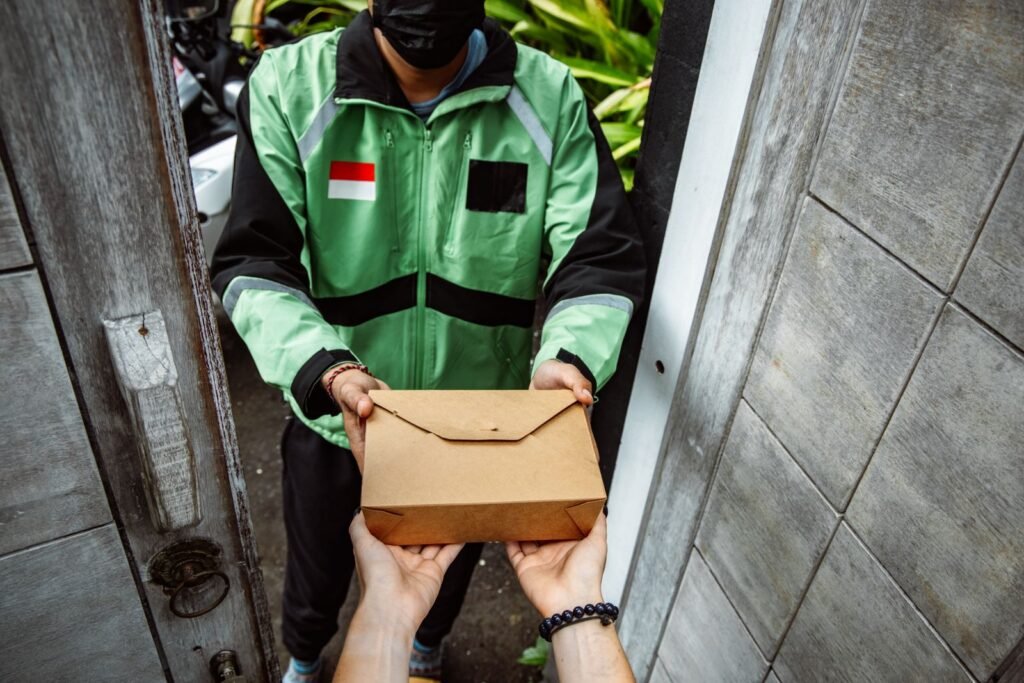
The next time an Amazon package arrives, there is a growing chance the person handing it over is wearing a camera, and that the camera took a picture of your front door, your car, your porch and possibly you.
Amazon has been testing camera equipped smart glasses on delivery drivers, and the program is now scaling. Reporting puts the target at roughly 5,000 drivers wearing them by the end of 2026, rising past 20,000 by the end of 2027. The glasses capture images of whatever enters the driver’s field of view during a shift, which on a residential route means houses and the people standing in front of them.
Amazon’s framing is that this is a logistics tool. The pictures feed an internal AI mapping system called Wellspring, which exists to work out where a door actually is, which gate is the right gate, and where a package can safely be left. That is a real problem worth solving. It is also the first time a major retailer has proposed solving it by photographing the country’s doorsteps at scale.
The short version
- What they are: smart glasses with a camera, worn by Amazon delivery drivers during shifts
- Scale: around 5,000 drivers by the end of 2026, more than 20,000 by the end of 2027
- What gets captured: people, vehicles and private property that enter the driver’s view while working, reportedly thousands of images per shift
- Amazon’s safeguard: faces and license plates are blurred before any human review
- What is missing: no opt out for property owners, and no stated retention limit
- Law enforcement: Amazon has confirmed police can obtain the images with a valid warrant
- For drivers: Amazon says wearing them is voluntary
What the glasses are for, according to Amazon
Credit where it is due: the underlying problem is genuine and annoying. Delivery addresses are a mess. A pin on a map points at a building, not at the specific door, stairwell, side entrance or lobby desk where a parcel belongs. Drivers learn routes by memory, and that knowledge disappears when they leave.
Wellspring is Amazon’s attempt to encode that knowledge. Feed it enough imagery of real approaches to real addresses and it can start telling a new driver which of three identical doors is number 14B. Amazon says the data is used only to improve deliveries and not for surveillance, and says use of the glasses is voluntary for drivers and third party delivery partners.
The difficulty is that the method and the stated purpose come apart. To learn where your door is, the system does not need a photograph of you answering it. It gets one anyway, because a camera on a person’s face records whatever that person is looking at.
The blurring is real. It is also not the part that matters.
Amazon’s main privacy answer is that faces and license plates are blurred before a human looks at anything. That is a meaningful safeguard and it is better than not doing it.
It is also answering a question nobody is primarily asking. Blurring protects the identity of a person who happens to be in a frame. It does nothing about the frame itself. A continuously refreshed photographic record of residential approaches is valuable, and sensitive, regardless of whether the pedestrians in it have smudged faces. Your house does not become anonymous when a stranger’s face is blurred.
Look at what the safeguard does not cover and the shape of the gap is clear.
| The question | Where things stand |
|---|---|
| Are faces protected | Amazon says faces and license plates are blurred before human review |
| Can a homeowner opt out | No. No opt out mechanism exists for property owners |
| How long are images kept | No fixed retention limit has been set publicly |
| Can police get the images | Yes, with a valid warrant. Amazon has confirmed this |
| Are drivers required to wear them | Amazon says participation is voluntary |
| Are people told they are being photographed | No notification process has been described |
The warrant sentence is the one to reread
Amazon confirming that law enforcement can access the images with a valid warrant is entirely lawful and entirely unremarkable as a legal matter. Any company holding records can be served with a warrant.
What makes it worth noticing is the combination. A warrant is only useful if the records exist. Before this program, there was no photographic archive of American residential approaches held by a single private company and refreshed daily by tens of thousands of wearers. Building that archive is the decision. Warrant access is just the consequence that follows automatically once it exists.
Neil Richards, a law professor at Washington University who works on privacy, made the sharper version of the point: these should be understood as surveillance tools, and the people who interact with a worker wearing them may be recorded without meaningful consent or even awareness. The second half is the operative part. A doorbell camera is your choice on your property. A camera on the face of someone walking up your path is not, and you have no way to know it is there.
What it does to the person wearing them
The privacy conversation has mostly been about households, which makes sense because households did not agree to anything. But the driver is wearing the device, and that side deserves attention too.
A head mounted camera running through a shift is, functionally, a continuous record of how a worker spent their day. Amazon says the purpose is mapping, and the glasses also offer drivers genuine conveniences by putting navigation and package information in their line of sight instead of on a handheld scanner. Both things can be true, and the record still exists.
Critics have raised the obvious concern, which is that a device producing a detailed account of every movement will intensify pressure on drivers to move faster, whether or not anyone writes a policy saying so. Amazon’s answer is that wearing them is voluntary. In a workplace where performance is measured in stops per hour, the practical meaning of voluntary depends heavily on whether the drivers who decline are treated the same as the drivers who do not, and that is not something an outside observer can verify from a press statement.
Where these numbers come from. The rollout targets, the per shift image estimates and the description of what the cameras capture come from press reporting rather than an Amazon product announcement, and the figures should be read as approximate. Amazon has confirmed the blurring, the warrant access and the voluntary framing. It has not published a retention policy, a notification process or an opt out, and the absence of those three is the basis for most of the criticism here.
Why this keeps happening in the same shape
There is a pattern worth naming. A company identifies a real operational problem, solves it by collecting a much broader dataset than the problem strictly requires, and then offers a privacy safeguard aimed at the narrowest possible interpretation of the objection.
Amazon has done a version of this before. The company turned out to be keeping a written list of inferences about customers, including guesses about their bodies, on a page most people had never found. The stated purpose was better recommendations, which was probably true, and the dataset was far wider than recommendations needed.
The same logic has been building out in physical space for years through license plate camera networks, where the gap between stated purpose and actual reach is now well documented. One researcher who built his own plate reader and pointed it at police vehicles got a visit from officers at his door, which tells you something about how asymmetric these systems are by design. And connected consumer hardware has shown repeatedly that the data a device moves bears little relation to what the device is for, as owners discovered when a smart coffee maker pushed a terabyte in ten days.
The glasses are the same move applied to the last unmapped surface, which is the path between the curb and your door.
The bottom line
Amazon is putting cameras on thousands of delivery drivers to build a better map of where doors are, and the images it collects along the way include your home and whoever is standing in front of it. Faces get blurred. There is no opt out, no published retention limit, no notice to the people photographed, and the archive is reachable with a warrant.
None of that is illegal, and the mapping problem it addresses is real. The thing to be clear eyed about is that the question was never whether Amazon would handle the images carefully. It is whether a private photographic record of residential America should be assembled at all, and nobody outside Amazon was asked.
Sources and further reading
- WashU: Amazon’s smart glasses raise privacy concerns, with law professor Neil Richards
- Cybernews: Amazon smart delivery glasses raise privacy concerns
- Moneywise: Amazon’s smart glasses will snap photos at doorsteps, and there is no way to opt out
- Android Headlines: Amazon delivery drivers are testing smart glasses that take constant photos
- Pulse 2.0: WashU privacy expert raises concerns about Amazon smart glasses for delivery drivers
About this article: GeekBlog covers U.S. technology news, AI, phones, smartwatches and gaming. Every story is written and checked under our Editorial Policy. Spotted a mistake or have a story tip? Contact our editors.
