

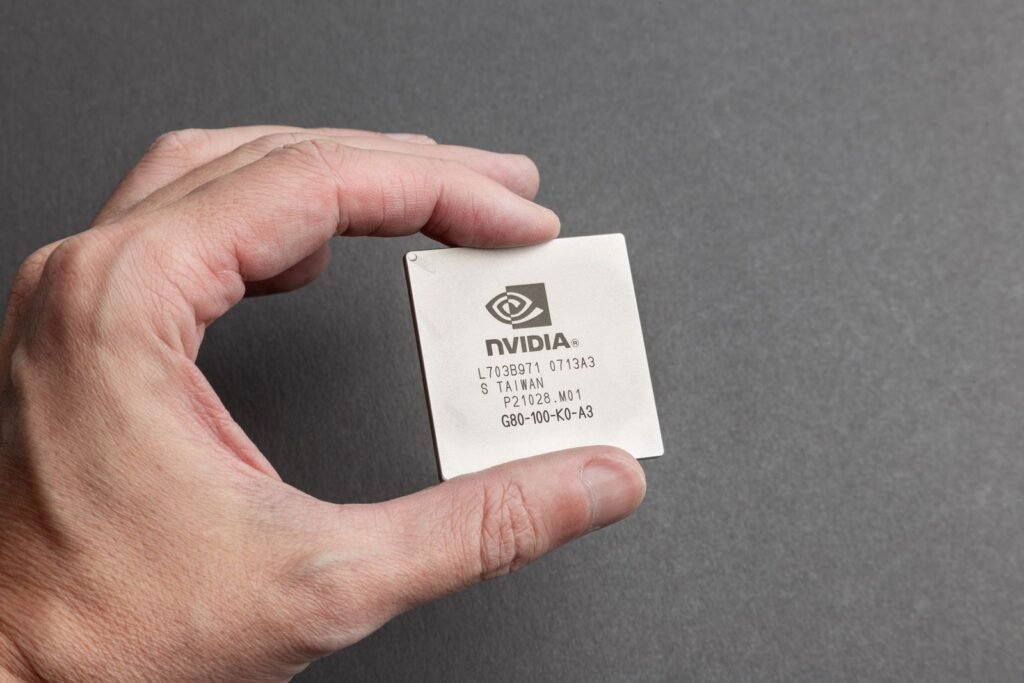
If you only looked at the numbers, Tuesday was a normal Nvidia day. Revenue beat the forecast by almost eight billion dollars, guidance went up again, and the stock rose about 4% after hours. The company that sells the picks and shovels of the AI boom is still selling a lot of picks and shovels.
But this was not a normal call. It was the first one since Jensen Huang, who co-founded Nvidia in 1993 and ran it ever since, resigned on November 12. And within a few hours, his replacement made it fairly clear that the Nvidia of the next few years will look different from his. China sales of the H200 are over. The giant loan guarantees now come with conditions spelled out in public. And the company says excess cash is going back to shareholders, not into an ever larger portfolio of startups.
The short version
- Q3 revenue: $115.8 billion, up 103% year over year, against $108 billion guidance
- Net income: $64.9 billion, up from $59.7 billion the quarter before
- Q4 guidance: about $130 billion, plus or minus 3%
- China: no more H200 sales there, says interim CEO Colette Kress
- Huang: offered to come back. The board said no
The quarter, in one chart
Nvidia’s third quarter of fiscal 2027 came in at $115.8 billion. That is more than double the same quarter a year ago and well above the $108 billion the company had told Wall Street to expect. Interim CEO Colette Kress, who is also still CFO, then guided the fourth quarter to around $130 billion and raised the outlook for fiscal 2028 to roughly 75% growth, up from 70%.
There is also a very large buyback running in the background. Nvidia added $150 billion to its repurchase program in September, spent $28.1 billion on its own shares during the quarter, and still has $227.3 billion left to use. With the stock down about 10% since Huang left, those repurchases now buy more shares per dollar than they did a month ago. That is an odd silver lining, but it is a real one.
Kress spent a good part of the call telling everyone nothing had broken. “From a business perspective, it’s business as usual,” she said. “We’ve engaged with our customers, we’ve engaged with our suppliers, our partners. They’re all 100% behind us.” She added that Nvidia has locked in memory and advanced packaging capacity and is working with TSMC to “narrow the supply and demand gaps.”
Why Huang is gone, and why he is not coming back
Quick recap for anyone who missed the last two weeks. Huang resigned as president, CEO and board member after disclosures about several extramarital affairs, including two with direct reports and one with Alice Huang, a former executive at Singapore data company Megaspeed. U.S. intelligence officials suspect she works for China’s Ministry of State Security, and the Commerce Department has been investigating whether Megaspeed diverted Nvidia chips to China since late 2024. We went through what Congress will ask Huang and what would have to be proven for real legal trouble earlier this week.
On Tuesday morning, Huang posted a long statement on X. He said he had “made serious mistakes” in his personal life, promised to cooperate with the board’s independent investigation, and added that if the board decided his return was in the best interest of the company “and America,” he “would be honored to answer these calls and return as CEO.”
The calls are real. An open letter signed by more than 10,000 current and former Nvidia employees asked the board to explain, with evidence, why his absence was necessary. A separate public petition passed 197,000 signatures, with names like Elon Musk on it.
The board was not moved. Chairman Harvey C. Jones opened the earnings call with this:
“Jensen Huang voluntarily resigned his positions as president, CEO, and board member. The Nvidia board unanimously accepted his resignation and does not intend to reinstate Jensen as CEO.”
Harvey C. Jones, Nvidia chairman
Jones said the search for a permanent CEO includes internal and external candidates. Meanwhile the pressure from outside keeps building. The Wall Street Journal reports the SEC has opened a civil probe into whether Nvidia’s disclosures misled investors. Treasury Secretary Scott Bessent accused the company over the weekend of knowingly selling powerful chips to China to “goose their revenues and their earnings.” And one senator, asked by Politico about a Huang comeback, called it “one of the worst ideas I’ve heard today.”
Change one: Nvidia walks away from China
The biggest strategic shift came almost in passing. Kress said Nvidia will no longer sell H200 chips in China.
That deal was Huang’s baby. He and President Trump brokered an arrangement where H200s headed for China were routed through the United States so the government could collect a 25% tariff. China hawks hated it. Huang defended it for years, arguing that ceding the Chinese market would be “a disservice to our country.” In practice, the deal was already mostly dead: Beijing had largely refused to accept the chips because it wants local buyers to use domestic hardware.
The bigger problem for Nvidia is a rule that landed one day before the call. On Monday, the Commerce Department issued interim export controls that bar advanced U.S. chips from foreign data centers that serve Chinese customers remotely. That closes the loophole where a Chinese lab simply rents Nvidia hardware sitting in Singapore or Malaysia.
Kress argued the new rules will have “no impact” on top line revenue, because the backlog for chips like Vera Rubin is so deep that any capacity freed up will be snapped up by someone else. That is probably true in the short term. The long term risk is different. Export control attorney Dan Fisher-Owens told TechCrunch that large data centers will need to certify they are not serving Chinese customers. Operators that cannot or will not do that may simply switch to other chips.
There is also an awkward technical reality hanging over all this. According to researchers cited by TechCrunch, every leading Chinese AI model shows signs of being trained on Grace Blackwell hardware that was never legally exportable to China. Those training runs likely happened in third countries, which is exactly the setup Monday’s rule is meant to kill.
Nvidia also used the day to create a board level committee for national security, export control compliance and global trade risk. It is chaired by director Suzanne Nora Johnson, with Stephen C. Neal and John O. Dabiri as members, and it will meet at least quarterly. The company’s existing compliance teams now report to it.
Change two: the money tap gets a valve
Under Huang, Nvidia did something no chipmaker had done at this scale: it financed its own customers. It bought stakes in hundreds of AI startups and neoclouds, then started guaranteeing loans for the data centers that would fill up with Nvidia hardware. Critics called it circular. Fans called it building the market.
Tuesday’s filings show just how big that strategy got.
On top of the equity, Nvidia carries $118 billion in loan guarantees. Almost all of that, $105 billion, backs OpenAI’s PORTS-Pike data center campus in Ohio, a project valued at about $500 billion. In exchange, OpenAI agreed to use only Nvidia equipment there. Reports say Kress already fought Huang on that deal and pushed the guarantee down from $250 billion.
On Tuesday she spelled out something investors had never seen in writing: a Nvidia guarantee only kicks in once the customer has raised its own money, built the facility, and installed Nvidia hardware. If the project stalls before that, she said, “our guarantee doesn’t exist anymore.” Kress insisted this was a clarification, not a policy change. Still, it was the first time Nvidia said it publicly.
For neoclouds that have leaned on Nvidia’s balance sheet, that distinction matters a lot. We have already seen CoreWeave asking customers to pay up front because of its interest bill. A more cautious Nvidia makes that kind of squeeze more likely across the sector.
| Topic | Huang’s Nvidia | Kress’s Nvidia (so far) |
|---|---|---|
| China H200 sales | Pushed for them, helped broker the tariff deal | Ended |
| Loan guarantees | $118B committed, OpenAI deal pitched far larger | Kept, but conditional and “far more selective” |
| Startup investing | About 350 startups backed, per PitchBook | “Rigorously evaluating” future deals |
| Spare cash | Heavily recycled into the ecosystem | Excess free cash flow returned to shareholders |
| Open source AI | Champion of Nemotron, bought Hugging Face | Unchanged, deal still on track |
| Export compliance | Management teams | New board committee, meets quarterly |
The line that will make venture capitalists nervous came near the end of Kress’s prepared remarks:
// Colette Kress, Q3 fiscal 2027 earnings call
"We intend to return all excess free cash flow
 net of strategic uses to shareholders during
 this last quarter and going forward."
Read it carefully and the escape hatch is in the middle: “net of strategic uses.” Nvidia is not saying it will stop investing. It is saying the default destination for spare cash is now buybacks and the burden of proof moves to the deal. Investors who spoke to TechCrunch expect smaller checks into existing portfolio companies and far fewer new ones. Kress did say data center projects with land, power and a finished shell are still a “top priority,” because those are the real bottleneck.
What did not change: open models and Hugging Face
One worry after Huang’s exit was that Nvidia would quietly drop his open source crusade. Hugging Face’s CEO called his departure “a sad day.” So far, that worry looks overblown.
Kress opened the call by saying Nvidia is “committed to fostering a vibrant open model ecosystem.” The $12.9 billion Hugging Face acquisition announced in September, which would be the second largest deal in Nvidia’s history, is still on track. Hugging Face serves more than 18 million developers and 200,000 companies. Kress also bragged that Nemotron is now the most used U.S. open model on OpenRouter, a platform where weekly token volume is up 35 times year over year. If you want a refresher on that model family, here is how Nvidia squeezed a 74B Nemotron model into 24GB.
Keep in mind: Huang has not been charged with anything, and the board’s investigation is still open. The suspicions about Alice Huang come from U.S. officials and have not been tested in court. The SEC probe is civil, not criminal, and was reported by the Wall Street Journal rather than announced by the agency.
What to watch next
- Huang’s testimony. He has agreed to testify before Congress, with a December 1 date reported. Anything he says about Megaspeed or China sales lands directly on the SEC probe.
- The CEO search. An internal pick like Kress signals continuity of the new, tighter approach. An outside hire could reset everything again.
- Southeast Asian data centers. The first operators to refuse the new certification will show how much demand Nvidia actually loses to the remote access rule.
- The next startup rounds. If Nvidia’s name starts disappearing from big AI funding announcements, Kress’s caution is real and not just call talk.
The odd thing about Tuesday is that both camps can claim they were right. Huang’s supporters can point at $115.8 billion and say the machine he built runs fine without him. The board can point at the same number and say that is exactly why it can afford to slow down the riskiest parts of his strategy. For the AI industry that has been living on Nvidia’s balance sheet, the second reading is the one that matters.
About this article: GeekBlog covers U.S. technology news, AI, phones, smartwatches and gaming. Every story is written and checked under our Editorial Policy. Spotted a mistake or have a story tip? Contact our editors.
