

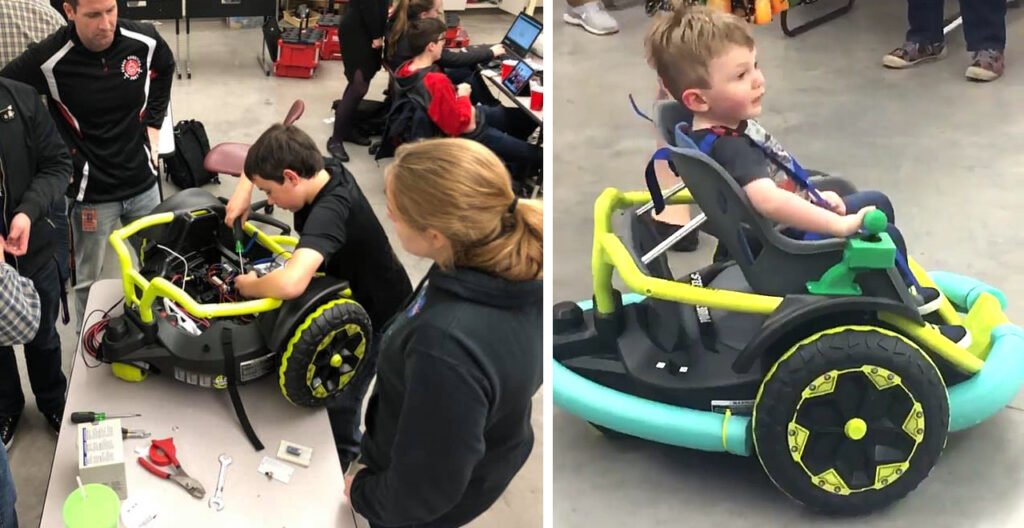
The video is fifteen seconds long and it is the same fifteen seconds every time. A small boy in a plastic car, grinning like he has just discovered fire, driving himself across a gymnasium floor. Behind him, teenagers in matching shirts trying to look casual about it.
What that clip does not show is the paperwork problem that made it necessary — and that problem is the actual story.
The catch-22 at the center of it
Cillian Jackson was born with a rare genetic condition that produces symptoms resembling cerebral palsy. He could hold himself upright if you set him there. He could not reliably crawl or walk. “He has an especially hard time controlling his body,” his father Tyler told reporters. Day to day, that meant being carried, or pushed in a stroller — moved, rather than moving.
The obvious fix is a powered chair. Here is where it gets strange.
Cillian would not be eligible through his family’s insurance until he turned three. That part is a simple age gate. But a power chair carries a second condition, and it is the one that matters: the applicant has to be judged capable of operating it safely. “One of the qualifications to get an electric wheelchair is that they have to be deemed proficient,” Tyler Jackson explained.
Read that twice. To qualify for the machine, you must first demonstrate that you can drive the machine. There is no provision for how you acquire that skill without one.
This is not a quirk of one insurer. RESNA, the professional body for assistive technology in North America, issued a formal position paper on pediatric power mobility that reads like a direct rebuttal: “Age, limited vision or cognition, behavioral issues, and the ability to walk or propel a manual wheelchair short distances should not, in and of themselves, be used as discriminatory factors.” The same paper notes that insurance policies “often limit children to one primary mobility device” and impose “restrictive guidelines based on age.”
The family’s physical therapist suggested a workaround: GoBabyGo, a volunteer programme that converts ride-on toy cars into powered mobility for very young children. There was no chapter near Farmington. So Tyler Jackson — himself a Farmington High School alumnus — asked the school’s robotics team.
What the students actually built
They did not fabricate a wheelchair from scratch, and the honest version of the story is more interesting than if they had. They started from a machine that already solved the hard mechanical problems — a secondhand Power Wheels ride-on car, brought in by Cillian’s parents — and replaced everything that made it useless to him.
Alex Treakle, a freshman who did most of the wiring, described the delivery in the way you would expect a fourteen-year-old to describe it: “The joy on his face really made my entire year.” Reese Kruse, a junior, led the physical design. Their coach, technology education teacher Spencer Elvebak, put it more plainly: “It was great to change a little kid’s life and give him mobility.”
They finished just before Christmas 2018. The story stayed local until late March, when KARE11’s Boyd Huppert ran it on his long-running Land of 10,000 Stories segment. Within a week it was on CNN, CBS, Fox, TODAY and the full ABC station chain, and eventually NBC Nightly News and the New York Times.
Why the commercial chair costs $20,000
The number invites an easy conclusion — that somebody is gouging families — and the reality is duller and harder to fix.
Which is also why the toy-car route works so well. A GoBabyGo conversion runs about $200 including the vehicle. It will not last five years, it is not a medical device, and it does not need to be. It needs to work now, while the child is two.
Why two is not too young — the part most coverage skipped
The reflex response to a toddler in a powered chair is that he is too small for it. The developmental literature says close to the opposite, and it is not a soft finding.
Self-produced movement is not just a motor milestone. It is one of the engines of cognitive development. A 2013 review in Frontiers in Psychology pulled the evidence together: infants who have crawling experience succeed at delayed hidden-object search tasks about 76% of the time, against 13% for infants who have not yet begun to move themselves. Wariness of heights — a genuinely useful survival instinct — appears within two to four weeks of the onset of crawling, not at a fixed age.
Crucially, the causal direction has been tested rather than assumed. Children whose locomotion is delayed by physical conditions show the same cognitive gains when movement finally arrives, later than usual — which separates the effect of moving from the effect of getting older. And experiments giving powered mobility devices to infants who could not yet crawl produced the psychological gains directly.
RESNA’s paper also notes how much the field has moved: powered mobility used to be treated as the last resort, offered once every other option had failed. That framing is now considered backwards. Waiting is not neutral. It costs the child the developmental window in which moving yourself teaches you what the world is.
Which is what Tyler Jackson was describing, without the citations, when he said: “He looks at the world differently when he is in his car as opposed to being carried around. He is aware he is in control of exploring.” His wife Krissy added the detail that gives it away as real: “He loves coming up to everything and exploring it. He really loves doors and door handles.”
The programme behind the plans
GoBabyGo started in 2012 with Cole Galloway, a physical therapy professor at the University of Delaware, and a straightforward observation: commercially available ride-on toy cars already have motors, batteries, wheels and a chassis, and cost a couple of hundred dollars. What they lack is a control the child can operate and a seat that holds him upright. Both are solvable with a switch, some pool noodles, PVC and an afternoon.
Volunteer chapters — engineers, therapists, university students, and increasingly high school robotics teams — do the conversions and give the cars to families for free. Counts vary by source and year, from roughly 40 chapters to 75, with somewhere around five to six thousand cars adapted by the late 2010s. Galloway’s stated ambition is 30,000 a year. The target age is six months to three years, chosen precisely because that is the window in which a conventional power chair is usually not an option.
What happened afterwards
Rogue Robotics did not stop at one. KARE11 later reported the team had built seven wheelchairs for children with disabilities, and the programme became a fixture of the team’s identity alongside its competition robot.
Cillian himself has largely stayed out of the news since 2019, which is probably how his parents want it. He would be around nine or ten now. Krissy Jackson’s line to FIRST, the robotics organisation, is the one that has aged best: “These kids, they don’t know the lives that they’re changing.”
Frequently asked questions
Who built the wheelchair?
Rogue Robotics, FIRST Robotics Competition team 2987, at Farmington High School in Farmington, Minnesota, coached by technology education teacher Spencer Elvebak. They delivered it in December 2018.
Why wouldn’t insurance pay for a wheelchair?
Two separate barriers. Cillian was not eligible for a chair through his family’s insurance until he turned three, and powered chairs additionally require the user to be judged proficient at operating one — a skill you can only acquire by using one. Coverage rules for power mobility in the US generally require that the user “has the mental and physical capabilities to safely operate” the device.
What was the wheelchair made from?
A secondhand Power Wheels ride-on toy car supplied by the family, with its original electronics removed and replaced by the team’s own control board and code, a 3D-printed single joystick on an adjustable mount, a child bicycle seat with a five-point harness, and a protective tubular frame.
How much did the students’ version cost?
The team never disclosed a figure. For comparison, a standard GoBabyGo conversion — the programme whose plans they worked from — costs roughly $200 including the car itself.
Can a two-year-old really drive a powered chair?
Yes, and younger. The pediatric literature documents joystick use from around seven months and competent driving from about fourteen months. Two-year-olds in one study reached competence after roughly seven weeks of practice.
What is GoBabyGo?
A volunteer programme founded in 2012 by Dr. Cole Galloway at the University of Delaware. Chapters modify commercial ride-on toy cars with accessible controls and supportive seating, then give them to families of young children with mobility impairments at no charge.
Sources
KARE11 Land of 10,000 Stories · CNN · CBS News and CBS Minnesota · Fox News · TODAY · The Hill · WQAD · ABC owned stations · Farmington Independent · FIRST Inspires · RESNA, position paper on the application of power mobility devices for pediatric users · CMS Local Coverage Determination L33789, Power Mobility Devices · Anderson et al., “The role of locomotion in psychological development,” Frontiers in Psychology 4:440 (2013) · Children’s Hospital Los Angeles · New Mobility, “The true cost of a wheelchair” · GoBabyGo Oregon · CNN Money · University of Delaware.
About this article: GeekBlog covers U.S. technology news, AI, phones, smartwatches and gaming. Every story is written and checked under our Editorial Policy. Spotted a mistake or have a story tip? Contact our editors.
