

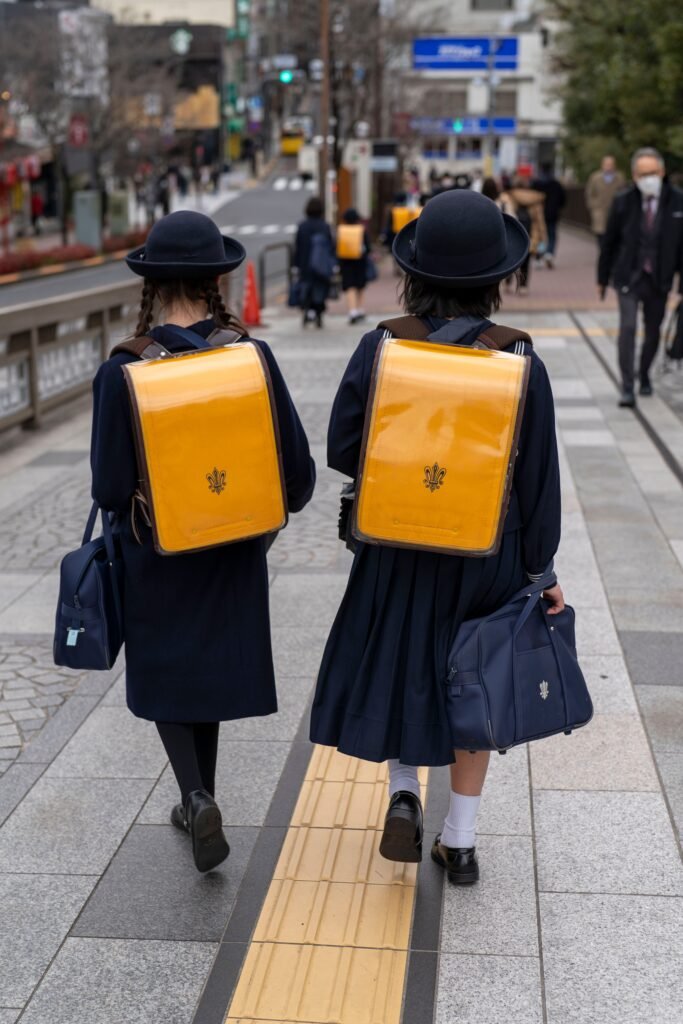
A post going around says Japanese children take no exams until age 10 because schools teach character first. It is close to true — and the real system is far more interesting than the meme.
1. So do Japanese kids take exams before age 10, or not?
They take tests. They don’t take high-stakes tests. Those are very different things, and the meme collapses them.
Japan’s national achievement survey — the closest thing it has to a standardized exam — is given in Japanese and math to sixth graders and third-year junior high students only. Around a million elementary students sit it each year, all of them 11 or 12. Nothing comparable exists for grades 1 through 5.
But short teacher-made tests start in year one, report cards go home from year one, and six-year-olds study Japanese, math, music, and art from day one. As Nathan Driskell of the National Center on Education and the Economy puts it, teacher-developed assessment in Japanese elementary schools is “fairly continuous.”
2. What actually fills the space
Two systems, and almost everyone online only knows about the first one.
Dōtoku (moral education) is a scheduled class: 34 hours in first grade, 35 hours a year from second grade through ninth — roughly one period a week for nine straight years. The curriculum is built around four relationships: with yourself, with other people, with nature and things larger than yourself, and with groups and society.
3. A 150-year timeline nobody mentions
Character education in Japan is not a wellness trend. It’s older than the lightbulb, and it has been banned once.
4. The half the meme always skips: tokkatsu
The weekly ethics class is the smaller piece. The bigger one is tokkatsu — “special activities” — an official part of the curriculum since 1968, and the reason Japanese schools feel different in ways no lesson plan can explain.
The theory, as researcher Catherine Lewis frames it: schools that meet children’s basic psychological needs for autonomy, belonging, and competence produce students who bond to school — and that bond measurably reduces antisocial behavior while lifting academic results.
Values here aren’t a subject. They’re a job you do every day at 1 p.m. with a mop.
5. Does the academic side survive all this? Emphatically yes
Here’s where the argument for character-first schooling gets genuinely strong. On PISA 2022, Japan finished first among OECD countries in both math and science, and second in reading. And while the OECD average fell after the pandemic, Japan’s scores rose in all three areas.
Japan ranked first in the world in science. Delaying the pressure cost it nothing academically. That is the single strongest fact the viral post has going for it.
6. Japan vs. the United States, side by side
| 🇯🇵 Japan | 🇺🇸 United States | |
|---|---|---|
| First standardized test | Grade 6 — age 11–12 | Grade 3 — age 8 |
| How often | Twice in nine years of compulsory school | Every year, grades 3–8, plus once in high school (federal law) |
| Values on the timetable | Yes — ~35 hours a year, grades 1–9 | Optional SEL; restricted or banned in a number of states |
| Who cleans the school | The students | Custodial staff |
| Who serves lunch | The students | Cafeteria staff |
| PISA 2022 math | 536 — 1st in the OECD | 465 — below OECD average territory |
| PISA 2022 science | 547 — 1st in the world | 499 |
The American numbers aren’t improving under all that testing, either. On the 2024 Nation’s Report Card, fourth grade reading fell 2 points from 2022 and 5 points from 2019, with roughly 40% of fourth graders below NAEP Basic — the largest share since 2002. Eighth grade reading matched those declines and set its own record. Fourth grade math rose 2 points; eighth grade math stayed flat after a historic 8-point collapse.
7. So why is Japan’s own data alarming?
Because the country that puts kindness on the timetable is simultaneously setting records in the opposite direction. Japan’s education ministry publishes these figures every autumn, and the 2024 school year was the worst on record.
Some of the bullying increase reflects better reporting rather than more cruelty. Twelve straight years of children refusing to walk through the door does not.
There’s a second catch: the pressure is delayed, not deleted. Around 37% of Japanese students attend juku — private cram schools — often in the evening, after a full day of the gentle character-first curriculum. And when entrance exams finally arrive, they arrive hard enough that Japan has a nickname for the experience: examination hell.
8. So is it a good approach?
The transferable part is real — and it’s smaller and far more concrete than “teach values.”
- ✅ Transfers: you can withhold ranking from children under 10 without losing an inch of academic ground. Japan is the proof.
- ✅ Transfers: daily shared responsibility — cleaning, serving, self-run meetings — teaches cooperation more durably than a worksheet about cooperation. And it costs nothing.
- ✅ Transfers: narrative feedback instead of a grade, for anything you’d rather children internalize than perform.
- ❌ Doesn’t transfer: the promise. Japan did not solve bullying, anxiety, or academic pressure by teaching kindness early. It moved the pressure later and outsourced part of it to cram schools.
- ❌ Doesn’t transfer: a government-screened moral textbook. That’s the part critics say undermines the whole exercise.
Character-first schooling is worth arguing for — the data supports it more than most American education debates admit. Just not as a system that produces happy children automatically, because the country in the meme is still working on that one.
• TruthOrFiction — fact-check of the “no exams until fourth grade” claim
• National Institute for Educational Policy Research (NIER) — Moral Education in Japan
• University of Tokyo, Tsuneyoshi Lab — Tokkatsu: the Japanese model of holistic education
• OECD / NIER — PISA 2022 results, Japan; NCES — PISA 2022 results, United States
• MEXT — Survey on Problematic Behavior and School Refusal, 2024 school year
• The Conversation — “From bakery to wagashiya: a textbook case of moral education in Japan”
• National Assessment Governing Board — 2024 Nation’s Report Card
• Review of Educational Research — meta-analysis on SEL and academic outcomes
If you or a young person you know is struggling, support is available — in the US, call or text 988.
About this article: GeekBlog covers U.S. technology news, AI, phones, smartwatches and gaming. Every story is written and checked under our Editorial Policy. Spotted a mistake or have a story tip? Contact our editors.
