

For most of the last decade, buying the non Pro version of a Chinese flagship meant accepting a list of quiet subtractions. You kept the chip and the screen, and you lost the good telephoto, the fast wireless charging, and usually a third of the battery. The base model existed to get people in the door.
The Oppo Find X10 does not read like that. Oppo put two 200MP sensors on it, an 8,000mAh battery behind an 8.4mm chassis, 80W wired and 50W wireless charging, and a 144Hz LTPO panel, then priced it below the Pro Max rather than below the competition. It launched in China on September 22 and went on sale there on September 24. The international version is now lined up for the second half of October, and a Geekbench listing for the global model has already appeared.
The interesting part is not the spec sheet. It is that a phone configured like this is the entry point to Oppo’s 2026 flagship line, and that two of the numbers everyone is quoting about it are wrong.
Which models actually leave China
Oppo launched three phones in the Find X10 family at home, and the global lineup is shorter. That matters because the cheapest of the three is the one that will not be sold internationally, which pushes the entry price up considerably for everyone outside China.
| Model | China price | Going global? |
|---|---|---|
| Find X10 E | From 4,999 yuan | Expected to stay in China |
| Find X10 | From 5,499 yuan | Yes, around October 21 |
| Find X10 Pro Max | From 6,799 yuan | Yes, same window |
So the Find X10 becomes the base model abroad rather than the middle one, which is the role the Find X9 played last year. If you were hoping the E variant would give Europe a sub 700 euro Find phone, that is not the plan.
The chip is not the one in half the roundups
Here is the first number worth correcting. A great many spec pages, including several that update automatically, list the Find X10 with a MediaTek Dimensity 9500. It does not have one. The phone ships with the Dimensity 9600M, which carries the internal identifier MT6993 and is built on a 3nm process with a Mali G1 Ultra MC12 graphics block.
The confusion has a traceable cause. In benchmark databases the Dimensity 9500 appears as a v1 revision and the 9600M as v2, and scrapers that read the revision field rather than the model string resolved it to the older chip. Once one aggregator published it, the rest copied.
The global unit has already been through Geekbench under model number CPH2911, and the results line up with a current generation flagship.
The 12GB ceiling on the global model is the one real downgrade so far. China gets a 16GB option with 512GB of UFS 4.1 storage, and the international version appears to top out lower. Twelve gigabytes is still plenty for 2026, and memory contract prices have been punishing all year, which is the likeliest explanation.
Two 200MP sensors, and what the second one is for
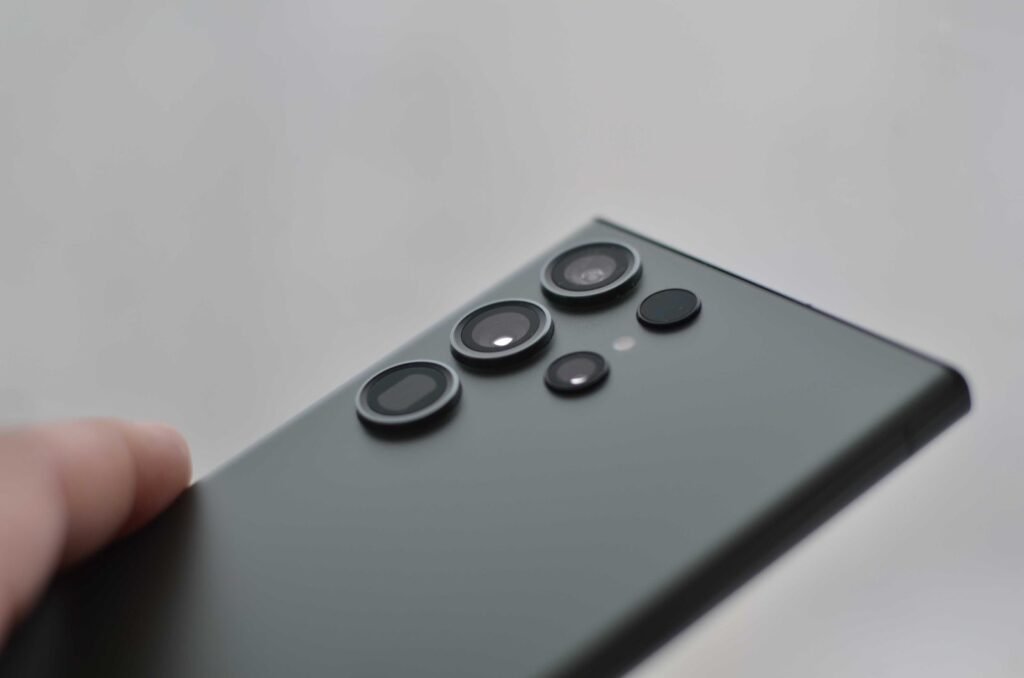
The camera arrangement is where the Find X10 stops behaving like a base model. There are three rear cameras, and two of them are 200MP.
| Camera | Specification |
|---|---|
| Main | 200MP, 1/1.4 inch sensor, f/1.6, optical stabilization |
| Telephoto | 200MP periscope, 2.8x optical, up to 120x digital |
| Ultra wide | 50MP, f/2.0 |
| Front | 50MP |
| Tuning | Hasselblad color calibration |
The main sensor is the headline, but the periscope is the one that changes how the phone behaves. A 200MP telephoto has enough pixels to crop aggressively and still produce a usable file, which is how Oppo gets from 2.8x optical to a claimed 120x without the image collapsing immediately. Cropping a 200MP frame down to 12MP leaves you roughly 4x of extra reach before you are inventing detail.
If you want genuinely long optical reach from this family, that is the Pro Max. Oppo put three 200MP sensors in the Pro Max where last year’s phone had three 50MP ones, and it pushes further on zoom. The Find X10 gets two of those three, which is the clearest line between the models.
8,000mAh in a phone 8.4mm thick
The battery figure is the one that makes people stop and reread. An 8,000mAh cell in a 216g, 8.4mm phone would have been impossible three years ago. It is possible now for a single reason: silicon carbon anodes hold far more lithium per unit of volume than graphite does, which has let Chinese manufacturers add capacity without adding thickness.
Charging is where the Find X10 shows its position in the range. It takes 80W wired and 50W wireless, which is quick, but OnePlus is pushing 9,000mAh at 100W on the OnePlus 16. Filling 8,000mAh at 80W takes meaningfully longer than filling 5,000mAh at the same rate, so expect a slower full charge than the brochure instinct suggests, with the compensation that you will need to do it less often.
Oppo also kept the ingress protection high, with both IP68 and IP69 ratings. IP69 covers high pressure water jets, which is a step beyond the IP68 immersion rating most flagships stop at.
The display numbers everyone quotes wrong
Here is the second correction. You will see the Find X10 described as a 2,000 nit screen and as a 3,600 nit screen, and both figures appear in reputable places. Both are real, and they measure different things.
| Brightness figure | What it means |
|---|---|
| 800 nits typical | Full screen white in normal use. This is the number you live with. |
| 2,000 nits high brightness | Outdoor mode, full screen, in direct sun |
| 3,600 nits peak | A small highlight area in HDR content only |
Peak brightness on a tiny patch of an HDR frame is a legitimate engineering achievement and an almost useless shopping metric. When you are squinting at a map on a bright afternoon, the 2,000 nit figure is what is working for you, and the 800 nit figure is what you see indoors.
The rest of the panel is straightforward and good: 6.59 inches, 1.5K resolution at 1272 by 2768, LTPO with a refresh rate that scales up to 144Hz. For a phone positioned below a Pro Max, a 144Hz LTPO panel is generous.
What it will cost
| Market | Find X10 | Status |
|---|---|---|
| China, 12GB and 256GB | 5,499 yuan | Official |
| China, 12GB and 512GB | 5,999 yuan | Official |
| Europe | Around 900 euros | Leaked target |
| India | Around 90,000 rupees | Leaked target |
| United States | Not sold | Oppo does not retail here |
Find X10 against Find X10 Pro Max
| Find X10 | Find X10 Pro Max | |
|---|---|---|
| 200MP sensors | Two | Three |
| Chipset | Dimensity 9600M | Dimensity 9600 Pro |
| Battery | 8,000mAh | 8,000mAh |
| China starting price | 5,499 yuan | 6,799 yuan |
| Leaked global target | About 900 euros | About 1,600 euros |
That last row is the whole argument. The Pro Max costs roughly 700 euros more for a third 200MP sensor, more zoom and a faster chip, with the same battery. Unless long reach photography is the reason you are buying a phone, the Find X10 looks like the better value by a wide margin, which is an unusual thing to be able to say about a base model.
Frequently asked questions
When is the global launch date?
Oppo has teased an international launch without naming a day. Leaks and retail listings point to October 21, possibly October 22, with availability through late October. Treat the date as expected rather than confirmed.
Does the Find X10 have a Dimensity 9500 or a 9600M?
A Dimensity 9600M, built on 3nm with the identifier MT6993. Spec pages listing a 9500 are misreading a benchmark revision field. The global Geekbench entry confirms the 9600M.
Is the global version worse than the Chinese one?
Only in memory, as far as anyone can currently tell. The global model has shown 12GB of RAM, while China offers up to 16GB. The chip, cameras, battery and display appear unchanged.
Will it be sold in the United States?
No. Oppo does not retail phones through US channels, and an imported unit would be missing cellular bands that American carriers rely on, particularly low band coverage.
How bright is the screen really?
800 nits in typical full screen use, 2,000 nits in outdoor high brightness mode, and 3,600 nits on small highlights in HDR content. The 2,000 nit figure is the one that matters in daylight.
Is 2.8x enough telephoto?
For portraits and most everyday zoom, comfortably. The 200MP sensor gives you room to crop to roughly 10x before quality falls apart. If you regularly shoot wildlife or stage photography, the Pro Max is the one to look at.
Is the Find X10 E coming to Europe?
It is not expected to. Global listings show only the Find X10 and the Find X10 Pro Max, which means the entry price abroad is set by the 5,499 yuan model rather than the 4,999 yuan one.
The bottom line
The Find X10 is the clearest example yet of something that has been happening quietly all year. The gap between a Chinese brand’s base flagship and its halo model has narrowed to the point where the cheaper phone is the sensible purchase, and the gap between either of them and a comparably priced phone sold in the West has widened in cameras and battery.
Two 200MP sensors, 8,000mAh, 144Hz LTPO, IP69, 80W wired and 50W wireless, for a leaked 900 euros. The caveats are real: the memory ceiling drops outside China, the periscope is short at 2.8x, charging is slower per milliamp hour than the direct competition, and nobody in the United States can buy one. But if Oppo lands anywhere near that leaked price when it goes global later this month, the Find X10 will be one of the more quietly compelling phones of 2026, and the Pro Max will have a hard time justifying its 700 euro premium.
Sources and further reading
- 9to5Google: Oppo Find X10 goes official, here are the full specs
- FoneArena: Oppo Find X10 and Find X10 E announced, price and specifications
- Gizmochina: Global Oppo Find X10 shows up on Geekbench
- 91mobiles: Global Oppo Find X10 appears on Geekbench ahead of international launch
- GSMArena: Oppo Find X10 full phone specifications
- Tech Advisor: Oppo Find X10 release date spotted
- Notebookcheck: Global Find X10 Pro Max launch window and price target leaked
About this article: GeekBlog covers U.S. technology news, AI, phones, smartwatches and gaming. Every story is written and checked under our Editorial Policy. Spotted a mistake or have a story tip? Contact our editors.
