

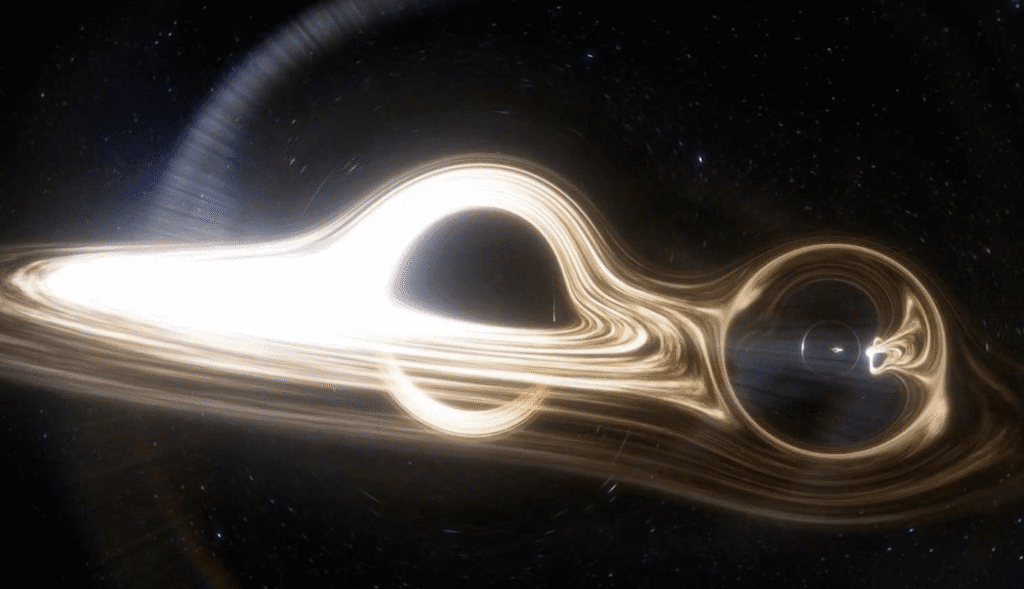
A historic breakthrough in black hole astronomy
Astronomers have achieved a groundbreaking milestone — capturing the first image of two black holes orbiting one another, solving a 40-year mystery and confirming the existence of binary black hole systems. The discovery, published in The Astrophysical Journal on October 9, 2025, reveals two supermassive black holes bound in a 12-year orbital dance at the heart of quasar OJ287, located about 5 billion light-years from Earth.
This achievement marks a major leap beyond previous imaging successes, which focused only on single black holes in the Milky Way and the Messier 87 galaxy. An international team led by Mauri Valtonen of the University of Turku, Finland, used cutting-edge radio telescope technology to distinguish the two black holes — which in optical observations appeared as a single point of light.
“For the first time, we’ve obtained a direct image of two black holes orbiting each other,” said Valtonen. “The black holes themselves are completely dark, but we can detect them through their particle jets and the glowing gas that surrounds them.”
The larger black hole is estimated to have a mass 18 billion times that of the Sun, while its smaller companion weighs around 150 million solar masses. Periodic fluctuations in the system’s brightness, first noted in 1982 by then-student Aimo Sillanpää at the University of Turku, provided the earliest hints of OJ287’s binary nature.
Revolutionary radio telescope technology
The breakthrough required unprecedented resolution — 100,000 times greater than what optical imaging can provide. The team achieved this using the RadioAstron satellite, operational from 2011 to 2019, which extended the reach of radio antennas up to half the distance to the Moon. Combined with 27 ground-based radio observatories across the globe, this created a virtual telescope five times the size of Earth.
“The satellite’s antenna stretched halfway to the Moon, dramatically improving image resolution,” Valtonen explained. “In recent years, we’ve only had access to ground-based telescopes, where image clarity is far more limited.”
Discovery of a “waving tail” phenomenon
The research also uncovered a previously unknown behavior in black hole jets. The smaller black hole produces a twisted jet resembling a “waving tail” or a “spinning garden hose”, caused by its rapid orbital motion around its massive partner. As the smaller black hole moves along its orbit, the jet’s direction changes, creating a dynamic, spiraling pattern that scientists expect to monitor closely in the coming years.
This discovery not only confirms the long-suspected existence of binary supermassive black holes, but also provides critical insights into the origins of gravitational waves — ripples in spacetime generated when such systems eventually merge. These findings will help refine future detections by observatories like LIGO, deepening our understanding of the universe’s most extreme phenomena.
