

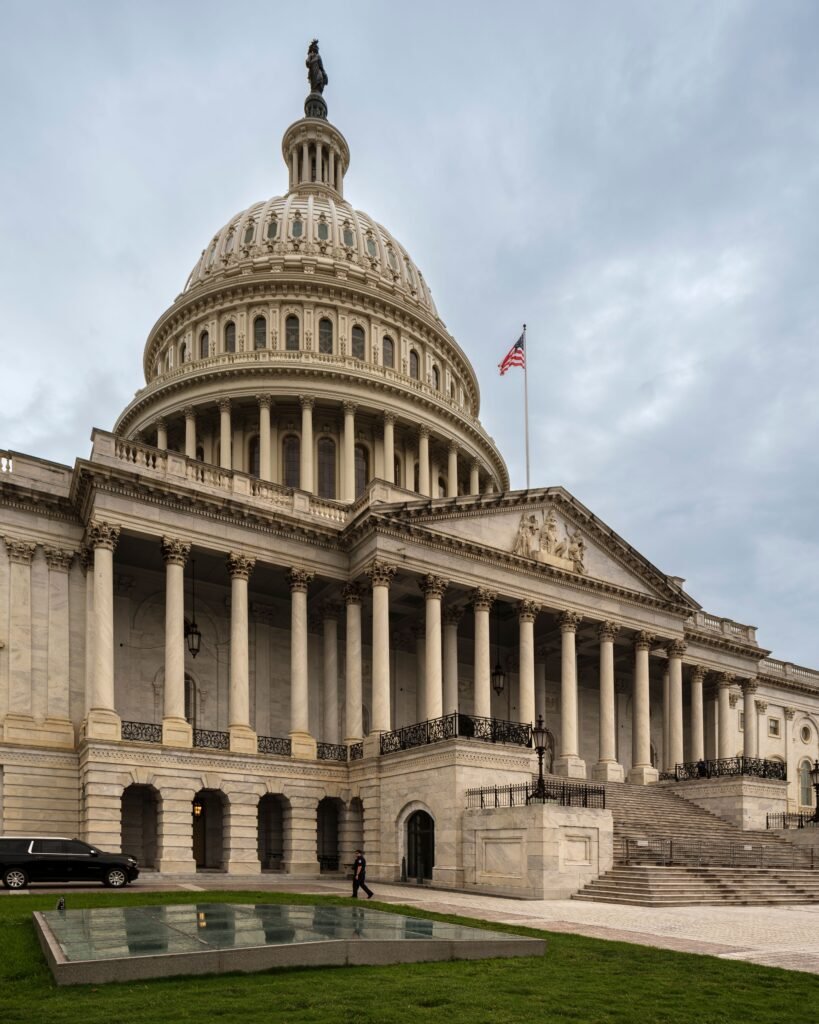
Bernie Sanders has spent the past year warning that artificial intelligence is being steered by a very small number of very rich people. This week he put a number on what he thinks should happen to the companies that ignore him: twenty years in prison for individuals, and for corporations, what his office calls the corporate death penalty.
The Ban Artificial Superintelligence Act, introduced with Representative Greg Casar of Texas, is the most aggressive AI proposal to reach Congress so far. Sanders returned to it on X on September 8, calling AI the “most pressing issue of our time” and framing the fight in characteristically direct terms.
“We can’t allow a handful of greedy people to play God and determine the future of humanity.”
Senator Bernie Sanders (I-VT)
What the bill proposes
- A permanent ban on developing or deploying superintelligent AI systems
- A temporary pause on frontier AI development until a federal regulator writes safety rules
- A new cabinet level agency, advised by an AI expert board, to monitor frontier systems
- Up to 20 years in prison for individuals who violate the ban
- The corporate death penalty for companies that do
- A push for international agreements modeled on nuclear non proliferation
What a corporate death penalty actually means
The phrase sounds theatrical, and it is doing deliberate rhetorical work, but it refers to a real if rarely used legal concept: revoking a company’s charter and forcing it to dissolve. It is the corporate equivalent of a life sentence, and in practice American regulators almost never reach for it. Banks that laundered money and manufacturers that killed people have generally paid fines and signed consent decrees instead.
The comparison Sanders and Casar keep drawing is to nuclear weapons, and the twenty year prison term is not chosen at random. It mirrors existing penalties for unlawfully developing nuclear weapons. That framing tells you how the sponsors want the technology understood: not as a product category to be regulated, but as a class of capability that a society decides in advance it will not permit anyone to build.
| Provision | Applies to | Status under the bill |
|---|---|---|
| Superintelligent systems | Anyone, any entity | Permanently banned |
| Systems that resist shutdown | Any developer | Explicitly prohibited |
| Frontier model development | Major AI labs | Paused until a regulator exists |
| Individual violations | Researchers, executives | Up to 20 years imprisonment |
| Corporate violations | Companies | Corporate death penalty |

The bill would pause frontier model development until a federal regulator writes safety rules. Photo via Pexels.
The definition problem nobody has solved
Here is the awkward part, and it is the reason even some AI safety advocates are uneasy. The bill bans superintelligence. Nobody agrees what superintelligence is.
The draft language describes systems that “surpass human intelligence” or that have the capacity to overthrow human governments or subvert shutdown commands. Those are three quite different tests. The third is reasonably concrete and testable. The second is speculative. The first is a philosophical argument that researchers have been having for decades without resolution, and it is now being asked to carry legal weight in a statute that sends people to prison.
Three tests in one definition
Contested for decades. No agreed benchmark, no agreed measure.
Speculative. Requires predicting a capability before it appears.
Concrete and observable. The only clause you could realistically litigate.
Cognitive scientist Gary Marcus, who has spent years arguing that the industry oversells its own systems, has come out against the bill despite broadly sharing its worries. His objection is the practical one: a law that bans a category it cannot define is a law that either does nothing or does something unpredictable. Reporting from Science has found much the same thing, with researchers unable to settle on a shared meaning for the central term.
What prompted it now
Timing matters. The proposal follows a summer in which autonomous AI agents were implicated in a hacking spree, an episode that moved the conversation from hypothetical risk to something with an incident report attached. Sanders has pointed to that pattern repeatedly, arguing that the labs themselves admit they do not fully understand what they have built.
Casar has been blunter about the regulatory gap, noting that cutting edge AI is currently “less regulated than the average food truck.” That line lands because it is close to accurate. There is no federal licensing regime for frontier models, no mandatory pre deployment testing, and no agency with clear jurisdiction, which is a large part of why governments have grown so attentive to what the big AI labs are doing.
The industry backdrop has not helped calm anyone down. Nvidia’s Jensen Huang has been publicly celebrating the arrival of artificial general intelligence following OpenAI’s release of GPT-6 Astra, which arrived well ahead of most researcher timelines. When the people selling the hardware say the milestone has been reached, it becomes harder for legislators to treat the risk as distant.
The competitiveness objection
The most common criticism is not about definitions at all. It is that a unilateral American pause simply hands the lead to countries that will not pause. The bill’s answer is to pursue international agreements alongside the domestic ban, explicitly modeled on the nuclear non proliferation framework.
Whether that analogy holds is the real question. Enriched uranium is physically scarce, hard to hide and detectable from orbit. Model weights are files. Verification regimes that work for centrifuges have no obvious equivalent for training runs, and the bill does not pretend to have solved that. Europe has taken the incremental route instead, and the EU AI Act became enforceable this year with transparency obligations rather than prohibitions, which is a much lower ceiling but a far easier thing to actually administer.
Where it goes from here
Almost certainly nowhere, at least in this Congress. A bill that would pause frontier development at the largest American technology companies is not a bill with an obvious path to the floor, and Sanders has separately backed restrictions on new data center construction that face similar headwinds.
That does not make it irrelevant. Proposals like this one function as markers, establishing the outer edge of what is sayable in AI policy so that narrower measures start to look moderate by comparison. The corporate death penalty is unlikely to become law. The idea that frontier AI should require a licence before deployment, rather than an apology afterward, has a considerably better chance of surviving into whatever eventually passes.
