

Update, September 25, 2026: The September 9 event has happened. For what Apple actually announced, see our coverage of Apple’s first foldable, the iPhone Duo and the Apple Watch Series 12 and Ultra 4 reviews roundup.
Featured image source: Pexels (free to use)
On Wednesday at 10 a.m. Pacific, John Ternus will walk onto the stage at Apple Park and run a keynote as chief executive for the first time. He took the job on September 1. He gets eight days of settling in before the biggest scheduled moment on Apple’s calendar.
The event is called “Surprise and Shine,” and the surprise is not really the foldable. Everyone has known the foldable was coming for a year. The surprise is what is missing from the lineup behind it.
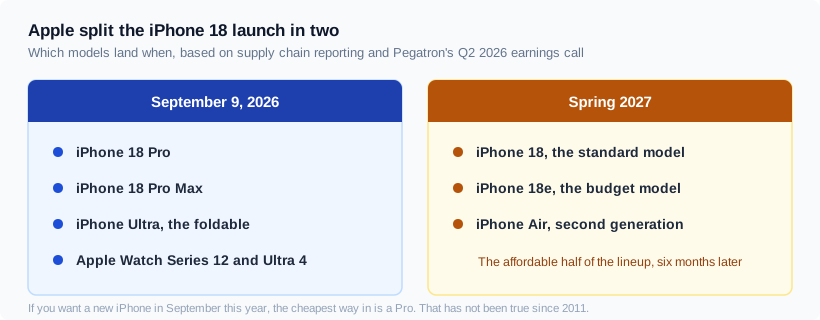
There will be no standard iPhone 18 on Wednesday. For the first time since 2011, if you want a new iPhone this fall, the cheapest way in is a Pro.
What to expect on September 9
- iPhone 18 Pro and 18 Pro Max: A20 Pro chip on a 2nm process, variable-aperture main camera, smaller Dynamic Island, Apple’s own C2 modem.
- iPhone Ultra: the first foldable iPhone, book-style, titanium, expected to start near $1,999.
- Apple Watch Series 12 and Ultra 4: continuous heart rate monitoring is the headline sensor change.
- Possible extras: the long-rumored home hub, a new Apple TV 4K, an updated HomePod mini.
- Not coming until spring: the iPhone 18, iPhone 18e and the second-generation iPhone Air.
The split is the actual news
Apple has broken its own release rhythm. The Pro models and the foldable arrive this month. The affordable half of the lineup, the standard iPhone 18 and the budget 18e, slips to the first quarter of 2027, along with the second-generation iPhone Air.
This is not a rumor with one shaky source behind it. Pegatron, one of Apple’s manufacturing partners, said as much on its Q2 2026 earnings call, which is about as close to confirmation as this kind of thing gets before Apple says it out loud.
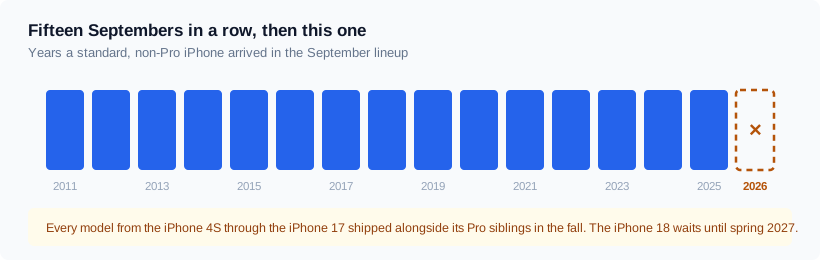
To understand how unusual that is, it helps to count. Every iPhone from the 4S in 2011 through the iPhone 17 last year launched in September next to its Pro siblings. Fifteen consecutive autumns where the entry-level model and the flagship shared a stage. That streak ends Wednesday.
Why Apple would do this
The reported logic is straightforward and slightly cynical: prioritize production and shipping capacity for the three highest-margin phones, and let the cheaper models arrive when the expensive ones have finished their run.
It is a reasonable manufacturing decision. A first-generation foldable is hard to build, yields on a new hinge and a crease-free panel are unpredictable, and 2nm capacity is not infinite. Putting the Pro models and the Ultra through the factory first, alone, removes a lot of contention.
It also happens to funnel every September upgrader toward a more expensive phone. Someone who walks into a store in October wanting “the new iPhone” will find that the new iPhone starts at Pro pricing. Six months later, when the standard model arrives, the upgrade urge has usually passed or the phone has already been bought.
What the split means if you were planning to upgrade
- Waiting is now a real option. If you wanted a standard iPhone, spring is the date, and there is no point rushing a Pro purchase to avoid a wait you were not going to make anyway.
- Trade-in timing matters more than usual. Quoted values move the moment new hardware is announced, and the drop tends to land before the new phones ship.
- The 17 becomes the value pick. With no new base model, last year’s standard iPhone is the cheapest current-generation option for six months.
- Carrier promos will skew Pro. Expect aggressive Pro deals precisely because there is no cheaper new model to advertise.
The foldable, finally
The iPhone Ultra is the piece that will take up the most stage time. Expectations point to a book-style design, an outer display measuring somewhere between 5.3 and 5.5 inches, and an inner display between 7.6 and 7.8 inches. A titanium frame, an unusually thin body, and a display Apple has reportedly worked hard to make effectively crease-free.
Most estimates put the starting price near $1,999, and a Vodafone listing in Egypt leaked pricing before Apple got to it, which is a very 2026 way for a $2,000 phone to be spoiled.
Apple is roughly seven years late to foldables, which is either embarrassing or shrewd depending on your view. The company’s usual pattern is to arrive after a category’s obvious problems have been solved by someone else and then compete on execution. Samsung spent those seven years discovering what breaks. Apple gets to ship a version that has learned from it, and it arrives with a MagSafe implementation that Samsung still handles through the case rather than the phone.
The Pro upgrades worth caring about
| Change | What it does | Who notices |
|---|---|---|
| Variable aperture camera | Physically adjusts how much light reaches the sensor rather than faking depth in software | Anyone who shoots in mixed light or wants real background separation |
| A20 Pro on 2nm | Speed and efficiency gains from a new process node | Heavy users, gamers, and battery life over a full day |
| C2 modem | Apple’s own cellular silicon replacing a third-party part | Nobody, if it works. Everybody, if it does not |
| Smaller Dynamic Island | Reclaims screen area at the top of the display | Anyone who has resented the cutout since 2022 |
The C2 modem is the quiet risk. Apple has spent years and a great deal of money getting off third-party cellular silicon, and modems are the component where a small regression produces a very loud customer response, because it shows up as dropped calls rather than a slightly lower benchmark.
The watches, and the rest
Apple Watch Series 12 and Ultra 4 are both expected. Continuous heart rate monitoring is the sensor story, and the Ultra 4 is reported to arrive thinner with roughly double the sensor count, which is a larger hardware change than the Ultra line usually gets.
Beyond that, the maybes: a home hub Apple has been rumored to be building for years, a refreshed Apple TV 4K, and an updated HomePod mini. Smart home is the category where Apple has consistently underdelivered relative to its own ambitions, so treat these as possible rather than expected.
What Wednesday is really about
Ternus is not an unknown quantity inside Apple. He ran hardware engineering, which means most of what he will present on Wednesday was built under him. What he has not done is stand in Tim Cook’s spot and be the person the company is measured against.
The compensation structure says something about how the board sees the job. Ternus keeps most of his $58 million package only if the stock performs, which is a fairly direct instruction about priorities. Launching a $2,000 phone and pushing the cheap models to spring is, whatever else it is, a decision that suits that instruction.
Bottom line
Wednesday delivers the foldable everyone has been waiting for and the Pro upgrades that will sell the most units. It also quietly formalizes something Apple has been drifting toward for years, which is that the September event is now a premium event and the affordable phones get their own slot later.
If you were going to buy a Pro, nothing changes. If you were going to buy the normal one, your phone just got a six-month delay, and nobody is going to say that from the stage.
