

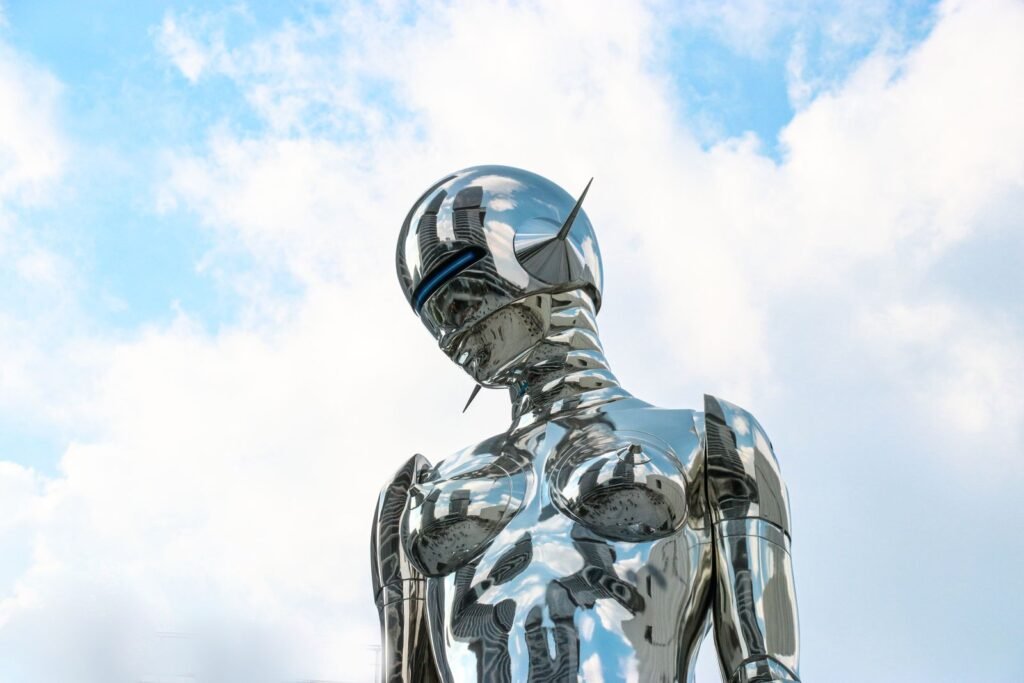
For three years, the internet has argued about why Bianca Censori almost never speaks in public. Her answer, it turns out, is a machine. The Australian architect and artist has unveiled a 10-foot robotic version of herself that will answer visitors’ questions in her own voice.
There’s a catch, and it’s the part everyone is talking about. To get an answer, you have to kneel.
The robot is the centerpiece of Bio Pop 2: Bianca Is My Baby Doll, which opens in New York on December 14. As UNILAD Tech reports, the reveal has left people somewhere between impressed and deeply uncomfortable.
The short version
- The piece is a 10 foot, 25-axis robotic self-portrait that took about five years to build.
- Visitors ask it questions and it answers in Censori’s voice.
- You must kneel before her to take part.
- It opens in New York on December 14, with limited spots handled through an RSVP page.
- It’s the second of a planned seven-part series of exhibits.
“For the first time ever, Bianca Censori speaks”
Censori announced the project on Instagram with a close-up of the robot’s face and a line in all caps: “FOR THE FIRST TIME EVER, BIANCA CENSORI SPEAKS.” The joke lands because her silence has become part of her public image. She is usually photographed, almost never quoted.
That isn’t entirely accurate, of course. Footage from a 2022 summit in Paris shows her talking about her work as a lead architectural designer at Yeezy, and she gave a long interview to Vanity Fair last year. But she has stayed notably quiet through Kanye West’s many controversies. That makes the idea of a giant mechanical Censori finally doing the talking feel very deliberate.
What “25-axis” actually means
In robotics, an axis is one independent joint that can move, like an elbow bending or a neck turning. Each one needs its own motor and control. The more axes, the more natural a robot can look, and the harder it is to build.
How 25 axes compares
Independent moving joints, approximate.
A single human hand has roughly as many degrees of freedom as the entire 10-foot robot.
Twenty-five axes is a lot for an art piece, but it is modest for a full humanoid. It suggests the motion is focused where an audience will notice, likely the head, face and arms, rather than walking. Companies building real working humanoids, like XPeng with its Iron robot on a car assembly line, are chasing far more joints for far more practical reasons.
What nobody has explained yet is the brain behind it. The announcement doesn’t say whether the robot runs a live AI model trained on Censori’s voice and views, or plays back answers she recorded in advance. That difference matters. One is a puppet with a script. The other is a cloned personality talking to strangers in real time.
Why the kneeling is the whole point
Most of the reaction online has focused on the kneeling rule. “I’m not kneeling before anyone except God real talk!” one commenter wrote. Another simply asked, “Cool but the kneeling?” A third pointed out they had heard her say “at most 10 words in 3 years.”
But the discomfort seems to be what she’s after. The first Bio Pop, staged in Seoul in December 2025, turned women into living furniture, with performers styled to look like Censori draped across sculptural pieces. Its theme was how domestic spaces confine and display women’s bodies. Bio Pop 2 flips that. The woman who is usually looked at becomes a towering figure that people have to bow down to.
| Bio Pop (2025) | Bio Pop 2 (2026) | |
|---|---|---|
| City | Seoul | New York |
| Centerpiece | Performers as human furniture | 10 foot robotic self-portrait |
| Censori’s role | Copied in the bodies of others | Copied in a machine that speaks |
| Audience | Looks at the bodies | Kneels and asks questions |
Robots in galleries aren’t new. Ai-Da, the humanoid “robot artist,” has had her paintings sold at auction, and Hanson Robotics’ Sophia spent years on talk shows. What’s different here is that the robot isn’t pretending to be its own person. It is a stand-in for a real, living and very famous woman.
The voice question nobody is asking yet
A robot that talks “in her voice” raises a question that will matter well beyond one art show. Voice cloning has become cheap and convincing, and laws are only starting to catch up. Tennessee’s ELVIS Act, passed in 2024, was the first US law to protect a person’s voice from being copied by AI without permission.
Censori owns her voice here, so consent isn’t an issue. But if the robot does use an AI model, visitors will be hearing words she may never have said herself. Earlier this year, sources told Globe that she had recorded “all of it” about her experiences, in voice notes and in writing. Whether any of that ends up in the robot’s answers is anyone’s guess.
Want to go?
The show opens December 14 in New York. In-person spots are limited and requested through the RSVP page on Censori’s exhibition website. The exact venue hasn’t been widely published yet, so check there before planning a trip. Bring knee pads, apparently.
A seven-year plan
Censori has framed Bio Pop as a long project, with seven exhibits planned over roughly seven years, running into the early 2030s. If the first one was about being watched and the second is about being heard, it’ll be interesting to see where she takes the idea next.
It also fits a bigger trend. As humanoid robots move from labs into public spaces, people are starting to argue about who they represent and who gets to control them. Back in Europe, a group of thirty robots even marched on Poland’s digital ministry to push for rules on AI. Censori’s version is stranger and more personal, but it asks a similar thing. When a machine wears a real person’s face and speaks with her voice, who exactly are you talking to?
About this article: GeekBlog covers U.S. technology news, AI, phones, smartwatches and gaming. Every story is written and checked under our Editorial Policy. Spotted a mistake or have a story tip? Contact our editors.
