

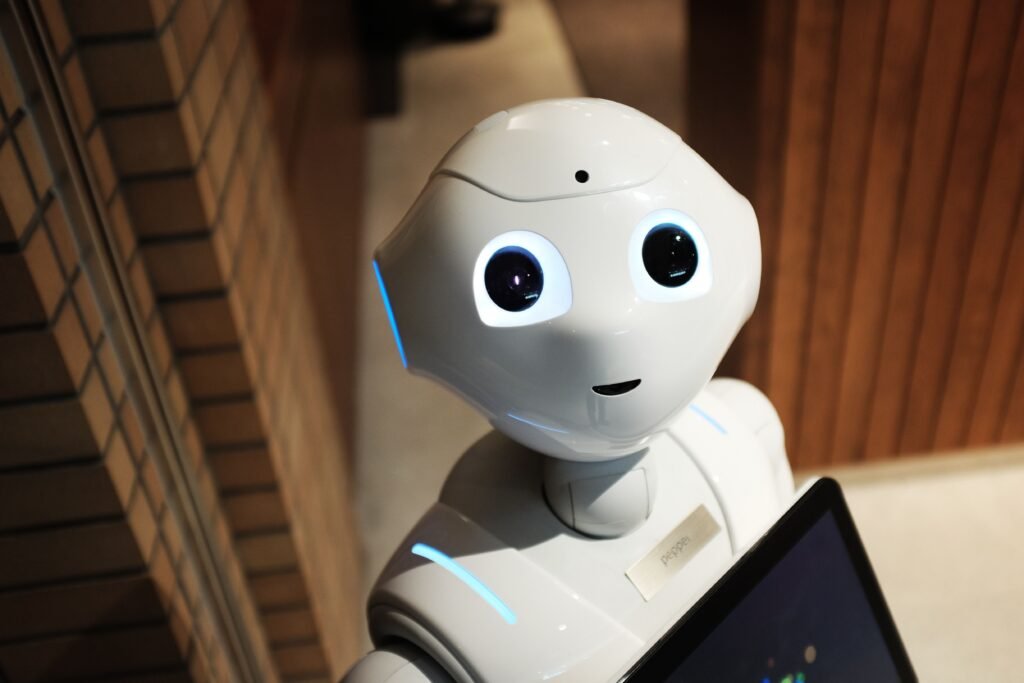
The chants came out of loudspeakers rather than lungs, and the marchers had charging ports, but the demands were the sort you would hear at any picket line. Defend workplaces. Time for rules. Don’t wait, regulate.
Roughly thirty robots gathered outside Poland’s Ministry of Digital Affairs in Warsaw on Monday, in what the organizers are calling the first demonstration of its kind. Some walked on two legs. Some trotted on four, in the Boston Dynamics dog shape that has become shorthand for the whole category. All of them were there to argue that machines like themselves should be regulated before they take any more jobs.
The short version
- About 30 robots demonstrated outside Poland’s digital affairs ministry in Warsaw
- The event was staged by a group called Democratism, first reported by AFP
- Chants played through loudspeakers included “don’t wait, regulate”
- Poland’s digital affairs minister turned up and agreed with the premise
- The organizer runs a robotics company and a recruitment agency, which critics have noticed
- The demand is labour law, not a ban on the technology
What actually happened on the street
The group behind it, Democratism, describes its aim as starting a public debate on how AI and robotisation affect the labour market. The robots came from Delta Robots, a Polish firm that has been building humanoid and quadruped machines for more than a decade, and they were driven rather than autonomous in any meaningful protest sense. Nobody is claiming the machines chose to be there.
That is the point, though, and the organizers were fairly open about it. Humans deployed robots to make an argument about robots, on the theory that a line of walking machines outside a government building communicates something a press release cannot. One of the units on site, an Agibot A3, was given a statement to deliver.
“The robots present here are meant to show that this technology is already a reality.”Statement delivered by an Agibot A3 at the Warsaw demonstration
It worked as theatre. Photographs of a quadruped robot standing next to a protest banner travel further than another think tank paper about workforce displacement, and the Polish government noticed within the hour.
| Detail | What we know |
|---|---|
| Where | Outside the Ministry of Digital Affairs, Warsaw |
| How many | Around 30 machines, bipedal and quadruped |
| Organizer | Democratism, fronted by Grzegorz Kulis |
| Hardware supplier | Delta Robots, a Polish manufacturer |
| The demand | Employment rules for AI and robot displacement, not a ban |
| Government response | The digital affairs minister came out and broadly agreed |
The minister showed up and agreed
Krzysztof Gawkowski, Poland’s digital affairs minister, came out to speak with the organizers rather than waiting them out. His concern was less about robots taking factory jobs and more about what happens when general purpose models are dropped into physical bodies that keep improving.
“Uncontrolled AI models, implemented into humanoids that will also keep evolving as robotisation moves forward, are a major problem.”Krzysztof Gawkowski, Polish minister of digital affairs
Poland is an interesting place for this argument to land. It has one of the larger manufacturing bases in the European Union, a fast growing outsourcing and shared services sector that employs a lot of people doing exactly the cognitive work generative models are aimed at, and it sits inside a bloc that has already passed the AI Act. The complaint is not that there are no rules. It is that the rules cover product safety and risk categories, and say very little about what an employer owes a worker replaced by software.

The demands were ordinary labour demands. The marchers were not. Photo via Pexels.
What the organizers are asking for
Grzegorz Kulis, who put the event together, framed the ask narrowly. Not a moratorium, not a ban, but employment protections written before the displacement rather than after it.
“We particularly want to address the issue of the potential replacement of people both by humanoid robots and by artificial intelligence in cognitive work. If we don’t react now, we may soon have a problem.”Grzegorz Kulis, organizer
He wants what he calls rules and regulations that act as a shield protecting workers, and he argues that the fact robots can already move through a city and stage a demonstration is itself the evidence. That is a rhetorical move, but it is not a dishonest one. The machines did walk down a street.
The conflict of interest is real and worth stating
Kulis is the chief information officer of a robotics company and the chief executive of an employment agency. He also served two terms on Poland’s Labour Market Council at the Ministry of Family, Labour and Social Policy, which is where the policy fluency comes from.
Critics have pointed out the obvious tension. A man who sells robots and sells staffing services benefits from attention on both sides of the trade, and a protest that puts his machines on the evening news is not a neutral act. Some have called it scare tactics dressed as advocacy.
The fairer reading is that the interest cuts both ways rather than in one direction. Someone running a recruitment business has a direct commercial stake in there still being humans to place, and someone inside the robotics industry has better visibility than most on how fast capability is moving. Neither of those makes the argument wrong. Both are worth knowing before you decide how much weight to give it.
Three separate arguments, often blurred together
The Warsaw protest was aimed squarely at the middle category, even though the imagery came from the first and the coverage often lands on the third.
Where this sits in a very loud year
The timing is not accidental. Regulation of AI has moved from conference panels to legislatures in a matter of months, and the proposals on the table are getting less cautious. In the United States, Bernie Sanders has put forward a bill that would effectively impose a corporate death penalty on labs that cross certain capability lines, which is a very different proposition from Polish employment law but draws on the same anxiety.
On the hardware side, the machines really are arriving. This week XPeng put a humanoid robot on a working assembly line, something Tesla’s Optimus has still not managed in public. The gap between demonstration and deployment is closing faster than most labour ministries move.
The awkward complication is that the economics have not settled. We looked earlier this year at why AI can cost more than the human workers it replaces and companies keep cutting anyway, which suggests the driver is not always pure efficiency. If layoffs are partly a narrative for investors rather than a spreadsheet result, then labour law is a strange tool to reach for, and also possibly the only one available.
Whether any of it matters
A staged protest by thirty machines will not write a statute. What it does is make a slow moving argument briefly impossible to ignore, and on that measure it worked, because a cabinet minister came outside to answer it and the wire services carried the pictures worldwide.
The test is what happens in six months, when the photographs have stopped circulating and someone has to draft language about retraining obligations, notice periods and severance in industries where the replacement is a subscription rather than a machine. That work is dull, contested and largely invisible. It is also the entire point, and no robot is going to do it for us.
