

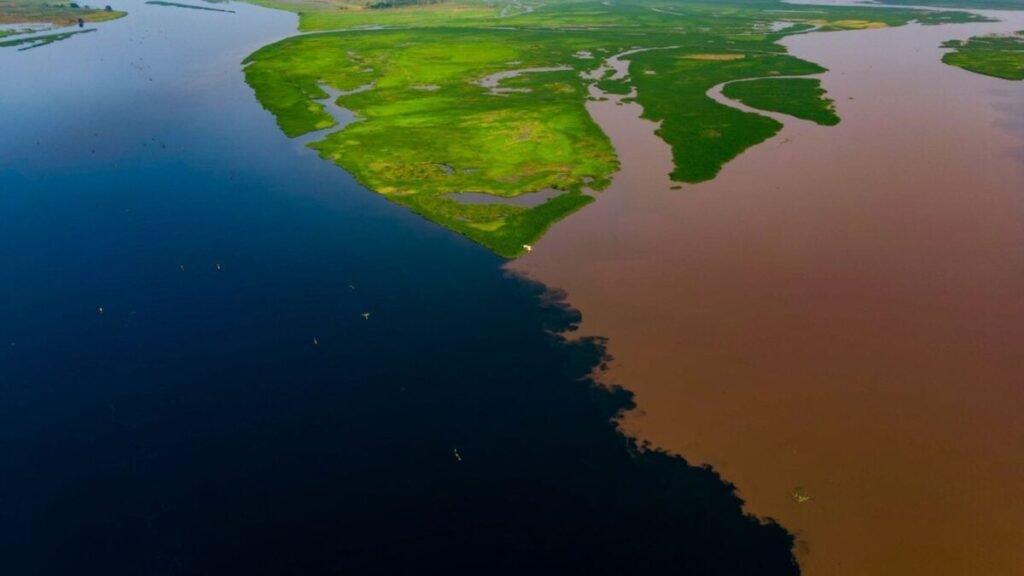
Often called the “lungs of Africa,” the Congo Basin is the world’s largest land-based carbon sink. For thousands of years, its swamps and peatlands have played a key role in regulating the global climate by soaking up vast amounts of carbon, but now, a troubling shift may be underway.
A study published Monday in the journal Nature Geoscience found that two lakes within the Basin—Lac Mai Ndombe and its smaller neighbor, Lac Tumba—are releasing carbon in the form of planet-warming carbon dioxide (CO2). While some of the CO2 comes from recently produced plant matter, up to 40% stems from the Basin’s ancient peat.
The swamps and peatlands of the Congo Basin only cover 0.3% of Earth’s land surface, but they hold 30 billion metric tons of carbon—one-third of the amount stored across all tropical peatlands. Scientists have long assumed that this carbon would remain locked inside the peat for millennia, but these new findings suggest otherwise.
“As for what this means for the peat’s stability, that is the 30-billion-tonne question!” lead author Travis Drake, a carbon biogeochemist at ETH Zürich, told Gizmodo in an email. “It is entirely possible that this is a natural, balanced cycle: The vast peatlands slowly release carbon from below while sequestering a comparable amount from above, resulting in no net loss,” Drake explained. “However, the more alarming possibility is that climate or land-use changes are actively destabilizing the system, causing it to lose its stored carbon.”
150 gigatons of ancient carbon each year
The role that the Congo Basin’s peatlands play in regulating the global carbon cycle, and thus the climate, is poorly understood. That’s largely because the central part of the Basin is difficult for researchers to access due to a lack of road infrastructure. To overcome this, Drake and his colleagues used the natural waterways as their highway.
Traveling aboard a large ship that served as both their living quarters and a floating laboratory, they navigated the Fimi River—a large tributary of the Kasaï—to reach the southern point of Lake Mai Ndombe.
Both Mai Ndombe and Tumba are large, shallow blackwater lakes surrounded by swamp forests with thick peat deposits underneath. “Blackwater” is a colloquial term for a river or lake with a high concentration of dissolved organic matter, which gives the water a deep brown color resembling strong tea, Drake explained. The subsurface peat layer has accumulated over thousands of years as plant material has sunk to the wetland floor and partially decomposed.
The researchers collected and analyzed water samples from both lakes, finding that 39% of the carbon in Lake Mai Ndombe and 40% in Lake Tumba comes from peat. This suggests that the breakdown of long-stored peat is a significant source of CO2 emissions from these lakes. The researchers estimate that Lake Mai Ndombe alone may be releasing more than 150 gigatons of ancient carbon into the atmosphere each year.
A potential climate feedback loop
How this carbon is escaping from the peatlands remains unclear, but Drake’s team believes it could be related to microbial activity deep within this organic layer.
As microbes feed on the stored carbon, they convert it into methane through a process called methanogenesis. The researchers suspect that this subsurface methane then travels up through deep soil flowpaths into the lake, where it reacts with oxygen to produce CO2.
“While we have found isotopic evidence in the lake supporting this, we still need to investigate the internal peat dynamics to confirm the full pathway,” Drake said.
It’s possible that climate change is also playing a role in mobilizing carbon from the peat. As rising global temperatures drive more frequent and prolonged droughts, this could cause the peatlands to partially dry out, exposing them to more oxygen and promoting rapid decomposition, Drake explained.
“There is actually paleoenvironmental evidence from regional peat cores showing that a similar climate-driven destabilization event has happened in the past, leading to massive losses of organic carbon,” he said.
If human-driven warming has led to a similar event today, a feedback loop may be taking shape. “Naturally, the CO2 released from such an event today would exacerbate climate change, though still to a lesser degree than the anthropogenic emissions currently driving the rapid buildup of CO2 in our atmosphere,” Drake explained.
He and his colleagues worry that rising temperatures and land use change could transform the Congo Basin’s blackwater lakes into sources of greenhouse gases, but how close they are to reaching this potential tipping point remains unclear. Their next project, which will investigate the mechanisms behind their findings and how these carbon emissions have evolved over the past 12,000 years, could offer some insight.
“Ultimately, our goal is to better constrain the carbon budget of these peatlands, establishing a baseline to assess future changes and determine their current stability,” Drake said.
Source: gizmodo.com
