

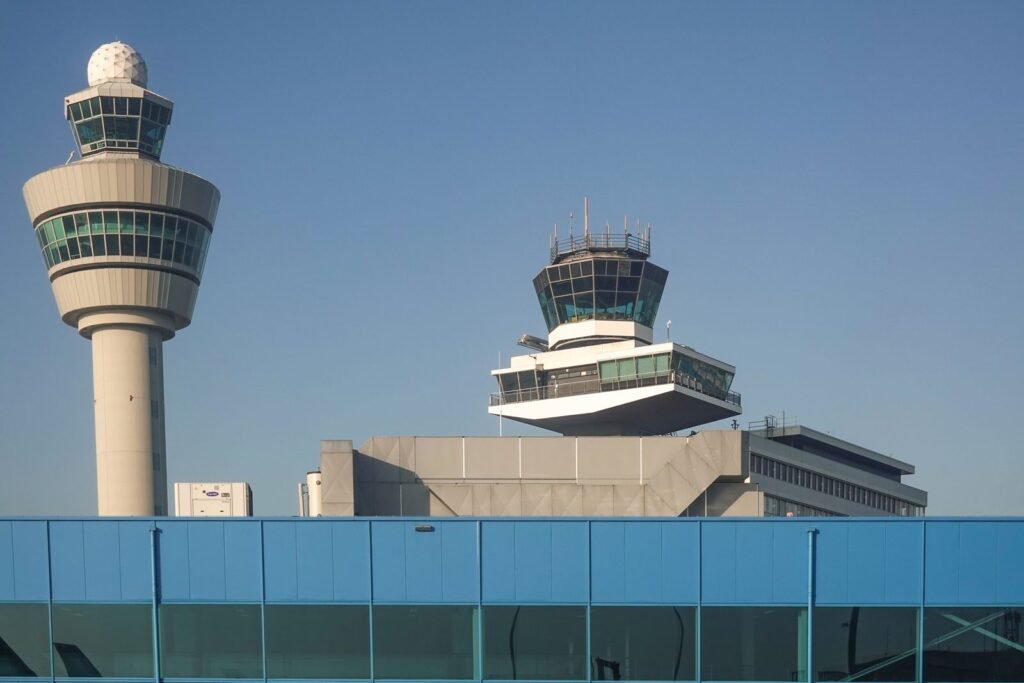
Last Friday afternoon, every departing flight in the United States was told to stay on the ground. For a little over four hours, the country’s air traffic system was effectively paused while engineers chased a failure deep inside the FAA’s telecom network. Now, with Thanksgiving less than two weeks away, the man in charge of US transportation is warning that it could happen again.
“You will have more of these, you will have more of them, unless the American people and Congress tell us to build,” Transportation Secretary Sean Duffy said at a White House press conference, as UNILAD Tech reported. He wants Congress to approve roughly $50 billion in emergency funding for a brand new air traffic control system. Here’s what actually broke, how bad the damage was, and what it means if you’re flying for the holidays.
The short version
- The FAA ordered a nationwide ground stop just before 4 p.m. ET on Friday, November 13. Airspace reopened at 8:15 p.m. ET.
- About 15,000 flights were delayed or canceled across Friday and Saturday, and the knock-on effects lasted into Sunday.
- Investigators are focused on two routers installed by contractor L3Harris during a copper-to-fiber upgrade. No sign of a cyberattack has been found.
- Duffy says the FAA still runs on “an old 1980 architecture for telecom” and wants about $50 billion to replace it.
- AAA doesn’t expect Thanksgiving travel to be disrupted unless another incident occurs.
What happened on Friday
The trouble started inside the network that connects the FAA’s air route traffic control centers, the big regional facilities that handle planes cruising between airports. Controllers began seeing intermittent communication drops and gaps in radar data. According to FAA Administrator Bryan Bedford, as many as 17 of the 22 centers were affected, although none of them went completely dark.
That was enough. With officials unable to guarantee that aircraft could be tracked and talked to normally, the FAA issued the ground stop citing “extraordinary circumstances and reasons for safety.” Planes already in the air were allowed to keep flying and land. New departures were frozen.
How the ground stop unfolded
All times Eastern, November 13 to 15, 2026
FRIDAY, AFTERNOON
Controllers report intermittent communications and radar gaps as L3Harris works on the FAA’s telecom network.
FRIDAY, 3:54 P.M.
Nationwide ground stop issued. Roughly 11,000 flights carrying more than 1.5 million passengers were still scheduled to leave US airports that evening, per Cirium.
FRIDAY, 7:05 P.M.
At least 827 flights diverted. 670 of them turned back to the airport they left from.
FRIDAY, 8:15 P.M.
Airspace reopens after more than four hours. Duffy warns the restart “is going to be slow.”
SATURDAY
Bedford says “the worst is behind us.” Thousands more cancellations as airlines reposition planes and crews.
SUNDAY, NOON
Still 3,798 delays and 1,638 cancellations within, into or out of the US, according to FlightAware.
The numbers behind the chaos
A four-hour pause doesn’t sound catastrophic until you remember how tightly airlines schedule their fleets. When a plane misses its Friday evening flight, it also misses the next one, and the crew may time out before they can fly again. That’s why the disruption snowballed well past the moment the airspace reopened.
Flight disruption after the ground stop
Delays and cancellations by day. Sources: FlightRadar24 (Friday), FlightAware (Sunday, as of noon ET)
Friday delays: ~10,000
Friday cancellations: 4,700+
Sunday delays (by noon): 3,798
Sunday cancellations (by noon): 1,638
4h+
departures frozen
17/22
control centers affected
~15K
flights disrupted Fri and Sat
827
diversions by 7:05 p.m.
Dallas Fort Worth International took the hardest hit, with 363 delays and 195 cancellations still on the board by Sunday lunchtime. Atlanta’s Hartsfield-Jackson logged 376 delays. It was the longest nationwide ground stop in 25 years, and only the second time all US departures have been halted since the September 11 attacks.
So what actually broke?
The short answer is a router, or at least that’s where investigators are looking. L3Harris, the defense and communications contractor that maintains a big chunk of the FAA’s telecom backbone, was in the middle of replacing aging copper lines with fiber optic connections. During that work, the network was flooded with an unusually high volume of connection attempts. The FAA’s preliminary finding is that excessive data traffic overwhelmed its legacy infrastructure.
Two pieces of hardware are now under the microscope: a router installed at an FAA site in Amarillo, Texas, and a second unit from El Dorado, Arkansas. When L3Harris cut those two sites off from the network, things stabilized. Both routers have been pulled and sent to L3Harris headquarters in Florida for what Duffy called “deep diagnostics testing,” with engineers from the FAA, Juniper and Cisco helping out.
“We think it was the installation or the router that was the bad actor,” Duffy said on Fox News Sunday. He added that President Trump “had the whole of government on the phone on Friday” to check for any sign of a foreign cyberattack, and that “we have no indication that that was at play here.” The FBI is still part of the investigation.
Why one router can do this much damage
Modern networks are built to route around a bad node. The FAA’s backbone is a patchwork of old and new equipment, and some of it was never designed to handle a sudden flood of traffic gracefully. When a device starts misbehaving, it can drown out legitimate data across a wide area instead of failing quietly on its own. If that sounds familiar, it’s the same basic story behind Microsoft’s day-long Outlook outage the same week, which the company also blamed on a network upgrade gone wrong.
This has happened before
Friday’s ground stop was the first nationwide one since January 2023, when the FAA’s NOTAM system crashed. That earlier outage traced back to a contractor who accidentally deleted files while syncing two databases. The pattern is hard to miss: aging systems, a routine maintenance job, and a contractor touching something that turned out to be more fragile than anyone thought.
| January 2023 | November 2026 | |
|---|---|---|
| System | NOTAM (pilot safety notices) | Telecom network linking control centers |
| Trigger | Contractor deleted files during a database sync | Router or installation fault during a fiber upgrade |
| Ground stop | Morning, roughly 90 minutes | Friday afternoon, more than 4 hours |
| Cyberattack? | No | No indication so far |
| Timing | Ordinary Wednesday | Two weeks before Thanksgiving |
In between, there were smaller scares too. In 2025, controllers handling Newark traffic lost radar and radio contact with planes for short stretches, which led to months of flight caps at one of the country’s busiest airports.
Why Duffy wants $50 billion
Duffy’s argument is simple: patching the old network piece by piece is what keeps causing these failures. “We’re still using an old 1980 architecture for telecom,” he said. “I need a brand new telecom system.” He says AT&T, Verizon and Lumen are ready to help build it, but only if Congress releases the money. Trump backed him on Truth Social, writing that much of the current system “is 50 years old” and that the work “should be done all at once, not in drips and drabs.”
The funding fight isn’t new. Here’s how the asks have grown.
Air traffic control funding: approved vs. requested
Billions of US dollars
$12.5B approved by Congress, July 2025
$30B extra requested by Duffy, September 2026
~$50B emergency ask after the ground stop, November 2026
Democrats aren’t sold. They point out that the administration still hasn’t spent billions already set aside for modernization and say there will be no blank check. Duffy’s response is that the existing money was earmarked for specific upgrades like radar, radios and electronic flight strips, not a completely new communications network. Expect this to become one of the louder fights in Washington over the next few weeks.
Should you worry about Thanksgiving?
Probably not more than usual, but it’s worth being prepared. Duffy himself said he doesn’t expect Friday’s disruption to spill into the holiday rush, and AAA has said it won’t affect Thanksgiving travel unless another incident occurs. The problem is that nobody can rule that out. The investigation into the routers is still running, and the fiber upgrade work that triggered all this hasn’t finished.
For a sense of scale, AAA counted about 6 million Americans flying domestically over last year’s Thanksgiving week. An outage like Friday’s during that window would strand a lot more people.
If your flight gets canceled, know your rights
- Refunds are automatic. Under DOT rules, if your flight is canceled or significantly changed and you don’t accept a rebooking or voucher, the airline owes you a cash refund, no matter what caused the problem.
- “Significant” means a delay of 3+ hours on domestic flights or 6+ hours on international ones.
- Hotels and meals are a different story. Airlines only promise those for problems within their control. An FAA network failure usually isn’t, so don’t count on a free room.
- Book early flights. Morning departures have fewer knock-on delays, and you have more options if something goes wrong.
- Get the airline’s app. Rebooking through the app is almost always faster than waiting in line at the gate.
If you’re heading out of the country, it’s also worth checking what onboard connectivity you’ll have to keep tabs on connections. We explained how to tell whether your flight has Starlink Wi-Fi on easyJet, and similar tools now exist for most big carriers.
The bigger picture
Friday’s ground stop wasn’t a hack, and nobody was hurt. Every plane in the air landed safely, and the system did exactly what it’s designed to do when it can’t guarantee safety: it stopped. But it also showed how much of America’s air traffic system still depends on decades-old infrastructure, and how a single bad router during routine maintenance can ripple out to more than a million passengers.
Whether Congress hands over $50 billion or not, the routers in Amarillo and El Dorado should tell us soon whether this was a one-off installation mistake or a warning about the whole network. Until then, if you’re flying for Thanksgiving, pack some patience along with the stuffing.
About this article: GeekBlog covers U.S. technology news, AI, phones, smartwatches and gaming. Every story is written and checked under our Editorial Policy. Spotted a mistake or have a story tip? Contact our editors.
