

Fairphone has been making repairable smartphones since 2013 and has spent most of that time politely explaining to Americans why they could not buy one. That ended on August 18. The Fairphone Gen 6+ is now on sale in the US for $649, unlocked, direct from the company and through Amazon.
On paper the spec sheet is unremarkable for the money. That is the entire pitch. Fairphone is not selling you a faster phone, it is selling you a phone you are still using in 2032, and the numbers behind that claim are more convincing than the marketing usually is.
The short version
- Price: $649 unlocked, sold via Fairphone’s own US store and Amazon
- Networks: AT&T and T-Mobile. Verizon is not supported
- Repairability: 12 user-replaceable modules, one screwdriver, a 10 out of 10 from iFixit
- Warranty: five years, with spare parts guaranteed through 2033
- The catch: a Snapdragon 7s Gen 4 is a mid-range chip, and no US carrier will subsidize this thing
What $649 buys
The Gen 6+ is a modest hardware bump over last year’s Gen 6, and the changes are aimed squarely at the two complaints people had.
| Spec | Fairphone Gen 6+ |
|---|---|
| Display | 6.31-inch LTPO AMOLED, just above FHD+, adaptive 10Hz to 120Hz |
| Chip | Qualcomm Snapdragon 7s Gen 4 |
| Memory | 12GB RAM, double the Gen 6 |
| Storage | 256GB UFS 3.1, with microSD expansion |
| Battery | 4,415mAh, user-removable without tools beyond a screwdriver |
| Cameras | 50MP Sony LYTIA main with OIS, 13MP ultrawide |
| Software | Android 16, at least six OS upgrades, support running into 2033 |
| Warranty | Five years as standard |
There is also a Cobalt Blue color, which sounds like a marketing choice until you learn why it is called that. Fairphone named it after the miners who dig the cobalt that ends up in every lithium-ion battery on earth, and ties it to the company’s long-running work on conditions in the Democratic Republic of Congo. Whether a paint color is the right vehicle for that message is a fair debate. It is at least a debate other phone makers are not having.
The math that actually matters
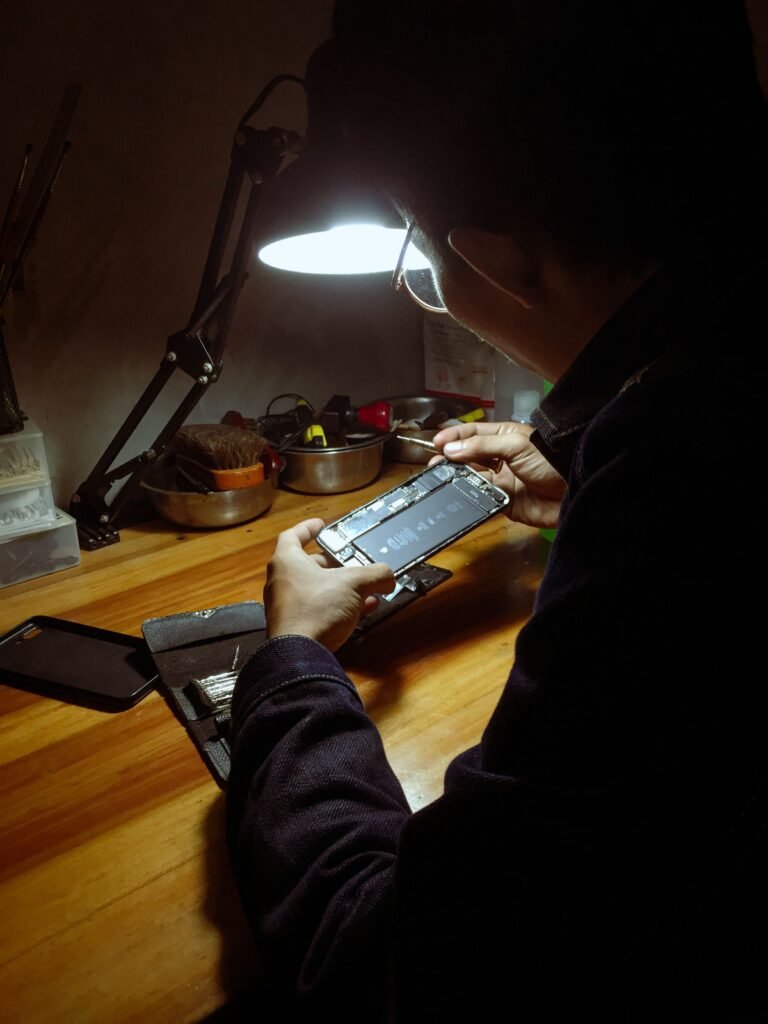
Twelve modules come apart with a single screwdriver: the battery, the display, the USB-C port, the camera units and more. iFixit gave the series a 10 out of 10, the only smartphone line to hold that score. Most repairs are a five-minute job on a kitchen table.
Here is where it gets uncomfortable for everyone else.
Cost of the three repairs people actually need
| Replacement screen | $90 |
| New battery | $40 |
| USB-C port | $20 |
| Out-of-warranty iPhone 17 screen, for comparison | around $329 |
A cracked screen and a tired battery on a Fairphone cost about $130 and an afternoon. On most flagships, the same two jobs cost more than a mid-range phone.
Then there is the warranty gap. Samsung, Google and Apple all ship a one-year standard warranty and sell you an extended plan on top. Fairphone includes five years. For a device most people keep three to four years, that is not a footnote, it is a different product category.
Fairphone is having its best year while the market shrinks
The easy dismissal of Fairphone has always been that ethical hardware is a niche hobby. The 2026 numbers make that harder to say with a straight face.
Global smartphone shipments fell 6 percent in the first quarter, squeezed by the DRAM and NAND shortage the industry has taken to calling RAMageddon and by consumers sitting on their wallets. That same shortage is why every new Pixel costs about $100 more this year, and it is pushing prices up across the board.
Fairphone grew 116 percent globally in that market, its third straight quarter of growth. The company has been closing in on a million phones sold and $500 million in lifetime revenue, milestones it had not quite crossed as of the US launch. Tiny by industry standards. Enormous by its own.
CEO Raymond van Eck was blunt about the opening he sees: “If you look to the US market, it’s heavily duopolistic with very little real consumer choice. Americans are exhausted by planned obsolescence, closed-box ecosystems, and expensive yearly upgrades.”
The support window is the real spec
Fairphone commits to at least six Android OS upgrades from Android 16, with OS updates reported as running to 2032 and broader software support plus guaranteed spare parts through 2033. That is a seven-year runway on a $649 phone. Amortized, it is one of the cheapest phones on the market, which is exactly the argument the company has been making since the Gen 6 arrived and we noted that it finally stopped feeling like a compromise, except in the US. That last clause is now out of date.
Where it gets complicated
Read this before you order
- No Verizon. The Gen 6+ works on AT&T and T-Mobile. If you are on Verizon, this is not your phone.
- No carrier deal. Roughly two thirds of US phone sales run through carriers, and carriers decide what gets sold. Fairphone is going direct, which means paying $649 up front instead of $27 a month.
- The de-Googled build is separate. A version running Murena’s privacy-focused /e/OS exists, listed at 699 euros in Europe and sold through Murena rather than Fairphone. In the US it is effectively T-Mobile only.
- Mid-range silicon. The Snapdragon 7s Gen 4 is fine. It is not going to win benchmark comparisons against a $649 phone from a company optimizing for benchmarks.
That last point is the honest tension in the whole proposition. Repairability costs you something. Modular construction means seams, screws and slightly more thickness. A seven-year parts commitment means picking components that will still be manufacturable in 2033, which rules out bleeding-edge silicon.
The company has also signaled it is not stopping at phones. Fairphone’s CEO teased two new products last month, and its earlier attempt to enter the US came through repairable earbuds rather than a handset.
Who should actually buy this
- People who break screens. If you have paid for two screen repairs in the last three years, the math already works.
- People who keep phones forever. A five-year warranty and a $40 battery mean the fourth year is not the year the phone quietly dies.
- Privacy-minded buyers on T-Mobile. The /e/OS route exists and is genuinely de-Googled, with the carrier caveat above.
- Not camera obsessives or mobile gamers. A 50MP LYTIA sensor and a 7s Gen 4 are competent. Nobody is claiming more than that.
What to watch next
- Whether any US carrier picks it up. Direct sales cap the ceiling. A carrier listing would change everything about the volume.
- Parts availability in practice. A 2033 promise is only worth what the warehouse actually stocks in 2031.
- Whether the repair pitch spreads. Right to repair rules keep tightening, and Fairphone has spent a decade proving a 10 out of 10 phone is manufacturable.
- The million-unit milestone. Fairphone was close before this launch. The US market is how it either clears that bar fast or discovers how hard this market really is.
About this article: GeekBlog covers U.S. technology news, AI, phones, smartwatches and gaming. Every story is written and checked under our Editorial Policy. Spotted a mistake or have a story tip? Contact our editors.
