

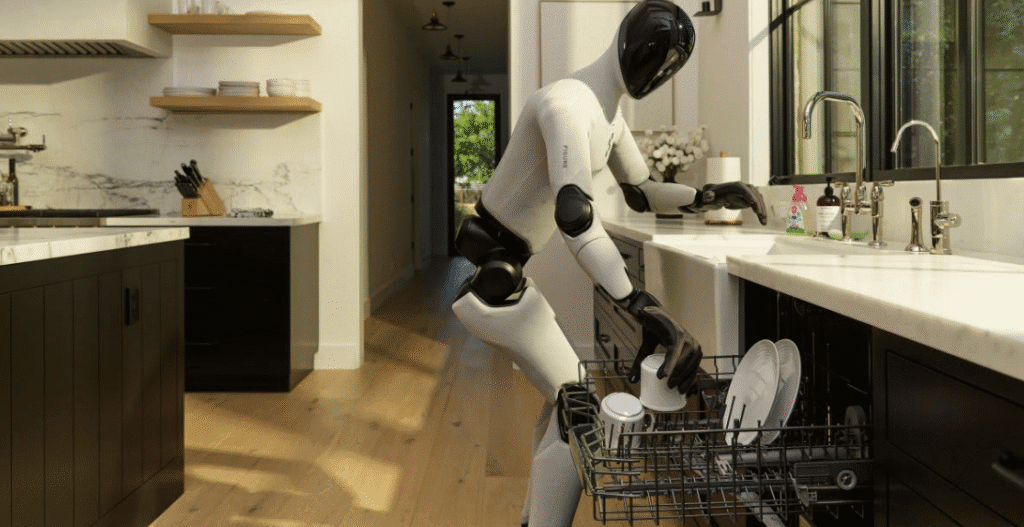
A new era for everyday robotics
Figure AI has officially unveiled Figure 03, a 1.68-meter-tall humanoid robot designed to revolutionize home life. The announcement, made in October 2025, marks a major milestone in the company’s mission to bring general-purpose robots into everyday households.
Figure 03 is a completely re-engineered successor to Figure 02, optimized for mass production and domestic use — though it won’t be ready for real-world deployment until 2026, according to the company.
Major technical upgrades and smarter design
Compared to its predecessor, Figure 03 introduces significant hardware and software improvements, including smaller yet stronger joints, 90% lower manufacturing costs, and redesigned hands with tactile fingertips and a built-in palm camera for precision tasks.
The robot can successfully load a dishwasher, clean a messy table, and perform basic laundry duties, though it still struggles with complex tasks such as folding clothes and requires human assistance when objects are dropped.
Powered by the company’s proprietary “Helix” neural network, Figure 03 features enhanced visual systems — double the frame rate and a 60% wider field of view than before. The AI operates on three distinct levels:
- System Zero manages balance and reflexes,
- System One handles nervous-system-like reactions,
- System Two governs reasoning and decision-making.
Despite these advances, CEO Brett Adcock acknowledged that the robot “won’t be fully ready for home use” at launch, setting 2026 as the goal for autonomous in-home functionality.
Billion-dollar backing and industrial ambitions
Figure AI raised over $1 billion in Series C funding in September 2025, reaching a valuation of $39 billion with backing from major investors including Nvidia, OpenAI, Microsoft, and Jeff Bezos. The company estimates that the humanoid robotics market represents a $40 trillion opportunity, roughly equivalent to the global value of human physical labor.
Its BotQ manufacturing facility in San Jose currently produces up to 12,000 robots per year, with plans to scale to 100,000 units within four years. Meanwhile, Figure 02 robots are already working 10-hour shifts at a BMW factory in South Carolina, showcasing the economic potential of humanoid robots in industrial environments.
Adcock says the company plans to use robots to help build future robots — creating what he calls a “flywheel effect”, where larger fleets reduce production costs and accelerate AI training.
The future of humanoid robotics
The launch of Figure 03 positions Figure AI at the forefront of the race to commercialize humanoid robots, competing with industry giants like Tesla’s Optimus, Boston Dynamics’ Atlas, and emerging efforts from Intel, Nvidia, and Alibaba.
While full autonomy in domestic settings may still be years away, Figure 03’s debut demonstrates rapid progress toward a world where robots handle daily chores, assist the elderly, and reshape the modern home — marking the next frontier in artificial intelligence and human-robot interaction.
