

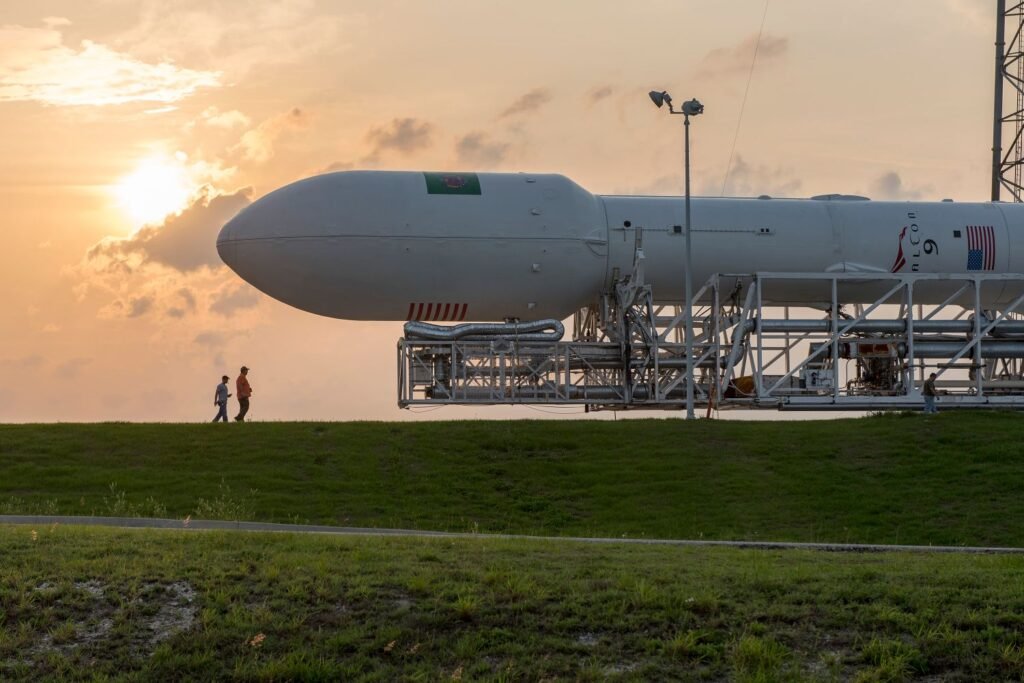
A YouTuber named Jack Gordon recently spent 24 hours on top of a NASA launch pad and spent a good chunk of it hunting for a door he never found. The thing he was looking for is directly beneath his feet, roughly 40 feet down, sealed behind a steel slab that would not look out of place in a bank vault.
It is called the rubber room, and it is one of the strangest pieces of safety engineering the Apollo program produced. The design brief was simple and horrifying: build a place where twenty people can survive a Saturn V detonating on the concrete above them. The solution involved springs, a domed ceiling and a 200-foot slide.
What It Was Built to Survive
A fully fueled Saturn V held around 2,500 tonnes of propellant. NASA engineers modeled what would happen if all of it went at once on the pad, and the answer was a fireball roughly 430 meters across, burning for 40 seconds at about 2,500 degrees Fahrenheit.
You cannot outrun that. The pad surface to a safe perimeter is a distance measured in minutes on foot, and the warning time in a propellant emergency is measured in seconds. Every conventional evacuation route was too slow, so the engineers stopped trying to get people away from the rocket and started trying to get them underneath it.
| Specification | Figure |
|---|---|
| Depth below the pad | 40 feet, roughly 12 meters |
| Entry chute | 200 feet, about 61 meters, from an opening on the pad surface |
| Capacity | Up to 20 people for 24 hours |
| Blast pressure rating | 500 psi |
| Acceleration rating | 75G |
| Exit route | A 366-meter tunnel, in reality a large air duct, opening at the pad perimeter |
| Backup exit | An escape hatch in the roof of the dome, if the tunnel were blocked |
Seventy-five G is the number that stops you. Occupants were meant to be seated and strapped into contoured seats, and the floor they sat on was not attached to the structure. It floated on springs and shock absorbers, so the shock arriving through the bedrock would be absorbed rather than transmitted straight through twenty spines.
Why a Slide
An elevator has moving parts, a power supply and a wait. In an emergency where the useful window is seconds, all three are liabilities. A slide has none of them. You get in it and physics does the rest.
The mechanics were more involved than the concept suggests. Crew inside the mobile launch platform, the enormous two-storey structure that carried the Saturn V to the pad, would make their way to Level A. A hatch there connected to a structure protruding from the pad, and that fed into the chute running down through the concrete. Sprinklers wet the slide so people moved faster.
The Astronauts Had Two Better Options First
The bunker was designed primarily for pad workers, the technicians and engineers who are on the structure during fueling and terminal count. The flight crew had a hierarchy of escape routes, and the slide was the last of them.
| Order | Method | How it worked |
|---|---|---|
| First | Launch escape system | A solid rocket on the nose pulls the capsule clear of the stack |
| Second | Slide wire | A cable from the top of the tower carrying the crew well away from the pad |
| Third | The rubber room | High-speed elevator from the 320-foot level to the pad surface in under 30 seconds, then into the chute |
That elevator specification is the detail that gives away how tight the timing was. Thirty seconds to fall 320 feet, and that was only the first leg. Everything about this system was designed around the assumption that you would find out you were in trouble far too late.
It Never Got Used, and Then It Was Forgotten
No rocket has ever exploded on a Launch Complex 39 pad. The rubber rooms sat there through the entire Apollo program doing nothing, which is the best possible outcome for a piece of safety equipment and a slightly anticlimactic end for the engineering.
After Apollo the bunkers went downhill fast. Water pooled in the rooms and the exit tunnels. Florida wildlife moved in, as Florida wildlife does. When the pads were rebuilt for the Space Shuttle, which used its own escape system of slide wire baskets carrying crews 763 meters clear of the pad, the bunkers were not refurbished. They were formally classified as “abandoned in place,” a phrase that manages to be both bureaucratic and a little sad.
By 2012 the pad B room had been closed off over lead paint concerns. The pad A room remained accessible, and photographers who got in came back with images of a domed concrete chamber, standing water, and a vault door hanging open onto an antechamber whose rubber lining is still there.
SpaceX Is Legally Required to Keep It
Pad 39A is not a museum. It is one of the busiest launch sites on the planet, leased to SpaceX since 2014. Falcon boosters land near it, Starship work continues around it, and none of that has anything to do with a 1960s blast bunker.
The lease covered that anyway. When NASA handed over the pad, the terms required that the rubber room and other historically significant parts of the structure be preserved as historical artifacts. So a bunker built for a rocket retired in 1973 now sits protected under a pad flying vehicles its designers could not have imagined, and the company operating above it has an obligation to leave it alone.
That is a lot of the modern space program in one image: new hardware running on old ground, with the previous era’s assumptions still physically present underneath. SpaceX has a habit of turning existing infrastructure into something else entirely, right down to the way researchers repurposed the Starlink constellation into an atmosphere scanner, and the pad is the same story pointed downward.
Why It Will Not Become a Tourist Attraction
People keep asking, and the answer is not really about preservation. It is that the thing sits directly beneath an active launch pad. Kennedy Space Center runs excellent tours, but no tour is going to route visitors 40 feet under a pad with a fueled vehicle on it, through a tunnel that is technically an air duct, into a room with standing water and lead paint next door.
There is also the awkward fact that the entrance is a chute you have to commit to. That was acceptable for trained pad crews facing an alternative involving a 430-meter fireball. It is a harder sell for a family from Orlando.
The realistic ceiling here is what already exists: occasional documented visits, NASA’s own photography, and videos that walk through the mechanics. Which is a shame, but understandable. Safety infrastructure has a way of becoming a problem for the people who inherit it, something the aviation world was reminded of when a military GPS jamming exercise was running as an air ambulance flew into a mountain.
The Bottom Line
The rubber room is a monument to a specific kind of engineering honesty. Apollo-era NASA looked at the numbers on a fully fueled Saturn V, accepted that anyone still on the pad in the last minutes could not be evacuated in time, and built them somewhere to hide instead. Then they mounted the floor on springs, because they had thought about what the shock wave would do to a human spine.
It never saved anyone, because it never had to. Sixty years later it is still down there, sealed, waterlogged, and legally protected, under a pad now launching rockets to orbit on a weekly basis.
