

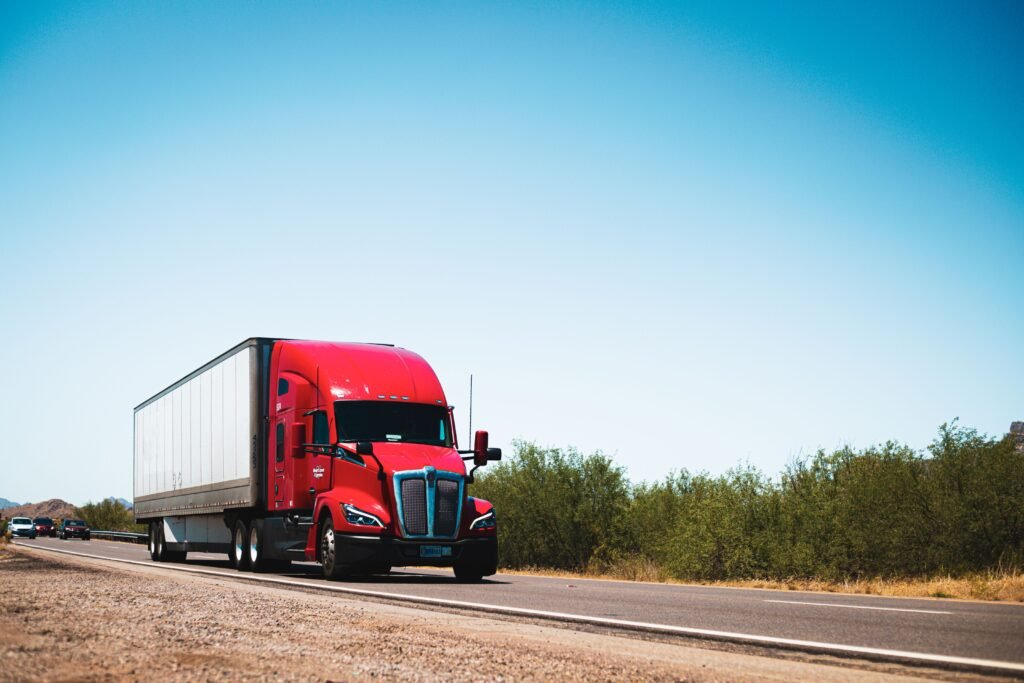
The first sign that something had gone wrong was a friendly text message. An executive at PlusAI, a self driving truck company based in Santa Clara, got a note from an acquaintance who had spotted two of the firm’s branded trailers parked near their workplace in Newark, California. Nice to see you expanding, the message said, more or less.
There was one problem. Nobody at PlusAI had sent those trailers anywhere. They had been sitting outside the company’s warehouse, roughly half a mile away, and nobody had authorized them to move.
What followed is the most satisfying crime story the AI hardware world has produced all year. Somebody had stolen two trailers wearing Nvidia and PlusAI logos, almost certainly believing they were about to become very rich. Inside each one was 20,000 pounds of sand.
The short version
- Two trailers branded Nvidia and PlusAI were taken from outside a Newark, California warehouse on the morning of Thursday, September 24
- The thieves broke the hand locks, hitched up and drove roughly half a mile before opening the doors
- Inside was 20,000 lbs of sand per trailer, about 20 tons in total, used as simulated cargo for autonomous driving tests
- Both trailers were abandoned and recovered within hours, contents intact
- Fremont Police confirmed the case is still open with no arrests
- The branding was the target. A trailer genuinely loaded with current Nvidia accelerators can be worth more than a truck full of luxury handbags
Why a self driving truck company hauls sand around
The sand is not a decoy. It is a test instrument.
An empty semi trailer and a loaded one are completely different vehicles. Weight changes stopping distance, changes how the rig behaves in a crosswind, changes how much the trailer pushes the tractor in a hard stop, and changes how the whole articulated assembly settles into a corner. A self driving system that has only ever been validated empty is a system that has learned almost nothing about the job.
So autonomous trucking companies ballast their trailers. PlusAI spokesperson Lauren Kwan put it plainly in the company’s statement to WIRED: the firm “uses simulated loads in its trailers to assist with research and development testing.” Sand is cheap, dense, evenly distributed and, crucially, nobody wants to steal it.
Until now, apparently.
| When | What happened |
|---|---|
| Thu, Sept 24, morning | Two trailers are taken from outside the PlusAI warehouse in Newark, California. Hand locks are broken |
| Shortly after | A PlusAI executive receives a message from an acquaintance who has spotted the branded trailers near their workplace |
| Same morning | The company confirms no trailer movement was authorized. Police are called |
| Half a mile away | Investigators believe the thieves opened the doors, found 20,000 lbs of sand in each trailer and walked away |
| Hours later | Both trailers are returned to PlusAI with the ballast still on board |
| Now | Fremont Police Department confirms the investigation is ongoing. No arrests |
The logo was the whole plan
This is the part that makes the story more than a joke. The thieves were not picking a random trailer off a lot. They picked the two with Nvidia branding on them, in an industrial corner of the Bay Area, at a moment when accelerator hardware is one of the most liquid stolen goods on the planet.
Nvidia and PlusAI have a working relationship on autonomous trucking software and hardware, which is why the logos were there at all. To anyone scanning a yard for a payday, those decals read as a shipping manifest.
The math behind that assumption is not stupid. Enterprise accelerators move through ordinary freight networks in ordinary dry vans, and a single rack of current generation Nvidia silicon can carry a price tag that would embarrass a container of designer goods. The figures below are indicative rather than an inventory of any specific shipment, but they explain the incentive.
Cargo theft is having a very good year
Strip away the comedy and this is a data point in a trend freight insurers have been shouting about all year. Verisk CargoNet put second quarter 2026 cargo theft losses at an estimated $304.6 million, more than double the $135.7 million recorded in the same quarter a year earlier.
The composition of those losses has shifted too. Organized crews have moved away from food and beverage loads, which are easy to fence but low margin, toward enterprise computing gear: servers, networking equipment, components, mining rigs. That freight usually travels as unremarkable dry van cargo with no special markings, which is exactly why a trailer that does carry a chipmaker’s logo becomes a target.
The uncomfortable lesson for everyone else. The thieves did not defeat a security system. They read a logo. Any company hauling high value hardware on public roads is advertising with its paint job, and the industry’s answer so far has mostly been to remove the branding rather than harden the trailer.
The internet had thoughts
Reddit, predictably, did not let this pass quietly. “The van with ‘Free Candy’ painted on the outside did not, in fact, contain candy,” went one of the better replies. Another commenter took the opportunity to point out that construction grade sand is genuinely a constrained global resource, which is true, and also does not help if you are trying to move 20 tons of it with no buyer and a stolen trailer.
There is a practical reason the trailers came back so fast. Twenty thousand pounds of loose ballast is not something you offload in a parking lot. Once the doors were open, the quickest exit was to leave everything exactly where it stood.
What this says about autonomous freight in California
The reason those trailers were full of test ballast in the first place is that autonomous trucking has quietly moved from demo phase to permit phase. California’s DMV approved a framework for heavy duty autonomous vehicle testing earlier this year, opening public roads to vehicles far larger than the robotaxis Bay Area residents have grown used to ignoring. Aurora Innovation and Kodiak AI were among the first cleared to test, and we went through what those permits actually allow in our look at California letting 80,000 pound robot trucks onto its highways.
Every one of those programs needs loaded miles. Not simulated loads in software, actual weight in an actual trailer moving down an actual highway, because that is the only way to validate braking models and trailer sway behavior against reality. Which means there are now a meaningful number of trailers on Californian roads carrying nothing but very expensive nothing.
Nvidia’s position in all of this is worth noting. The company is not only supplying chips for data centers, it is supplying the compute that sits inside the trucks, which is why its name ends up on a trailer in Newark at all. That breadth is also why regulators keep circling, something we covered when the DOJ started asking questions about how Nvidia spent roughly $20 billion without technically buying anything.
Where the case stands
Fremont Police Department has confirmed the investigation remains open and that no arrests have been made. PlusAI has its trailers, its sand and an anecdote that will outlive most of its press releases.
The thieves, assuming they are ever identified, face the specific humiliation of having executed a reasonably competent trailer theft against one of the most valuable product categories on earth and coming away with construction material. Somewhere in the Bay Area, two people are still arguing about whose idea it was to check the doors before driving further than half a mile.
Sources and further reading
- UNILAD Tech: Thieves thought they stole millions in Nvidia GPUs but got a nasty surprise when they opened up the doors
- Tom’s Hardware: Thieves steal Nvidia labeled trailers and score 20 tons of ballast sand instead
- HotHardware: Thieves chase GPU paydirt in Nvidia trailer heist
- Verisk CargoNet: cargo theft trend reporting
- California DMV: Autonomous vehicles program
