

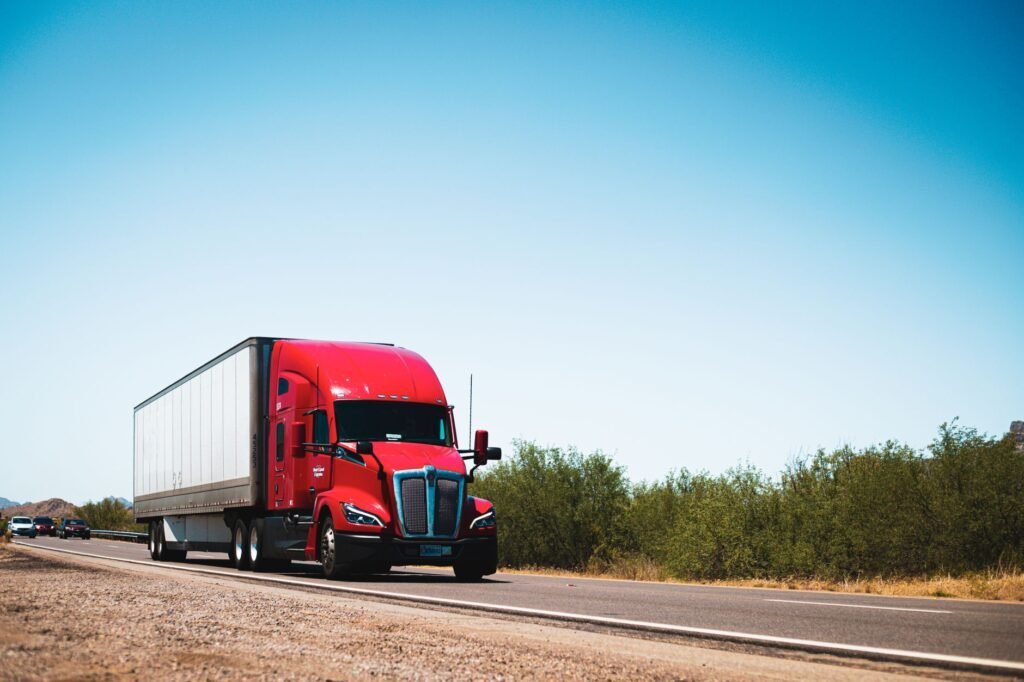
California spent years as the one state that would not let a self-driving truck near a public road. That ended quietly this month. The Department of Motor Vehicles has now issued heavy-duty autonomous vehicle testing permits to Aurora Innovation and Kodiak AI, and Kodiak already has a small number of trucks running on real California highways.
These are not delivery pods. A loaded Class 8 tractor trailer can legally weigh 80,000 pounds, which is roughly twenty times a Waymo. The state that has spent a decade watching robotaxis circle San Francisco has just agreed to find out what happens when the same idea gets forty tons heavier.
The short version
- What changed: the California DMV granted the first heavy-duty autonomous vehicle testing permits, to Aurora and Kodiak
- When: Kodiak received its permit on August 13, with Aurora following. Testing has already started
- The catch: a human safety operator has to be behind the wheel, and the trucks are barred from streets posted at 25 mph or under unless they are on a direct route between destinations
- How it became legal: regulations the DMV approved on April 28 lifted a blanket ban on public road testing for autonomous vehicles over 10,000 pounds
- The fight: Teamsters California sued the DMV on August 5, arguing the agency skipped the economic impact analysis the law requires
What actually got approved
Until this spring, California’s autonomous vehicle rules had a hard weight ceiling written into them. Anything over 10,000 pounds was simply out of scope, which is why companies like Aurora and Kodiak built their commercial operations in Texas and the Southwest instead. The April 28 regulations replaced that ceiling with a framework, and the framework is deliberately slow.
It works as a ladder with three rungs. A company starts with drivered testing, where a trained human sits in the driver’s seat ready to take over. If that goes well, it can apply for driver-out testing, where nobody is in the cab but the truck is still not earning money. Only after that comes driver-out deployment, which is the version where an autonomous truck can legally haul freight for a paying customer with no human aboard.
Aurora and Kodiak are on rung one. Nobody in California is anywhere near rung three.
The restrictions people keep skipping past
A permit sounds like permission to do anything. It is not. The testing permit comes bolted to a set of conditions that are worth reading, because they explain why you are unlikely to see one of these trucks on your street.
| What the permit allows | What it does not |
|---|---|
| Testing autonomous Class 8 trucks on California public roads | Running them with an empty cab |
| Operating with a trained safety operator behind the wheel | Hauling freight for a paying customer |
| Highway and arterial routes | Roads posted at 25 mph or lower, unless the truck is on a direct route between destinations |
| A gradual expansion of fleet size as the program proves out | Any automatic path to the next permit tier |
That 25 mph clause is the one that quietly does the most work. Residential streets, school zones and dense downtown blocks are where the posted limit drops that low, and those are exactly the environments where a long combination vehicle has the worst visibility and the longest stopping distance. The rule pushes early testing onto the roads these systems handle best.
Kodiak and Aurora are not starting from zero
California is a new jurisdiction for both companies, not a new problem. Kodiak has been running driverless trucks commercially outside the state for some time, largely in the Permian Basin, where private lease roads and repetitive routes make the engineering tractable. Aurora has been operating on the Dallas to Houston corridor in Texas, a state with a far lighter regulatory touch.
What both have accumulated is the thing California’s DMV actually cares about, which is a disengagement record. The permit is not a bet that the software is finished. It is a bet that the safety case is documented well enough to be worth watching in public.
The Teamsters case is about paperwork, and that is the point
Teamsters California filed suit on August 5 seeking to overturn the regulations outright. The complaint is not really an argument about whether the trucks are safe, at least not primarily. It is an argument about how the rules got written.
The union says the DMV used a streamlined rulemaking track that is meant for minor updates, the kind expected to produce less than $50 million in costs or benefits in the first year. Waving through a technology that the union estimates could eventually displace more than 200,000 employee semi truck drivers in California, it argues, is not a minor update, and skipping the economic impact analysis is not a technicality.
Procedural challenges get dismissed as lawyering, but they are often the only lever available. The union already lost the direct fight. In September 2023, Governor Newsom vetoed AB 316, a bill that would have written a human operator requirement for autonomous heavy trucks into state law. His veto message argued existing law already gave regulators enough authority to build a sensible framework. The DMV then built one, and the union is now arguing it built it wrong.
What this means for the people currently driving
Not much this year, and probably not next year either. Every truck operating under these permits has a paid human in it. The economics of autonomy only start working at the deployment stage, and nothing in the current permits gets a company there.
The longer arc is harder to wave away. Long haul highway driving is close to the ideal case for automation, because it is repetitive, geometrically simple compared to a city intersection, and performed on roads designed for predictable behavior. It is also the segment of trucking with the worst retention, which is why the industry keeps describing a driver shortage that the Teamsters describe as a wage problem. Both things can be true, and automation resolves the argument in a direction that does not favor drivers.
It is worth remembering how slowly this has actually moved. The robotaxi rollout has taken more than a decade to reach a handful of metros, and even there the economics are still being argued over. We looked at that math directly when we compared what a Waymo ride costs against an Uber, and the answer was messier than either side’s marketing. Freight is a different business with different margins, but the pattern of “sooner than you think” turning into “later than promised” has been remarkably consistent.
Three things to watch next
- The first driver-out application. That is the moment this stops being a demo and starts being a policy decision
- Whether the court pauses the rules. If the Teamsters win an injunction, permits already issued get complicated fast
- Disengagement reports. California requires them, and unlike company blog posts they are public and comparable year over year
The honest read
California did not just approve driverless trucks. It approved a supervised experiment with a human in the seat, on a subset of roads, with a lawsuit attached and two more permit tiers still to clear. That is a meaningfully smaller story than the headline suggests.
It is also the first time the largest freight market in the United States has said yes to any of it. The state that held out longest is now the state where the next few years of this argument get settled, and the people with the most at stake are the ones currently sitting in the seat that the technology is designed to empty. The broader question of whether automation actually saves anyone money is still open, and we have written before about how badly the arithmetic has held up in other industries.
Sources and further reading
- TechCrunch: Self driving trucks are officially testing on California highways
- Heavy Duty Trucking: California advances autonomous truck testing
- InsideEVs: Self driving trucks are already hitting the road in California
About this article: GeekBlog covers U.S. technology news, AI, phones, smartwatches and gaming. Every story is written and checked under our Editorial Policy. Spotted a mistake or have a story tip? Contact our editors.
