

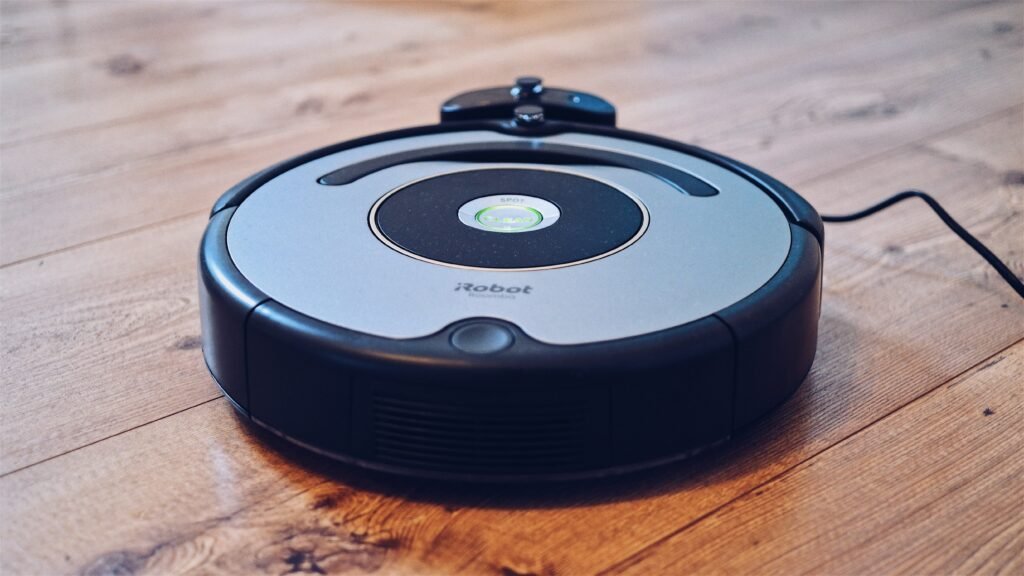
On Christmas Day 2023, a man in Taoyuan, Taiwan, opened an app to talk to his wife through the robot vacuum at their holiday home. The vacuum has a speaker, so this is a normal thing to do with it.
What appeared instead was a live camera feed, and another man standing in the room. He hit record.
That footage won him roughly $15,700 in civil damages. It also got him five months in prison, because the court that heard his wife’s counter suit took the view that catching someone in an affair does not retroactively make it legal to film them undressed in their own home.
The short version
- What he did: accessed the household robot vacuum remotely, found a live camera feed, and used the built in recording function
- What he won: NT$500,000, about $15,700, after suing for NT$2 million. Adultery is not a crime in Taiwan, but breaching the marriage contract carries civil liability
- What he got: five months from the Taoyuan District Court for unlawful recording, commutable to a NT$150,000 fine, roughly $4,740. He can appeal
- The reasoning: his wife had a reasonable expectation of privacy and had not consented to being filmed without clothing. Marriage does not remove that
- The part that applies to you: a great many robot vacuums sold since 2023 ship with a camera, a microphone, remote driving and a record button, all reachable from a phone
Two courts, two very different questions
The case is unusual because both sides won something, and the split tells you exactly how the law is thinking about this.
He had already been suspicious. Belongings at the holiday home in Guishan did not belong to him, and reviewing the property’s security footage showed an unfamiliar man driving his wife there and staying the night. The vacuum was not the beginning of the investigation. It was the moment the investigation produced something he could not legally hold.
| The case | Question the court asked | Outcome |
|---|---|---|
| His civil claim Infringement of marital rights | Did the affair happen, and what is it worth? | He won. Sought NT$2 million, awarded a quarter of it |
| Her criminal complaint Unlawful recording of intimate images | Was he allowed to obtain the evidence that way? | He lost. Five months, commutable to a fine, appeal available |
The court did not dispute that the footage was true, or that it proved what he said it proved. It held that the method was a separate offense with its own consequences, and that being married to somebody does not grant a licence to film them.
Whether the arithmetic punishes him is another matter. He was awarded more than three times the fine that would convert the sentence.
Your robot vacuum is a camera on wheels
Here is the part that has nothing to do with Taiwan.
Most people bought a robot vacuum to avoid sweeping. What a lot of them now own is a networked device with a camera, a microphone, a speaker, a map of every room in their home, and an app that lets a logged in account drive it somewhere and watch.
Manufacturers do not hide this. They sell it. Roborock’s higher end machines let you see and speak to whoever is home through the app. Ecovacs advertises live HD video with two way audio. Dreame markets a patrol mode that sends the robot to a specific room so you can check on it remotely. These are listed as features, in the marketing, on the box.
The problem is not that the capability is secret. It is that the mental model people carry around is “vacuum,” and the device is closer to a security camera that can open doors. Every account with app access has the same powers, and in a shared household that is usually more than one person, indefinitely, including after a relationship has stopped being friendly.
It has gone wrong without a spouse involved
In December 2022, MIT Technology Review reported that images captured by development versions of iRobot’s Roomba J7 had ended up on social media. The photos were ordinary household scenes shot from ankle height, except for the one of a young woman sitting on the toilet. They had been sent to Scale AI for labeling, and gig workers in Venezuela shared them. The testers had signed agreements permitting data collection. Very few of them appear to have understood what that sentence covered. iRobot terminated the Scale AI contract after being contacted for comment.
A year later, researchers Dennis Giese and Braelynn Luedtke disclosed flaws in the Ecovacs Deebot X2, including a weak PIN protecting the video feed and a Bluetooth issue that allowed full access from more than 100 meters away. In May 2024 the practical consequence arrived: Deebot X2 units in Minnesota, Los Angeles and El Paso were taken over and driven around homes shouting obscenities at their owners. One chased a dog. Ecovacs attributed the incidents to credential stuffing and shipped a firmware update later that year.
The Taiwan case is different from all of those, and worse in one specific way. Nothing was broken into. No vulnerability was exploited. A person who was supposed to have access used the access he was supposed to have.
That is the failure mode no firmware update addresses, and it is the same shape as most smart home privacy problems that actually reach a courtroom. It is also the reason exposed cameras keep making news even when nobody is attacking them, as with the license plate readers that were found streaming to the open internet with no attacker required at all.
The legal principle is the useful bit
Strip away the setting and the ruling says something fairly simple. Evidence of wrongdoing does not launder the way you obtained it. A court can accept that your footage proves what you claim and still convict you for making it.
Taiwan is not an outlier here. Recording somebody in a place where they reasonably expect privacy is an offense in most jurisdictions, and in a large number of US states the consent rules for recording apply regardless of who owns the property or the device. Owning the house does not settle it. Owning the vacuum definitely does not.
The practical version, for anyone tempted: footage gathered this way tends to cost more than it wins, and it hands the other side a criminal complaint they would not otherwise have had.
Worth checking on your own machine
- Does it have a camera and mic at all? Obstacle avoidance models usually do. Older lidar only units usually do not
- Who is still logged in? Check the shared users list in the app. Ex partners, former housemates and old phones are the common surprises
- Change the password after anyone moves out. Removing a shared user is the step people forget, and it is the whole ballgame
- Turn off remote video access if you never use it. Most apps let you disable the live feed while keeping the cleaning
- Keep the firmware current. The Ecovacs fixes were real fixes, and they only help machines that installed them
- Set a no go zone for the bathroom and bedroom if the feature exists. It limits what the camera can ever see
The honest read
The story travels because it is funny in a way that gets less funny the longer you look at it. A man tried to talk to his wife through a vacuum cleaner and found out something he did not want to know, and the device that told him also produced the evidence used against him.
But the reason to file it away is duller. A device sold on the promise of not having to think about it turns out to have a camera, a microphone, the ability to move through your home on command, and a list of people who can trigger all of that from anywhere. Most owners have never opened that list.
Consumer hardware has spent a decade quietly acquiring sensors that the people who bought it do not associate with the product, from vacuums that see to websites playing inaudible sound through your speakers to identify you. The capability arrives in a firmware update. The mental model never does. This case is what it looks like when the gap between the two finally reaches a courtroom, and it will not be the last one.
About this article: GeekBlog covers U.S. technology news, AI, phones, smartwatches and gaming. Every story is written and checked under our Editorial Policy. Spotted a mistake or have a story tip? Contact our editors.
