Close Menu
GeekBlog

    Subscribe to Updates

    Get the latest creative news from FooBar about art, design and business.

    What's Hot

    Anthropic Is Reportedly Building Its Own AI Chip, and Samsung Wants In

    July 5, 2026

    Commodore’s Callback Flip Phone Is Betting You Want Less Phone, Not More

    July 4, 2026

    Inside Hyundai’s Metaplant, Where AI and Robots Build Cars to Order

    July 3, 2026
    Facebook X (Twitter) Instagram Threads
    GeekBlog
    • Home
    • Mobile
    • Tech News
    • Blog
    • How-To Guides
    • AI & Software
    Facebook
    GeekBlog
    Home»Tech News»This Galaxy Is 99% Dark Matter—and Basically Invisible
    Tech News

    This Galaxy Is 99% Dark Matter—and Basically Invisible

    Michael ComaousBy Michael ComaousFebruary 19, 20263 Mins Read
    Share Facebook Twitter Pinterest LinkedIn Tumblr Email Copy Link
    This Galaxy Is 99% Dark Matter—and Basically Invisible
    Share
    Facebook Twitter LinkedIn Pinterest Email Copy Link

    Dark matter doesn’t emit, absorb, or reflect light. It’s invisible but supposedly makes up 85% of the universe’s mass. Because it’s so abundant, astronomers believe it should explain many unsolved mysteries surrounding the cosmos, including an extraordinary dim galaxy “hiding” in plain sight.

    Last summer, astronomers vetted candidates for so-called dark galaxies, or a rare class of galaxies with remarkably low surface brightness. The paper on the findings, published in The Astrophysical Journal Letters, surmised that so-called “dark galaxies” should have “some of the most extreme properties among all known galaxies.”

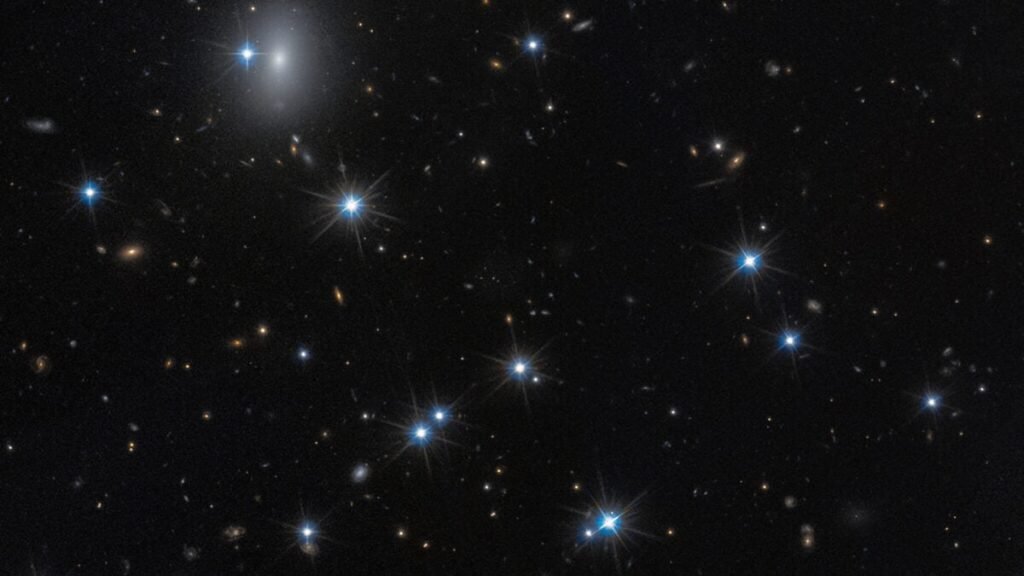
    And today, NASA shared high-resolution images of one such galaxy, CDG-2. If the astronomers’ hypothesis is correct, CDG-2 would be among the most heavily dark-matter-filled galaxies ever identified.

    “Seeing” the invisible

    Again, dark matter doesn’t interact with light. However, astronomers infer its presence from dark matter’s gravitational influence on surrounding objects. Often, this refers to unseen mass that seems to be driving galaxies, planets, stars, and supernovas—you name it—to appear a certain way.

    Simply put, if dark matter didn’t exist, many of the models scientists use to understand the cosmos would break down. Although scientists have yet to directly detect dark matter, dissenters have also yet to find an alternative that explains things better. So the consensus, at least for now, is that dark matter exists.

    Hints of an invisible galaxy

    CDG-2 lies within the Perseus galaxy cluster, a section of the universe filled with globular clusters, or tightly bound units filled with millions of stars. Accordingly, this neighborhood is known for its particularly rich population of densely packed stars.

    Then, Hubble noticed a close collection of four globular clusters among the bunch. When Hubble, ESA’s Euclid, and the Subaru Telescope in Hawaii collectively took a closer look, astronomers noticed a faint glow circling the area—leading them to wonder if the whole thing was actually just one galaxy.

    The circle marked with a dashed red boundary indicates the location of the dark-matter-dominated galaxy. Within the red, dashed circle are four globular clusters outlined by small, blue circles. Credit: NASA/ESA/Dayi Li (UToronto)/Joseph DePasquale (STScI)

    The researchers behind the study conducted a statistical analysis of the galaxy, finding that the four clusters likely are part of a single galaxy—and a dark one at that.

    “This is the first galaxy detected solely through its globular cluster population,” David Li, the study’s lead author and an astronomer at the University of Toronto, said in a NASA release.

    A crowded neighborhood

    According to the researchers, CDG-2 has a luminosity equivalent to roughly 6 million Sun-like stars, with the globular clusters contributing around 16% of that total. In terms of mass, however, 99% of the galaxy’s mass appears to be dark matter.

    The “normal” matter in CDG-2—primarily hydrogen gas for star formation—was likely stripped away by the dense population of galaxies inside the Perseus cluster, the scientists said. But even if CDG-2 isn’t necessarily a dark galaxy, it’s still an odd one, the researchers said, and would be an ideal candidate to study and test theories on clustered star formation and its potential implications, according to the paper.

    Either way, it looks like astronomers have no shortage of things they’re counting on dark matter to prove.

    Source: gizmodo.com

    Galaxy
    Share. Facebook Twitter Pinterest LinkedIn Tumblr Telegram Email Copy Link
    Previous ArticleI found a hidden smart lock that’s as easy as using tap-to-pay
    Next Article Ford wants to make EVs more affordable for you
    Michael Comaous
    • Website

    Michael Comaous is a dedicated professional with a passion for technology, innovation, and creative problem-solving. Over the years, he has built experience across multiple industries, combining strategic thinking with hands-on expertise to deliver meaningful results. Michael is known for his curiosity, attention to detail, and ability to explain complex topics in a clear and approachable way. Whether he’s working on new projects, writing, or collaborating with others, he brings energy and a forward-thinking mindset to everything he does.

    Related Posts

    6 Mins Read

    Anthropic Is Reportedly Building Its Own AI Chip, and Samsung Wants In

    6 Mins Read

    Commodore’s Callback Flip Phone Is Betting You Want Less Phone, Not More

    4 Mins Read

    Inside Hyundai’s Metaplant, Where AI and Robots Build Cars to Order

    8 Mins Read

    AI Is Eating the World’s Memory Chips, and Your Next Gadget Is Paying the Price

    7 Mins Read

    License Plate Readers Are Learning to Track Your Phone, Not Just Your Car

    7 Mins Read

    AI Now Costs More Than Human Workers, So Why Are Layoffs Still Happening?

    Top Posts

    The Mesh Router Placement Strategy That Finally Gave Me Full Home Coverage

    August 4, 20251,171 Views

    Discord will require a face scan or ID for full access next month

    February 9, 2026770 Views

    Best Stores for Buying MP3 and Digital Music You Can Keep Forever

    August 2, 2025685 Views
    Stay In Touch
    • Facebook

    Subscribe to Updates

    Get the latest tech news from FooBar about tech, design and biz.

    Most Popular

    The Mesh Router Placement Strategy That Finally Gave Me Full Home Coverage

    August 4, 20251,171 Views

    Discord will require a face scan or ID for full access next month

    February 9, 2026770 Views

    Best Stores for Buying MP3 and Digital Music You Can Keep Forever

    August 2, 2025685 Views
    Our Picks

    Anthropic Is Reportedly Building Its Own AI Chip, and Samsung Wants In

    July 5, 2026

    Commodore’s Callback Flip Phone Is Betting You Want Less Phone, Not More

    July 4, 2026

    Inside Hyundai’s Metaplant, Where AI and Robots Build Cars to Order

    July 3, 2026

    Subscribe to Updates

    Get the latest creative news from FooBar about art, design and business.

    Facebook
    • About Us
    • Contact us
    • Privacy Policy
    • Disclaimer
    • Terms and Conditions
    © 2026 GeekBlog

    Type above and press Enter to search. Press Esc to cancel.

    Ad Blocker Enabled!
    Ad Blocker Enabled!
    Our website is made possible by displaying online advertisements to our visitors. Please support us by disabling your Ad Blocker.