Close Menu
GeekBlog

    Subscribe to Updates

    Get the latest creative news from FooBar about art, design and business.

    What's Hot

    A Military GPS Jamming Test Was Running When This Air Ambulance Hit a Mountain

    August 9, 2026

    Reddit Just Hired an AI to Read Your Posts, and Moderators Are Not Sold

    August 9, 2026

    Apple Quietly Raised Its Trade-In Values, and Some Jumped Almost 30%

    August 9, 2026
    Facebook X (Twitter) Instagram Threads
    GeekBlog
    • Home
    • Mobile
    • Tech News
    • Blog
    • How-To Guides
    • AI & Software
    Facebook
    GeekBlog
    Home»Tech News»This Might Be the Most Massive Black Hole Ever Discovered
    Tech News

    This Might Be the Most Massive Black Hole Ever Discovered

    Michael ComaousBy Michael ComaousAugust 13, 20253 Mins Read
    Share Facebook Twitter Pinterest LinkedIn Tumblr Email Copy Link
    This Might Be the Most Massive Black Hole Ever Discovered
    Share
    Facebook Twitter LinkedIn Pinterest Email Copy Link

    Recommended for you:

    Upcoming DeepSeek AI model failed to train using Huawei’s chips
    Tech News·Aug 14, 2025

    Upcoming DeepSeek AI model failed to train using Huawei’s chips

    Astronomers have identified what could be a new supermassive black hole, and with an estimated mass 36 billion times that of the sun, it is about 10,000 times heavier than the black hole at the center of the Milky Way. This would make it among the most massive objects ever detected.

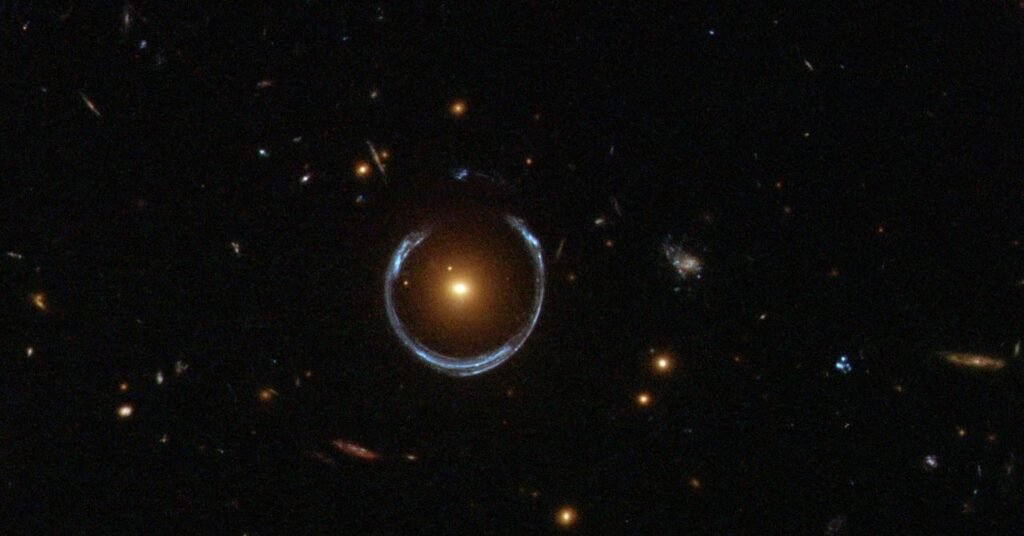
    The finding, published in the Monthly Notice of the Royal Astronomical Society, was made by researchers from the Institute of Cosmology and Gravitation at the University of Portsmouth in the UK in collaboration with the Federal University of Rio Grande in Brazil. The scientists located the signs of the new supermassive black hole within a gravitational lens known as the “Cosmic Horseshoe,” pictured below. A gravitational lens occurs when the gravity of a massive object, such as a galaxy, is so great that it bends light and time that passes near it, distorting light traveling from behind.

    The Cosmic Horsehoe was discovered by the Hubble telescope in 2007. The galaxy LRG 3-757 sits at its center, while the blue horseshoe shape surrounding this yellow-colored object is distorted light emitted from another galaxy beyond it. LRG 3-757 is one of the most massive galaxies ever observed by astronomers, having a mass 100 times that of the Milky Way, and it sits approximately 5.6 billion light-years away from Earth.

    The gravitational lens known as the Cosmic Horseshoe, so named because of the appearance of the incomplete ring of blue light that surrounds its central galaxy, LRG 3-757.

    Photograph: NASA/ESA

    Thanks to this luminous structure, astronomers have been able to calculate the mass of the black hole that presumably lies at the center of LRG 3-757 (while not definitively proven, large galaxies are assumed to have a black hole at their center). Although there are no direct observations of this black hole, measurements of the motion of light in the ring and the velocity of stars in the inner regions of the galaxy are consistent with the presence of an ultramassive black hole. “By combining these two measurements we can be completely confident that the black hole is real,” Thomas Collett, professor of astrophysics at the University of Portsmouth, said in a press statement.

    Collett also suggests that a black hole of such proportions could only originate from the merger of two supermassive black holes resulting from the collision of galaxies. Astronomers are still debating whether this will be the shared fate of our galaxy, the Milky Way, and neighboring Andromeda.

    What About TON 618 and the Like?

    Any astronomy enthusiast knows that the most massive object found in the universe so far is potentially TON 618. According to the most widespread estimates, this black hole has a mass equivalent to 66 billion suns, almost twice that of the Cosmic Horseshoe.

    However, scientists are cautious about labelling TON 618 as the most massive object ever seen. Being located more than 10 billion light-years away, its host galaxy and surrounding objects cannot be observed in detail. What little is known about it comes from analysis of its brightness and from theoretical models that allow us to estimate its size. The uncertainty is too high to consider it the most massive black hole known.

    In contrast, the Portsmouth researchers argue that the Cosmic Horseshoe black hole offers greater observational certainty, unlike distant, almost mythological holes like TON 618. As such, they claim that their discovery could represent the most massive black hole confirmed to date.

    This story originally appeared on WIRED en Español and has been translated from Spanish.

    Share. Facebook Twitter Pinterest LinkedIn Tumblr Telegram Email Copy Link
    Previous ArticleWhy it’s a mistake to ask chatbots about their mistakes
    Next Article Bye bye ChatGPT? US government can now use Claude AI for just $1
    Michael Comaous
    • Website

    Michael Comaous is a dedicated professional with a passion for technology, innovation, and creative problem-solving. Over the years, he has built experience across multiple industries, combining strategic thinking with hands-on expertise to deliver meaningful results. Michael is known for his curiosity, attention to detail, and ability to explain complex topics in a clear and approachable way. Whether he’s working on new projects, writing, or collaborating with others, he brings energy and a forward-thinking mindset to everything he does.

    Related Posts

    8 Mins Read

    A Military GPS Jamming Test Was Running When This Air Ambulance Hit a Mountain

    8 Mins Read

    Reddit Just Hired an AI to Read Your Posts, and Moderators Are Not Sold

    7 Mins Read

    Apple Quietly Raised Its Trade-In Values, and Some Jumped Almost 30%

    8 Mins Read

    Samsung Just Beat Dolby to the Next HDR Standard, and Prime Video Is the Test Case

    7 Mins Read

    The New Siri Arrives This Fall, but a Lot of iPhones Are Not Invited

    7 Mins Read

    NASA Says Pointing Your Phone at the August 12 Eclipse Can Permanently Wreck the Camera

    Top Posts

    AI’s Memory Boom Is Quietly Crushing the Budget Smartphone

    August 5, 20266 Views

    Scientists Didn’t Say Earth Is Becoming Uninhabitable. Here’s What the “Hothouse Earth” Study Actually Says

    August 5, 20266 Views

    Meta Wants an AI Agent Managing Your Life. Wall Street Isn’t So Sure

    August 2, 20265 Views
    Stay In Touch
    • Facebook

    Subscribe to Updates

    Get the latest tech news from FooBar about tech, design and biz.

    Most Popular

    Best Stores for Buying MP3 and Digital Music You Can Keep Forever (2026)

    August 2, 2025930 Views

    Discord will require a face scan or ID for full access next month

    February 9, 2026770 Views

    Trade in your old phone and get up to $1,100 off a new iPhone 17 at AT&T – here’s how

    September 10, 2025383 Views
    Our Picks

    A Military GPS Jamming Test Was Running When This Air Ambulance Hit a Mountain

    August 9, 2026

    Reddit Just Hired an AI to Read Your Posts, and Moderators Are Not Sold

    August 9, 2026

    Apple Quietly Raised Its Trade-In Values, and Some Jumped Almost 30%

    August 9, 2026

    Subscribe to Updates

    Get the latest creative news from FooBar about art, design and business.

    Facebook
    • About Us
    • Contact us
    • Privacy Policy
    • Disclaimer
    • Terms and Conditions
    © 2026 GeekBlog

    Type above and press Enter to search. Press Esc to cancel.