

Follow ZDNET: Add us as a preferred source on Google.
ZDNET’s key takeaways
- Google’s AI Overviews offered bad medical advice, says The Guardian.
- Experts found some of the data to be misleading and even dangerous.
- Don’t rely solely on AI to research serious medical conditions.
Turning to AI to answer health-related questions seems like an easy and convenient option that may spare you from a doctor’s visit. That’s particularly true with a tool like Google’s AI Overviews, which summarizes the results that pop up during a regular Google Search.
Also: How to get rid of AI Overviews in Google Search: 4 easy ways
But that doesn’t mean Google’s AI is the best route to take, especially if you’re researching a serious medical problem or condition.
‘Really dangerous’
A recent investigation by British newspaper The Guardian concluded that Google’s own AI Overviews put users at risk by providing false and misleading health information in its summaries. To conduct its tests, The Guardian used AI Overviews to research several health-related questions. The paper then asked different medical and health experts to review the responses.
Also: 40 million people globally are using ChatGPT for healthcare – but is it safe?
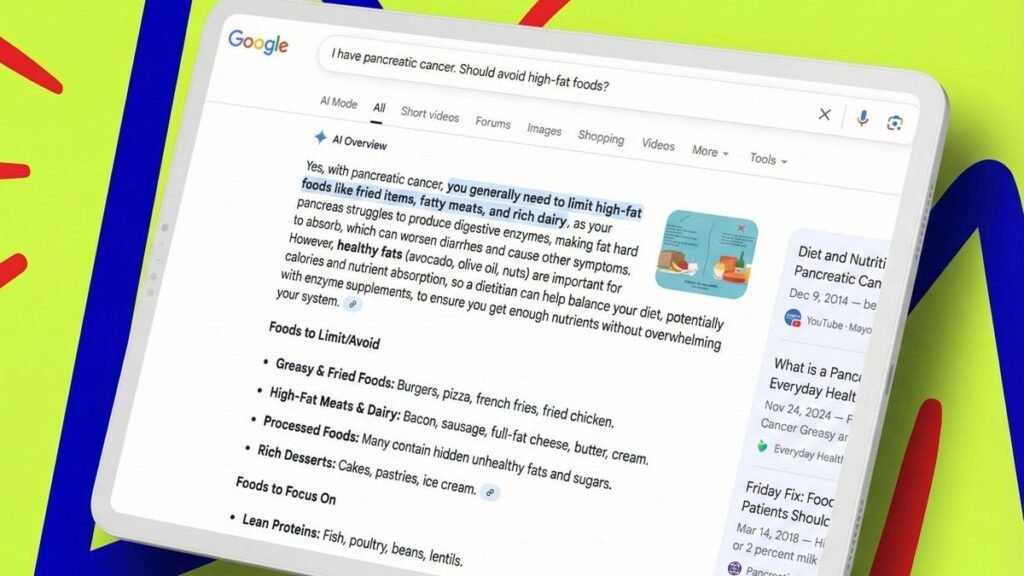
In one case described by experts as “really dangerous,” Google’s AI Overviews advised people with pancreatic cancer to avoid high-fat foods. But the experts said that this is the exact opposite of the correct advice. In another instance, the AI-generated information about women’s cancer tests was “completely wrong,” according to the experts.
Here, a search for “vaginal cancer symptoms and tests” listed a pap test as a test for vaginal cancer, which the experts said was incorrect.
In a third case, Google served up false information about critical liver function tests that could give people with serious liver disease the wrong impression. For example, searching for the phrase “what is the normal range for liver blood tests” resulted in misleading data with little context and no regard for nationality, sex, ethnicity, or age.
Inaccurate results
Based on its investigation, The Guardian also said that AI Overviews offered inaccurate results on searches about mental health.
In particular, some of the summaries for such conditions as psychosis and eating disorders displayed “very dangerous advice” and were “incorrect, harmful, or could lead people to avoid seeking help,” Stephen Buckley, the head of information at mental health charity Mind, told Google.
In response to a request for feedback on The Guardian’s findings, a Google spokesperson send ZDNET the following statement:
“Many of the examples shared with us are incomplete screenshots, but from what our internal team of clinicians could assess, the responses link to well-known, reputable sources and recommend seeking out expert advice. We invest significantly in the quality of AI Overviews, particularly for topics like health, and the vast majority provide accurate information.”
Also: Using AI for therapy? Don’t – it’s bad for your mental health, APA warns
Google also reviewed the specific questions posed by The Guardian and qualified some of the answers.
For example, the AI Overview doesn’t say that pap tests are meant for diagnosing vaginal cancer but says that vaginal cancer can be found incidentally on a pap test, according to Google. For the pancreatic cancer example, the overview cites Johns Hopkins University as one reputable source.
For the mental health example, Google said the overview pointed to a source that links to a free, confidential, national crisis support line. For the liver test query, Google said that the AI Overview stated that normal ranges can vary from lab to lab and that a disclaimer advised people to consult a professional for medical advice or diagnosis.
My experience
I tested AI Overviews by submitting some of the same questions that The Guardian asked. In one search, I told Google that I have pancreatic cancer and asked if I should avoid high-fat foods.
The AI said that you do often need to limit high-fat foods with pancreatic cancer because your pancreas struggles to produce digestive enzymes. But you also need calories, so working with a registered dietitian to find the right balance of healthy fats and easy-to-digest options is crucial to avoid weight loss and malnutrition.
Also: Google search chief talks future of news content amid AI scramble
Next, I searched for “vaginal cancer symptoms and tests.” Here, AI Overviews did list a pap test as one of several diagnostic tests but qualified it by saying that this type of test checks for abnormal cells on the cervix, which can sometimes find vaginal cancer.
Asking Google AI for the normal range for liver blood tests gave me general ranges but also offered specific numbers by gender and age.
Based on my own limited testing, the answers provided by AI Overviews seemed less cut and dry than those obtained by The Guardian. But that points to another challenge with AI and search in general.
The way you phrase your question influences the answer. I could ask the same question two different ways and get two different responses, one that’s partially accurate and potentially useful and the other inaccurate and unhelpful.
In defending its AI Overviews, Google said that the system uses web rankings to try to ensure that the information is reliable and relevant. If any content from the web is misinterpreted or is lacking context, the company will use those examples to try to improve the process.
Don’t risk your health
Still, The Guardian’s investigation points out the pitfalls of relying on AI for any critical research, especially involving serious health conditions. The key takeaway here is “Don’t.” Don’t risk your health by assuming that the information provided by an AI is going to be correct.
Also: Sick of AI in your search results? Try these 8 Google alternatives
If you do insist on using AI for this purpose, double-check and triple-check the responses. Run the same search across different AIs to see if they’re in agreement. Better yet, investigate the sources consulted for the answers to see if the AI interpreted them correctly.
Best yet, talk to your doctor. If you are experiencing a serious medical condition, your doctor’s office should always be your primary point of contact. Don’t be afraid to reach out. Many medical offices provide email and messaging for patient questions. While it may be tempting to turn to AI for quick and easy answers, you don’t want to run the risk of getting the wrong information.
Source: www.zdnet.com
