

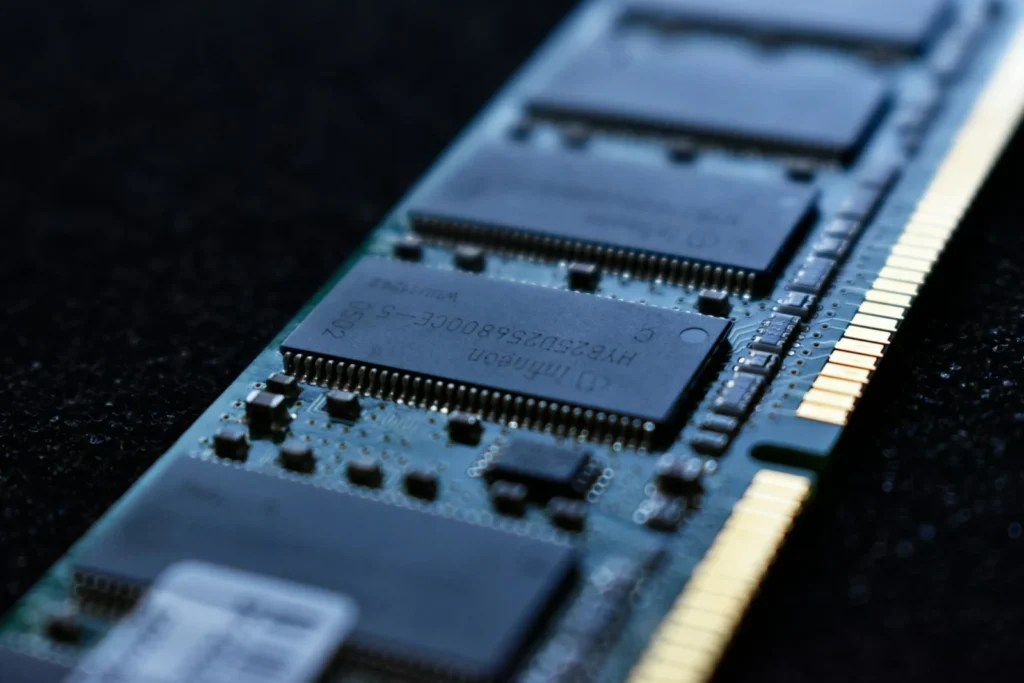
Memory chips went from cheap commodity to scarce, expensive component in about a year. The cause is the AI data center buildout, which is absorbing a huge share of the world’s DRAM and flash output, and the effects now reach laptops, phones, game consoles and graphics cards. Here is why prices rose, what the memory makers themselves have said, and what the outlook looks like as of October 2026.
Why DRAM and NAND prices shot up
Three companies, Samsung, SK hynix and Micron, make the vast majority of the world’s DRAM. When their biggest customers suddenly want far more memory, there is no large pool of spare capacity anywhere else to fill the gap.
That is what happened as cloud providers raced to build AI data centers. Every AI accelerator ships with stacks of high bandwidth memory (HBM), and the servers around those accelerators carry large amounts of conventional DRAM and fast SSD storage too. HBM is also wafer hungry: producing a gigabyte of it uses considerably more manufacturing capacity than a gigabyte of standard DRAM. As makers moved their lines toward HBM and server parts, which earn much higher margins, output of the ordinary memory used in laptops and phones shrank.
The price data shows how fast it moved. Market research firm TrendForce projected in February 2026 that conventional DRAM contract prices would rise 90 to 95 percent in a single quarter (the first quarter of 2026), with NAND flash up 55 to 60 percent. Increases slowed later in the year but did not reverse: TrendForce expected DRAM contract prices to climb another 13 to 18 percent in the third quarter, and NAND another 10 to 15 percent, describing the DRAM market as extremely tight.
What the memory makers have said
Unusually, the companies selling the chips have been blunt that the shortage is not a short blip.
In December 2025 it announced it would exit the Crucial consumer business to focus on data center customers. On September 30, 2026, it said supply and demand will be much tighter in its fiscal 2027 and 2028 than in 2026.
On its April 2026 earnings call, its memory chief said customers had already placed orders for 2027 and that the supply gap should widen further next year.
In July 2026, CEO Kwak Noh Jung said 2027 could be the worst year for supply in the industry’s history and that demand may outrun capacity until around 2030.
The SSD controller maker’s CEO agreed in a February 2026 TV interview that some companies could cut product lines or even fold if they cannot secure memory.
The numbers behind those statements are striking. Micron reported fiscal 2026 revenue of $133.19 billion, up from $37.38 billion a year earlier, and guided to about $61.5 billion for just the next quarter. Samsung’s chip division generated the overwhelming majority of the company’s operating profit in early 2026. In other words, the shortage is extremely profitable for the people who make memory, which is one reason they are expanding carefully rather than flooding the market.
How the shortage hits PCs, phones, consoles and GPUs
| Product | What changed |
|---|---|
| PC upgrades | RAM kits and SSDs cost far more than in 2025, and Micron has wound down its Crucial consumer brand. |
| Laptops | TrendForce expected retail notebook prices to rise across the board as pricier parts flow through inventory. |
| Smartphones | Phone makers were expected to raise prices to cover expensive mobile DRAM, with budget and midrange models squeezed hardest. |
| PlayStation 5 | Sony raised US prices on April 2, 2026, citing memory costs. The standard PS5 went from $549.99 to $649.99. |
| Nintendo Switch 2 | The US price rose $50 to $499.99 on September 1, 2026, with Nintendo pointing to changed market conditions. |
| Graphics cards | Graphics memory prices rose along with DRAM as capacity was reallocated, which keeps pressure on card prices. |
Even if you never buy a stick of RAM yourself, you pay for it inside everything else. Memory is in TVs, cars, routers and tablets, so manufacturers either raise prices, ship less memory than they planned, or quietly drop lower margin models.
The outlook as of October 2026
New factories are coming, but slowly. Micron says its first new Idaho fab should start producing wafers around mid 2027, a second Idaho fab in late 2028, and its first New York fab in 2030. Samsung and SK hynix are adding capacity too, yet all three put much of it toward HBM and server memory, where demand keeps rising.
That is why the realistic expectation is not a price crash in 2027. Micron’s own forecast calls for supply to remain constrained in both DRAM and NAND through 2028, while SK hynix leadership talks about an imbalance lasting toward 2030. Price increases may slow from the shock of early 2026, but a return to the cheap memory of 2023 and 2024 is not on any maker’s roadmap.
FAQ
Why is RAM so expensive in 2026?
AI data centers are buying memory faster than the industry can make it, and the big makers shifted production to high margin AI products, leaving less for consumer devices.
When will memory prices go down?
No major maker expects relief before 2028. Micron, Samsung and SK hynix all describe 2027 as tighter than 2026.
Should I buy RAM or an SSD now or wait?
If you need it now, buy now. Every public forecast points to tight supply for at least another year, so waiting is unlikely to save money in the near term.
Is Crucial memory still available?
Micron said it would ship Crucial consumer products to retail partners only through the end of February 2026, so what you find now is remaining stock.
The verdict
The RAM crunch is a structural shift, not a temporary hiccup. AI infrastructure has become memory’s most important customer, and the three companies that dominate DRAM are prioritizing it. For consumers, that means pricier gadgets and upgrades through 2027 at least, so the best strategy is to buy what you need, size it generously and keep good hardware in service longer.
Updated October 2026: rewritten as an explainer on the memory shortage with current maker statements, price data, device impacts and the outlook.
Featured photo: Liam Briese on Unsplash.
About this article: GeekBlog covers U.S. technology news, AI, phones, smartwatches and gaming. Every story is written and checked under our Editorial Policy. Spotted a mistake or have a story tip? Contact our editors.
