

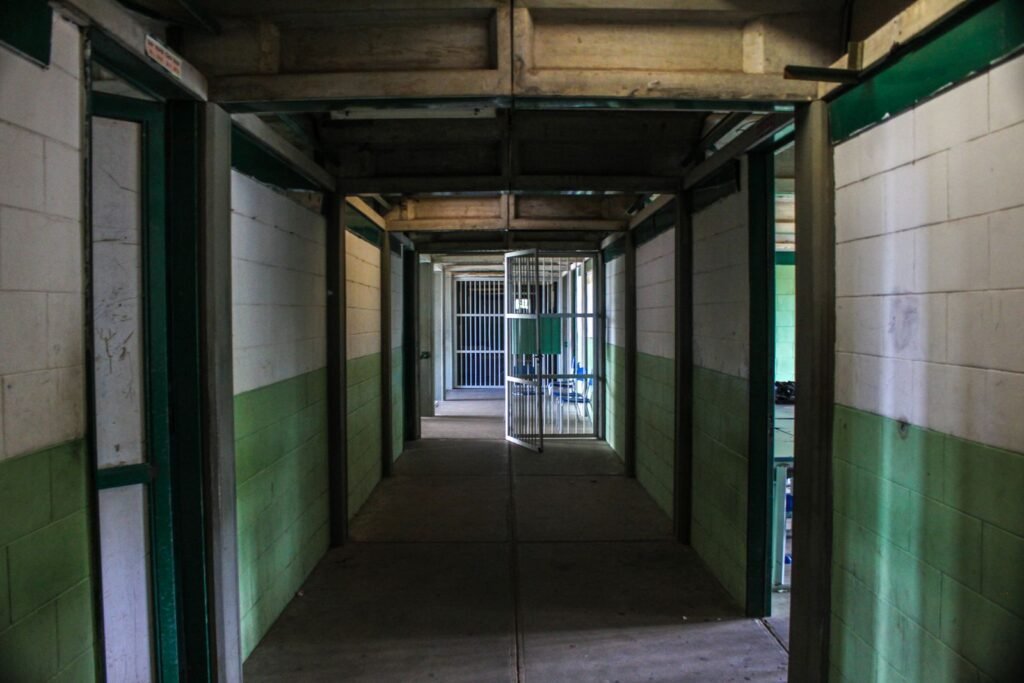
In August 1971, a Stanford psychologist turned a university basement into a mock jail, handed a group of college-age men uniforms and nightsticks, and pulled the plug six days into a planned two-week run. Fifty-five years later, Netflix has rebuilt the idea inside a real detention center in Georgia, added cameras, a safe word and a streaming budget, and called it The New Stanford Prison Experiment.
The six-episode series premiered on October 21, 2026, and the reaction has been about what you would expect for a show that restages one of the most infamous studies in psychology. As UNILAD Tech reports, one of the show’s producers is now pushing back on the outrage, arguing that this version is a very different thing from what Philip Zimbardo ran at Stanford.
She has a point on the safeguards. Whether that makes the show worth making is a separate question, and the critics are not convinced.
The short version
- Netflix’s The New Stanford Prison Experiment premiered October 21, 2026: six 45-minute episodes, 30 volunteers, a decommissioned wing of a working jail in Canton, Georgia.
- Executive producer Jane Lipsitz says a straight recreation “would be unconscionable,” and points to psychological screening, a safe word and round-the-clock psychologists.
- The 1971 original ran 6 of a planned 14 days and has been badly undermined by archival research showing guards were nudged toward toughness.
- Early reviews range from “rather exhilarating” (San Francisco Chronicle) to a two-star Guardian pan.
- It lands weeks after Netflix drew fire for using an ElevenLabs AI clone of Gene Wilder’s voice in Wonka’s The Golden Ticket.
What Netflix actually made
The series comes from Alfred Street Industries, the company run by Dan Cutforth and Jane Lipsitz, the Emmy-winning producing duo whose credits include Project Runway, Top Chef and Nailed It!. Lipsitz and Cutforth are the lead executive producers, alongside Nan Strait, Dan Volpe, Jeff Grogan and Mike Odair, according to Variety, which broke the release date in mid-September.
The setup: 30 people from a range of backgrounds spend a scheduled two weeks in a decommissioned section of the Cherokee County Adult Detention Center in Canton, Georgia. The rest of the facility is still an operating jail. Eight participants are randomly assigned as guards, split across day and night shifts, and 22 become prisoners. Reviews note that three of the 30 are women, a deliberate break from the all-male 1971 study. Time’s Judy Berman argues the show “incorporates women but doesn’t know what to do with them.”
Watching from outside the cell block is a three-person panel: Harvard behavioral scientist Alison Wood Brooks, Pulitzer Prize-winning journalist Trymaine Lee, and retired federal corrections officer Michael Cantrell, per Slate. Only one of the three is a research scientist, which says a lot about whether this is science or television.
The producer’s defense: “unconscionable” if it were a copy
Lipsitz has been the public face of the pushback. In comments emailed to The Stanford Daily and echoed in Netflix’s own Tudum interview, she acknowledged how the announcement landed. “There was a lot of outrage that anyone would even attempt the Stanford Prison Experiment again,” she wrote, adding that “given what happened with the original, I completely understand that reaction.”
Her argument is that the comparison stops at the title. “If we were simply recreating the original experiment, that would be unconscionable,” Lipsitz said. “But this is a different time, with different participants, different safeguards and, ultimately, a very different journey.”
The safeguards she lists are concrete. Participants made informed decisions when signing up, went through psychological screening before entering, and could leave at any moment. “Everyone had a safe word they could use to opt out at any time, and psychologists were available 24/7 for support,” she said. Multiple outlets report the word was “Pineapple.” Lipsitz also said the team spent more than a year developing the series.
Not everyone at Stanford is buying it. Psychology student Anh-Thu Dang told The Stanford Daily that the show “gives a bad name to Stanford’s psych department.” We could not find any official statement from Stanford University itself, and Netflix declined interview requests from at least one critic, Reality Blurred’s Andy Dehnart.
The study it is borrowing from has not aged well
The basic story of 1971 is familiar. Zimbardo recruited young men through a newspaper ad offering $15 a day, roughly $125 in today’s money. Twenty-four were selected after psychological screening and randomly split into prisoners and guards. The “prisoners” were picked up at home by real Palo Alto police officers. The run was planned for two weeks and was shut down after six days, after Christina Maslach, then a graduate student, confronted Zimbardo about what she saw in the basement.
For decades, the takeaway taught in intro psych classes was that ordinary people placed in a toxic system turn cruel on their own. That claim has taken serious damage. French researcher Thibault Le Texier went through the Stanford archives and interviewed 15 of the original participants for his 2018 book Histoire d’un mensonge (History of a Lie), then summarized the findings in English in the 2019 paper “Debunking the Stanford Prison Experiment” in American Psychologist.
His core finding is that the guards were told how to behave. The most cited evidence is a recording of the study’s “warden,” David Jaffe, telling a guard that “the guards have to know that every guard is going to be what we call a ‘tough guard.'” Le Texier also flagged biased and incomplete data collection, and reported that a lawyer’s visit raising legal concerns, plus guards losing control of the remaining prisoners, fed into the abrupt ending. Zimbardo dismissed the paper as largely an ad hominem attack. He died at his San Francisco home on October 14, 2024, at 91.
Not every critic goes as far as calling the whole thing staged. A reanalysis of the Jaffe tape by a team led by Alex Haslam found experimenter influence was significant, while stopping short of saying coaching alone explains the cruelty. Either way, the experiment is now widely treated as a lesson in research ethics and experimenter bias rather than solid evidence about human nature.
Prison TV has been tried before, with scientists in charge
Netflix is not the first to put this idea on television. In 2002, the BBC aired The Experiment, a study designed and run by psychologists Steve Reicher and Alex Haslam. Fifteen men were randomly assigned as prisoners or guards in a specially built institution, and the study ended early, on day eight.
What happened there was close to the opposite of the Stanford legend. In their 2006 paper in the British Journal of Social Psychology, Reicher and Haslam reported that the guards failed to identify with their role and were reluctant to impose authority, and the prisoners eventually overcame them. The group then tried an egalitarian commune, and when that collapsed, moves toward a tyrannical regime met weakening resistance. Their conclusion was that powerlessness and the failure of groups are what make tyranny psychologically acceptable.
The BBC version also had real research ethics. Approval from the University of Exeter was conditional on safeguards, including three-phase screening involving independent clinical psychologists, constant monitoring, and an independent ethics panel that could halt the study at any time. That is the benchmark Netflix’s guardrails should be measured against.
| Stanford (1971) | BBC Prison Study (2002) | Netflix (2026) | |
|---|---|---|---|
| Run by | Philip Zimbardo, Stanford | Reicher and Haslam, with the BBC | Alfred Street Industries for Netflix |
| Participants | 24 men selected | 15 men | 30 people, 3 women |
| Setting | University basement | Purpose-built mock prison | Unused wing of a working jail, Georgia |
| Length | 6 of 14 planned days | 8 days, ended early | Scheduled for 2 weeks |
| Oversight | Researcher also acted as superintendent | University ethics approval, independent panel | Screening, safe word, on-call psychologists, 3-person panel |
What the critics are saying
The early reviews are mostly rough. The Guardian’s Jack Seale gave it two stars under a headline asking whether anyone could believe “this insulting TV show is real.” Reality Blurred’s Andy Dehnart wrote that two episodes produced “absolutely nothing surprising” and compared the show unfavorably with, of all things, an AI-recreated Gene Wilder reading about Everlasting Gobstoppers over a jail loudspeaker. Slate concluded the show is “certainly different, but I wouldn’t say it’s better,” and Ready Steady Cut called it a waste of time.
The San Francisco Chronicle is the notable outlier. It called the show Netflix’s “altogether gentler take” on a flawed simulation and said it is “genuinely surprising, and rather exhilarating,” how the experiment ends. We will not spoil it here.
The bigger worry among critics is less about cruelty on camera and more about viewers mistaking a produced reality show for science. A cast of 30, a mixed panel and editing for drama make good TV, not a controlled study.
Netflix’s reality track record does not help
Lipsitz is asking audiences to trust Netflix’s safeguards, and the company’s unscripted history makes that harder. In November 2023, a UK law firm sent letters of claim to Studio Lambert on behalf of Squid Game: The Challenge contestants, citing hypothermia and nerve damage after hours of standing still in the cold during a “Red Light, Green Light” shoot at Cardington Studios. The show’s spokesperson said at the time that no lawsuit had been filed.
Love Is Blind has drawn actual lawsuits. Season 2 contestant Jeremy Hartwell sued Netflix, Kinetic Content and Delirium TV, alleging cast members were given alcohol while food and water were limited, paid below Los Angeles County minimum wage, and faced a $50,000 penalty for leaving early. Kinetic said there was “absolutely no merit” to the claims; the parties later reached a settlement of undisclosed size. Netflix has had a busy legal calendar beyond reality TV too, including the trademark lawsuit a metal band filed over KPop Demon Hunters.
The Wonka problem
The timing is awkward. Wonka’s The Golden Ticket, a nine-episode competition show built on Willy Wonka & the Chocolate Factory, premiered on September 23, 2026, with an ElevenLabs-generated recreation of Gene Wilder’s voice guiding contestants. Wilder died in 2016. His widow, Karen Wilder, approved the use, and the estate called the show a celebration of what he brought to the role. Variety’s review called it a “ghoulish misuse of AI,” and plenty of viewers agreed.
Estate consent is not the same as consent from the performer, and there is still no unified rulebook for digital recreations of dead actors. It is the same unease that surrounds the researcher who built an AI copy of herself to study griefbots: the technology works well enough that the ethical questions now arrive before the rules do.
Put the two shows side by side and you get a pattern. Netflix keeps reaching for famous, emotionally loaded material, whether that is a beloved dead actor or a notorious psychology study, and promising that modern safeguards make it fine. Sometimes the safeguards are real. Lipsitz’s list is better than anything Zimbardo had in 1971. But “safer than a discredited 1971 experiment” is a low bar, and the reviews so far suggest the show has not given anyone a strong reason to clear it.
Sources and further reading
- UNILAD Tech: Netflix producer hits back at outrage over recreation of Stanford Prison Experiment
- Variety: Inside Netflix’s controversial reality series
- Variety: Netflix sets New Stanford Prison Experiment for October release
- Netflix Tudum: Interview with Jane Lipsitz
- The Stanford Daily: Netflix show inspired by Stanford Prison Experiment releases
- CNN: Netflix reimagines the infamous Stanford Prison Experiment
- Slate: Netflix’s show went just about how you’d expect
- Time: The baffling gender politics of Netflix’s New Stanford Prison Experiment
- San Francisco Chronicle: Safer than the original. Is it better?
- Reality Blurred: New Stanford Prison Experiment review
- The Cinemaholic: Where The New Stanford Prison Experiment was filmed
- Le Texier (2019): Debunking the Stanford Prison Experiment, American Psychologist
- Stanford Report: Philip Zimbardo dies at 91
- Reicher and Haslam (2006): Rethinking the psychology of tyranny, the BBC Prison Study
- The Hollywood Reporter: Squid Game: The Challenge injury claims
- TheWrap: Love Is Blind contestant sues Netflix and Kinetic Content
- NBC News: Netflix turns Willy Wonka’s chocolate factory into a social experiment
- The Next Web: Netflix’s Wonka show uses an AI Gene Wilder voice
About this article: GeekBlog covers U.S. technology news, AI, phones, smartwatches and gaming. Every story is written and checked under our Editorial Policy. Spotted a mistake or have a story tip? Contact our editors.
