

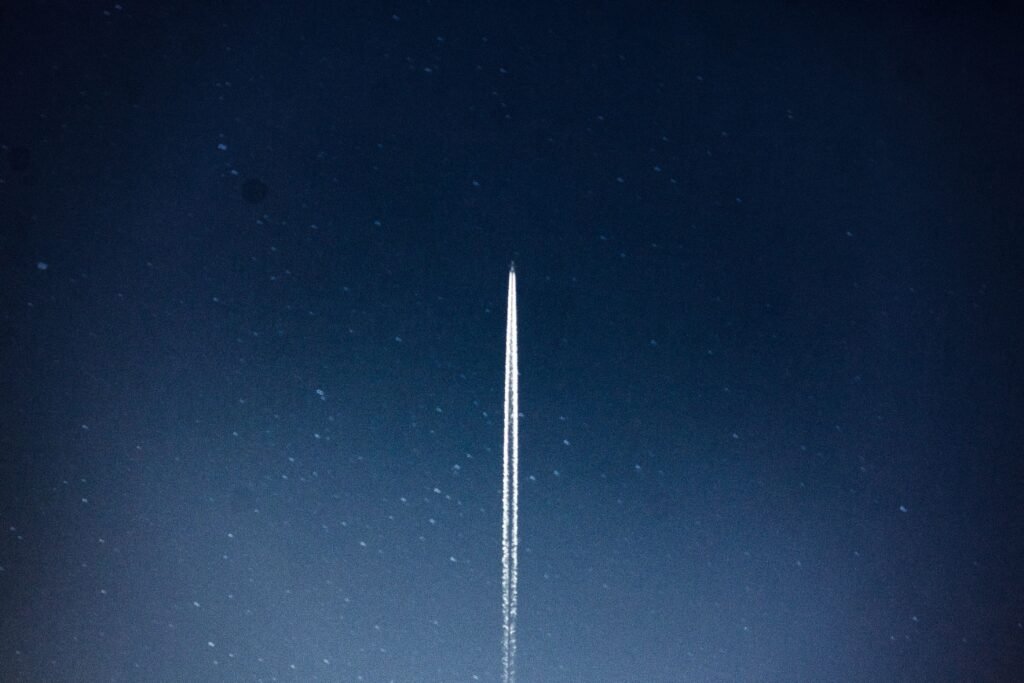
At 7:26 in the morning on August 30, a Falcon Heavy lifted off from Launch Complex 39A at Kennedy Space Center carrying an observatory that exists because a spy agency had a spare part lying around.
The Nancy Grace Roman Space Telescope is now three months into a million mile cruise toward a gravitational parking spot beyond the Moon. When it gets there and opens its eye, it will do something neither Hubble nor Webb can do: photograph an enormous slice of sky in one shot, at Hubble’s level of detail, over and over, for years.
The short version
- What launched: NASA’s Nancy Grace Roman Space Telescope, on a SpaceX Falcon Heavy, at 7:26 a.m. EDT on August 30, 2026
- The mirror: 2.4 meters wide, exactly Hubble’s size, originally built for the National Reconnaissance Office and handed to NASA in 2011
- The trick: Hubble resolution across a field of view at least 100 times larger, which NASA says lets it survey the sky roughly 1,000 times faster
- Where it is going: the L2 point, about 1.5 million kilometers out, the same neighborhood as Webb. Arrival takes about three months
- When you see pictures: NASA expects the first images in early 2027
The mirror nobody needed
In January 2011, the National Reconnaissance Office called NASA with an unusual offer. It had two complete telescope assemblies sitting in storage that it no longer had a use for, each one estimated to be worth at least $250 million. The optics were Hubble class, 2.4 meters across, built to look down rather than up.
NASA took them. One of those assemblies became the heart of Roman.
It is a great story, and it gets told as a bargain, which is where it starts to mislead. The full mission cost roughly $4.3 billion, and whether the donated optics actually saved money is genuinely argued over by people who track mission budgets. A free mirror still has to be requalified, reconfigured for a completely different job, and wrapped in an instrument package designed around its specific quirks. What the donation clearly did buy was capability. Because the NRO optics were shorter and wider than a classic Hubble design, they produce a much bigger focal plane, and a bigger focal plane is exactly what a survey telescope wants.
What Roman is actually for
Roman is not a successor to Hubble or a rival to Webb. It is a different instrument answering a different kind of question, and the difference comes down to statistics.
Webb is a light bucket. Its 6.5 meter mirror is built to stare at faint, distant, individual things for a long time. Roman is a census taker. Its job is to photograph vast numbers of galaxies quickly enough that astronomers can do meaningful math on the population rather than on individual members. Over its primary mission, it is expected to measure light from roughly a billion galaxies.
That matters most for dark energy, the thing that makes up about 70 percent of the energy content of the universe and that nobody can explain. The leading candidate is Einstein’s cosmological constant, a fixed vacuum energy baked into spacetime that never changes. The alternative is that dark energy evolves, strengthening or weakening across cosmic time. Telling those apart requires measuring how fast the universe expanded at many different epochs, precisely, and that requires enormous samples. It is a question that a narrow, deep telescope structurally cannot answer alone.
| Roman | Hubble | Webb | |
|---|---|---|---|
| Primary mirror | 2.4 m | 2.4 m | 6.5 m |
| Field of view | At least 100x Hubble’s | The baseline | Narrow, built for depth |
| Built to | Survey huge areas repeatedly | General purpose imaging | Stare deep at faint targets |
| Where it orbits | L2, about 1.5M km out | Low Earth orbit | L2, about 1.5M km out |
| Launched | August 2026 | 1990 | 2021 |
Two instruments, one of them a gamble
The Wide Field Instrument does the heavy lifting and will consume around three quarters of the five year primary mission across three planned surveys: a wide area survey at high galactic latitude, a time domain survey at high latitude built to catch supernovae as they brighten and fade, and a survey pointed at the crowded galactic bulge to hunt for exoplanets through microlensing.
The second instrument is more interesting precisely because it might not work well. The Coronagraph Instrument is formally a technology demonstration, which is NASA’s way of saying nobody is promising results. It uses deformable mirrors that reshape themselves in real time to blot out the glare of a star so that a planet next to it becomes visible. Doing that in visible light, from space, with active optics, has never been done. If it works, it is the direct ancestor of the instrument that would eventually photograph an Earth sized planet around a Sun like star.
The woman on the nameplate
Nancy Grace Roman was NASA’s first chief astronomer and the first woman to hold an executive position at the agency. She spent the 1960s and 1970s doing the deeply unglamorous work of convincing Congress, and quite a few astronomers, that putting a telescope above the atmosphere was worth the money. Hubble exists in large part because she kept making that argument, which is why she is usually called the mother of Hubble.
Naming a survey telescope after her is a better fit than it first appears. Roman’s contribution was not a single discovery. It was building the case, patiently, for infrastructure that would let thousands of other people make discoveries.
What to actually expect
Be patient. The spacecraft has to get to L2, cool down, unfold its solar array and sunshade, and go through instrument commissioning before anyone sees a usable frame. NASA is pointing at early 2027 for the first images, and first images are a public relations event rather than science. The real output starts when the surveys begin and the data releases start landing in public archives, where anyone with the patience to learn the tools can dig through them.
That is the part worth waiting for. Roman is expected to generate an enormous volume of data, and unlike a targeted observatory where telescope time is fought over proposal by proposal, a survey instrument produces a public map that thousands of researchers can mine for questions nobody thought to ask when it launched. Some of the most interesting results will come from people studying things the mission was never designed to find. We have seen that pattern before with galaxies that turned out to be almost entirely dark matter, a finding that came out of survey data rather than a targeted hunt.
Three things worth watching
- L2 arrival and commissioning. The riskiest stretch is over once the instruments are cold and focused
- Whether the coronagraph delivers. It is labeled a demo for a reason, and a good result changes what the next flagship looks like
- The first dark energy constraints. Not the pretty pictures. The numbers that either tighten around the cosmological constant or start to pull away from it
The honest read
A telescope built around military surplus optics sounds like a shortcut, and the framing does the mission a disservice. Roman took fifteen years, $4.3 billion, and a redesign of nearly everything behind the mirror. The donated hardware did not make it cheap. It made it possible to build a wide field survey instrument at Hubble resolution, which is a genuinely different machine from anything currently flying.
What that machine produces will not look like the images that made Webb famous. It will look like catalogs, and catalogs are where the arguments about what the universe is made of actually get settled. NASA has spent a lot of the past year managing expectations about what its science program can afford, and against that backdrop a working survey telescope arriving on schedule is a bigger deal than it sounds. It also joins an agency that has been unusually busy explaining itself lately, from closing the book on the 2024 YR4 asteroid to swatting down hoaxes that traveled further than the facts did.
