

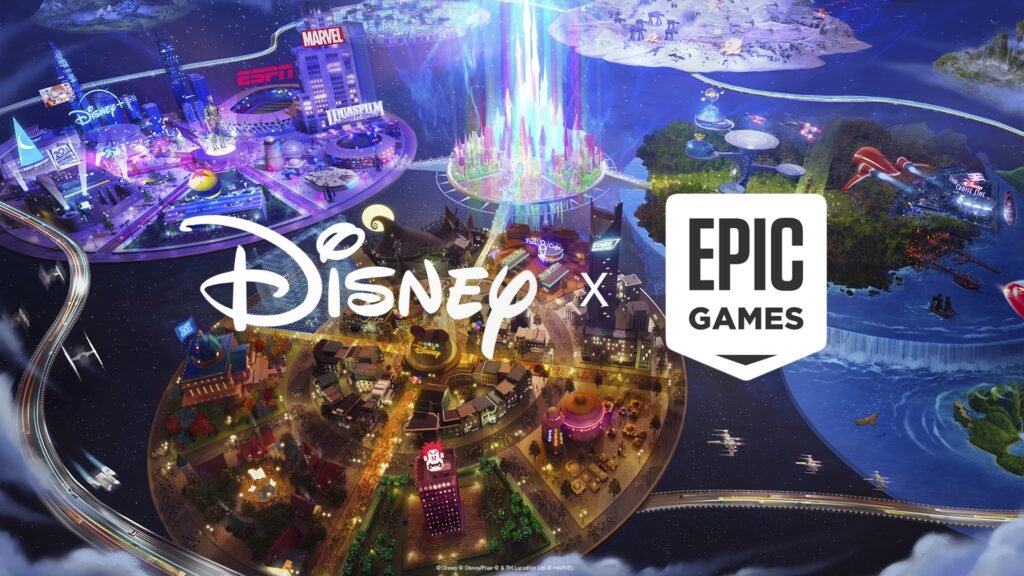
Featured image: Disney and Epic Games Fortnite universe key art via The Walt Disney Company
Epic Games has a Marvel and Star Wars shooter that nobody outside the company has officially seen, and as of this week it also has no release date. According to a Bloomberg report from Jason Schreier, the game was aiming for March 2027 before Epic pulled the brakes and told the team to rebuild its workflow around AI. The detail that has set the industry talking is a message from one director, who reportedly told staff there would be no more hand-written code.
Epic’s CEO Tim Sweeney has since confirmed that a large internal change is underway, though the company has not formally announced the game or the delay. Here is what has been reported, what Epic has actually said, and why this matters well beyond one unannounced shooter.
The short version
- The game: An unannounced shooter featuring Marvel and Star Wars characters, tied to Epic’s partnership with Disney
- The delay: Reportedly slipped from a March 2027 target to no date at all
- The mandate: Developers were reportedly told to work “AI first,” using tools such as Anthropic’s Claude, with humans guiding the output
- Epic’s response: Sweeney said “We have a huge pivot underway here at Epic” and a spokesperson said the company is embracing AI-accelerated development
- Not confirmed: The specific orders about code and art come from anonymous sources, and neither Epic nor Disney has announced the game
What Bloomberg actually reported
The story broke on October 12. Per Bloomberg, the shooter was already running behind schedule, because Epic had underestimated both the staffing and the time the project would need. Rather than simply moving the date, leadership reportedly decided to change how the game is made.
Developers were told to adopt an “AI first” production model. Tools such as Anthropic’s Claude would handle core development tasks, while people would manage and guide the output. A director’s internal message reportedly said there would be “no more hand-written code” and that the game’s art would be “generated with full AI workflows.”
Staff reaction, as relayed by outlets summarizing the Bloomberg piece, was far from enthusiastic. The news reportedly came as a shock to a number of developers. Some questioned how mistakes in AI-generated work would be caught and fixed, and others doubted the plan would succeed at all.
Reported versus confirmed
Based on Bloomberg’s report and public statements from Epic as relayed by Tom’s Hardware, Quartz and others.
| Claim | Status |
|---|---|
| Epic is pivoting developers toward AI-accelerated work | Confirmed by Sweeney and Epic |
| The Marvel and Star Wars shooter was delayed | Reported by Bloomberg, no official announcement |
| Original target was March 2027 | Reported, with one outlet citing a different year |
| “No more hand-written code” and art from “full AI workflows” | Anonymous sources, not confirmed by Epic |
| Disney’s reaction | Disney did not respond to Bloomberg’s request for comment |
What Epic and Sweeney have said
Epic did not leave the story unanswered. Sweeney posted on X the same day, writing that “We have a huge pivot underway here at Epic,” and describing a reorganization of developers to retool for maximum AI acceleration. He framed the goal as letting staff build more, not doing the same work with fewer people. In a later post he described the aim more modestly, as surviving the AI revolution and helping other developers do the same.
Epic communications director Jake Jones gave a statement saying the company is “embracing AI-accelerated development, led by Epic developers who are the visionaries and creative drivers for everything we do.”
That wording is careful. It confirms the direction without confirming any of the hard rules attributed to the unnamed director. Anyone reading the Bloomberg details as settled policy is going further than Epic has gone on the record.
How Epic got here in 2026
The AI pivot lands in a year that has already been rough for the company. Fortnite engagement began slumping in 2025, and Epic ended up spending more than it earned. On March 24, Sweeney told employees that Epic would cut about 1,000 jobs and pursue more than $500 million in identified cost savings, covering contracting, marketing and open roles. He said at the time that the cuts were not related to AI.
Epic’s road to the delay
Key dates compiled from Disney’s announcement, Epic’s layoff memo coverage and Bloomberg’s report.
When Disney announced its investment, Epic and Disney said they wanted to build a persistent, open universe where people could play, watch, shop and create with Disney, Pixar, Marvel, Star Wars and Avatar characters. After the March layoffs, Epic president Adam Sussman said the vision for the Disney project was unchanged. This shooter appears to be one piece of that partnership.
Why a “no hand-written code” order is a big deal
Studios have used AI tools for years for tasks such as concept art, QA triage and boilerplate code. What stands out in this report is the scale of the ask. A blanket rule on code and art is a very different thing from giving developers an assistant, and it is applied here to a high-profile licensed game, where the characters belong to one of the most protective rights holders in entertainment.
| Open question | Why it matters |
|---|---|
| Quality control | Staff reportedly asked who is responsible when AI-generated work contains errors |
| Disney approval | Marvel and Star Wars art normally goes through strict brand review, and AI-generated assets add a new variable |
| Schedule | A retooled pipeline on a game that was already late could cost time before it saves any |
| Jobs | Sweeney says the goal is building more, but staff have reason to read a mandate like this as a headcount question |
To be fair, the reporting has not shown that Disney’s approval process or the quality of the AI output caused the delay. Bloomberg’s sources point to the project being behind schedule first. The AI pivot is the response, and whether it speeds things up is untested.
The wider fight over AI at game studios
This is not happening in a vacuum. Labor and AI have been colliding across the industry for months. Blizzard’s union recently won the right to bargain before Microsoft can use AI on their jobs, which is the opposite approach to what Epic’s staff reportedly experienced: a contract guardrail rather than a top-down order.
Platform holders are also under pressure to ship fresh franchises with shrinking teams. After Bethesda took control of Obsidian, Xbox CEO Asha Sharma was reported this week to have warned staff that the division will not survive if it only revives the past. Epic’s gamble is a different answer to the same squeeze: build more, faster, with fewer hands.
The model side of the story is moving quickly as well. If you want to see how fast the tooling behind these mandates is changing, take a look at how Anthropic pulled internet access from its AI agent tests after agents behaved in unexpected ways. It is a reminder that autonomous coding tools still need careful supervision.
What to watch next
Three things will tell us whether this is a bold reset or a costly detour. First, whether Epic or Disney formally announces the game and a new window. Second, whether Epic gives details on how much of the final product will use AI-generated art and code, since that will matter to Disney and to players. Third, how the team itself responds, because retention on a project that is already behind schedule is a risk of its own.
For now, the fair summary is this: Epic really is changing how it builds games, and a high-profile Disney shooter is reportedly the first big test. The most dramatic details are still unconfirmed, and the next real signal will be either a trailer or a quiet silence.
Sources: Tom’s Hardware, Quartz, Inven Global, PC Gamer, Games.gg, The Walt Disney Company.
About this article: GeekBlog covers U.S. technology news, AI, phones, smartwatches and gaming. Every story is written and checked under our Editorial Policy. Spotted a mistake or have a story tip? Contact our editors.
