

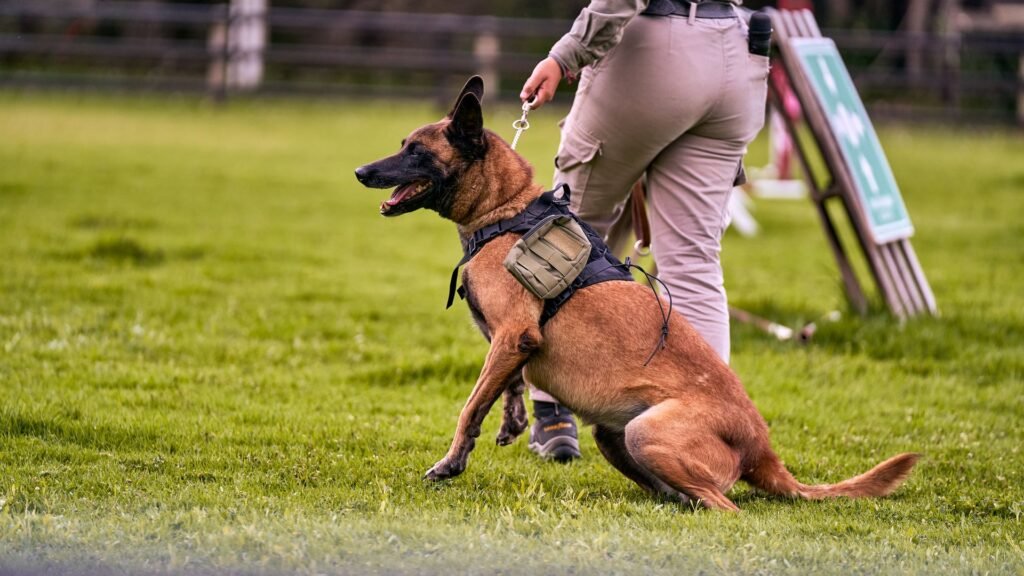
The U.S. military has a dog problem, and two of the most headline-friendly founders in tech think the answer is a lab. Warhound, a Texas startup dreamed up by Anduril founder Palmer Luckey and Colossal Biosciences CEO Ben Lamm, came out of stealth on October 22 with $200 million in seed money and a plan to clone and gene-edit working dogs for the armed forces, police and first responders. UNILAD Tech summed up the reaction online in one phrase Lamm himself used: the “Captain America” of dog programs.
Strip away the comic book framing and the pitch is more practical than it sounds, and also a lot less finished. No Warhound dog exists yet. The company has no signed customers and no price. What it does have is a real supply chain gap, a stack of serious investors and a timeline that puts the first cloned puppies on the ground in early 2027. Here is what is actually known.
The short version
- Warhound raised a $200 million seed round, reportedly at a $1.2 billion valuation, from backers including Sequoia Capital, In-Q-Tel, ARK Invest and Franklin Templeton.
- The plan: biobank cells from proven working dogs, edit out inherited diseases, and clone them through Viagen, a cloning company Colossal owns.
- Anduril supplies gear the dogs wear, such as armor, eye and ear protection and links to its EagleEye system. Nothing goes inside the dog.
- First births are expected in early 2027, with dogs in service in roughly two years.
- Luckey holds no equity. Colossal owns a stake and licenses its technology. Former Pentagon chief data officer David Spirk is CEO.
The problem Warhound says it is solving
The Pentagon’s Military Working Dog Program fields more than 2,200 dog and handler teams, according to the company. Most of those dogs are not American. Warhound says more than 80% are bought from Europe.
That figure lines up with older government data. When Bloomberg Government looked at Air Force purchasing records, 407 of the 427 dogs the Air Force bought in 2019 were born overseas, as Military Times reported at the time. The Senate Armed Services Committee has warned that “due to the finite number of breeders overseas, as well as rising market demand, the cost to procure whelped military working dogs from Europe is skyrocketing.” Lamm also points to an American Kennel Club assessment that there is “now a shortage of even mediocre quality foreign dogs available,” and says the U.S. is bidding against other governments, China and Russia among them, for the same animals.
Then there is attrition. According to Warhound, fewer than half of the dogs bought are judged fit for service after an acquisition and training pipeline that takes about three years. That means buying and training roughly 200 dogs to field 100. Air Force officials have given similar numbers for years, describing about half of candidates washing out of training and certification.
Each of those dogs is expensive. Published estimates vary depending on what is counted, but Air Force figures cited over the years put direct training at around $20,000 per dog and the cost of delivering one to an operational unit at more than $40,000. Some handlers and the AKC put the value of a fully trained detection dog well above $100,000. Every washout is money spent on an animal that never deploys.
How Warhound wants to build a better dog
Lamm laid out the plan to Fortune in stages. First, find dogs that have already finished training and proven themselves, then biobank their genetic material. Second, clone those dogs. Third, make targeted gene edits.
The clones would come mostly from Belgian Malinois, the breed favored by special operations units, along with some shepherds and Labradors. Viagen, the Texas company Colossal owns and the best-known commercial animal cloner in the U.S., will handle production. The first edits are defensive. Warhound wants to remove variants tied to hip dysplasia, muscle degeneration and certain cancers so that “no dog enters service carrying genetic markers known to cause common career-ending conditions.”
The later goals are fuzzier. Lamm told Fortune the company is still working out which other traits are “scientifically and responsibly actionable,” while also “planning future genetic enhancements to improve their already exceptional performance.” Reports have mentioned speed, agility and a sharper nose for explosives. None of those edits have been described in any detail, and Lamm himself concedes that “training and environment will always influence performance.” A clone is a genetic twin, not a copy of the dog’s experience.
Anduril’s role is hardware. It will supply body armor, eye and ear protection and integration with its EagleEye system, so that “dogs, handlers, and autonomous systems operate as one team.” The launch release calls this gear “cybernetic Augments,” which is doing a lot of work for what is essentially a smart vest. If you have followed the Pentagon’s push toward drones and autonomy, including its plan to build a dedicated autonomous warfare command, the pitch of a dog as “the oldest autonomous system there is” will sound familiar.
What is claimed and what has been shown
| Claim | Where it stands | Status |
|---|---|---|
| $200M seed round | Reported by Fortune; $1.2B valuation per TechCrunch | Confirmed |
| 80%+ of dogs from Europe | Company figure, consistent with 2019 Air Force data | Supported |
| Under half pass training | Company figure; officials have cited about half | Supported |
| Cloned working dogs | First cell lines being edited; births expected early 2027 | In progress |
| Disease-variant edits | Hip dysplasia, muscle degeneration targeted; no data published | Unproven |
| Performance enhancements | Traits not yet chosen | Aspirational |
| Customers and pricing | No signed customers; “Canine-as-a-Service” model discussed | None yet |
Cloning working dogs is not new
Warhound is not the first to try this. South Korea’s customs service put six cloned sniffer dogs to work in 2009. In 2019, Chinese scientists cloned a top police dog, a Kunming wolfdog named Kunxun, with the stated goal of cutting training time, and Beijing police later added several cloned K-9s. Viagen has cloned pets for paying customers for years, at a posted price of about $50,000 per dog.
What is new is scale and the gene editing layer. Lamm admits nothing at the needed scale exists, so Warhound plans to build national kennel and training infrastructure “starting with private capital.” That is a big operation for a company whose product will not be old enough to start training until well into 2027 or later. Military dogs usually start formal training at around 18 months.
The dire wolf question hangs over it
Colossal’s credibility matters here, because Warhound is built on its tools. In April 2025 the company announced it had brought back the dire wolf. What it actually produced were three pups, Romulus, Remus and Khaleesi, made by editing about 20 sites across 14 genes in gray wolf cells, cloning them and using domestic dogs as surrogates. The IUCN’s Canid Specialist Group responded bluntly that “the three animals produced by Colossal are not dire wolves,” and Colossal’s own chief science officer later described them as gray wolves with 20 edits.
Lamm brushed this aside in the Warhound context. “Our warhounds are genetically modified dogs just like our dire wolves were genetically modified wolves,” he told Fortune. “I assume there is no way for anyone to debate the definition of a dog.” Fair enough on the naming. The open question is whether edits for disease resistance actually reduce washouts, and that is something only years of data on real dogs can answer.
Who is behind it, and the welfare debate
The cap table is unusual for a seed round. Sequoia Capital, In-Q-Tel (the venture arm funded by the CIA and other intelligence agencies), ARK Invest, Franklin Templeton, 8VC, Lux Capital, Breyer Capital and Bob Nelsen are among the named backers, several of whom already invested in Colossal or Anduril. CEO David Spirk spent eight years in the Marine Corps, served as the first chief data officer at U.S. Special Operations Command and later at the Pentagon, and worked on Project Maven. Despite the headlines, Lamm says he and Luckey “developed the concept” but are not co-founders, and Luckey owns no equity.
Reaction online split fast. Some people asked why the military would not just use robot dogs. Others worried that engineered animals would be treated as more expendable. Warhound is trying to get ahead of that. American Humane has signed on to certify its training programs and to reunite retired dogs with their former handlers, and its president, Robin Ganzert, said the program could make “health, welfare, and exceptional care fundamental to a working-dog program from the very beginning.” Lamm also rejects the robot comparison outright: “No machine today matches a dog’s nose or its judgment in complex environments.”
For now, Warhound is a well-funded promise. The supply problem is real and documented, the cloning technology works, and the gene editing is the part nobody can grade yet. Check back in early 2027, when the first puppies are due. That is when this stops being a press release and starts being a dog.
Sources and further reading
- UNILAD Tech: $200 million Warhound startup plans to genetically engineer the ‘Captain America’ of dogs
- Fortune: Palmer Luckey teams with Ben Lamm to launch $200 million Warhound
- Tech Funding News: Warhound raises $200M at a $1.2B valuation
- SOFX: Warhound raises $200 million to clone and gene-edit military working dogs
- Military Times: What would it take for the U.S. military to “buy American” for working dogs?
- IUCN SSC Canid Specialist Group: statement on Colossal’s dire wolf claims
- American Kennel Club: What are military working dogs?
About this article: GeekBlog covers U.S. technology news, AI, phones, smartwatches and gaming. Every story is written and checked under our Editorial Policy. Spotted a mistake or have a story tip? Contact our editors.
