

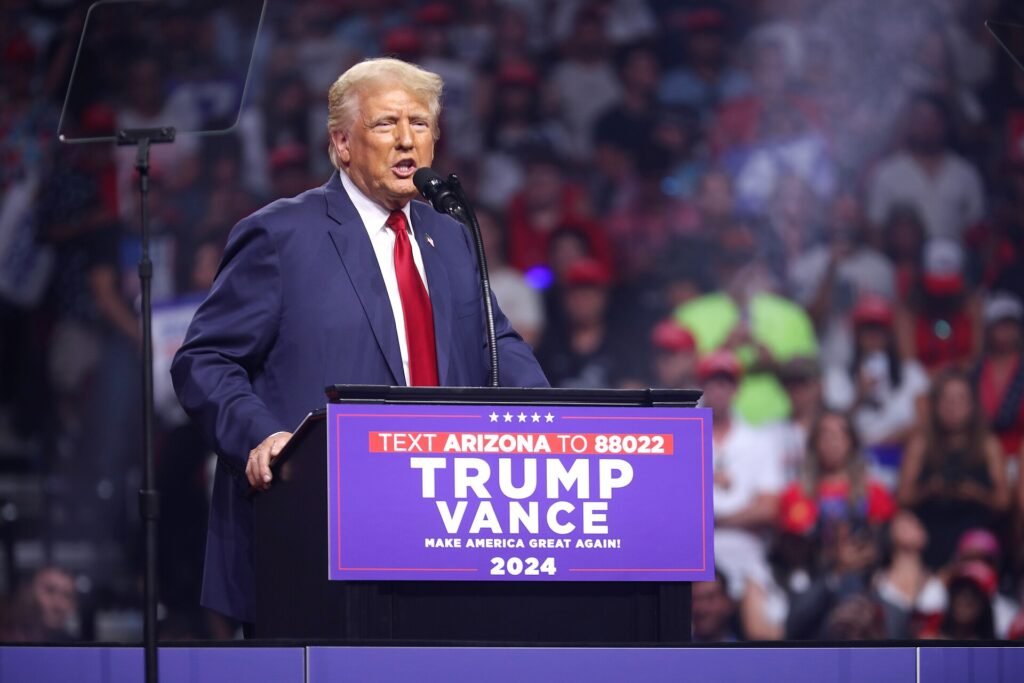
Donald Trump turned 80 this year, and the question of how he’s aging has followed him through the midterm campaign. On November 1, The New York Times tried to answer it with data instead of clips. Its reporters went through a decade of Trump’s speeches, interviews, social media posts and public schedules, and used an AI model to grade thousands of speech passages for rambling and incoherence.
The headline numbers spread fast, including in UNILAD Tech’s write-up. He swears about two and a half times as often as he did in 2015. His speeches run twice as long. His “all-or-nothing” language is up 19%. We pulled together what the analysis found, how this kind of AI text analysis actually works, and why the Times itself says the numbers can’t diagnose anything.
The short version
- The Times reviewed Trump’s public output since 2015 and used an AI model to score more than 6,500 speech passages for rambling.
- Rambling and confusing digressions are up 2.5 times compared with his 2016 rallies.
- Swearing rose from about 6 to about 15 words per 10,000. Average remarks grew from 42 to 85 minutes.
- Absolutist words like “always,” “never” and “completely” are up 19% from a decade ago and 5% from 2024.
- The Times notes that language changes alone can’t establish cognitive decline. The White House says Trump is in excellent health.
What the Times actually measured
This wasn’t one model reading transcripts and spitting out a verdict. According to a summary of the piece by The Daily Beast, the Times reviewed thousands of Trump’s speeches, interviews, posts and schedules dating back to 2015. Some measures were simple counting, like how often certain words show up. The harder measure, rambling, used an AI model that assessed more than 6,500 speech passages against a rubric the team built and checked through manual review.
Here’s how the main findings compare across time.
| Measure | About a decade ago | 2024 | Now (second term) |
|---|---|---|---|
| Swear words per 10,000 words | 6 | 14 | About 15 |
| Average length of remarks | 42 minutes | n/a | 85 minutes |
| All-or-nothing words | Baseline | Lower than now by 5% | Up 19% on a decade ago |
| Rambling or confusing digressions | Baseline (2016 rallies) | n/a | 2.5 times more frequent |
| Vocabulary level | 4th to 5th grade | 4th to 5th grade | 4th to 5th grade (little change) |
| Official events per day | 2.1 (first term) | n/a | 1.3 |
| Social media posts per day | 13 (2016) | 34 | 21 |
A few details from the Times findings, as reported by the Seoul Economic Daily, are worth adding. In his second term, Trump has posted between midnight and 5 a.m. on roughly three days out of every ten. There have been 240 instances of him publishing more than ten posts in a single hour. And his vocabulary is the one measure that has barely moved. It sits at a fourth to fifth grade level, compared with the eighth grade level that’s typical for past presidents.
How AI reads a speech
The interesting tech story here is the method, because it’s the same toolkit researchers have used for years to study language and the brain. It comes in two layers.
The first layer is counting. You take a transcript, define a list of words, and measure how often they appear per 10,000 words so long and short speeches can be compared fairly. Swear words and absolutist words such as “always,” “never,” “totally” and “everything” fall into this bucket. It’s cheap, transparent and easy to repeat. Psychologists have used the same approach before. A 2018 study by Mohammed Al-Mosaiwi and Tom Johnstone in Clinical Psychological Science found absolutist words were far more common in online forums about anxiety, depression and suicidal thoughts than in control forums.
The second layer is judgment, and that’s where the AI model comes in. “Rambling” can’t be counted with a word list. You need to read a passage and decide whether it stays on topic or wanders through a chain of digressions. The Times used a model to score more than 6,500 passages against a rubric, and used manual review to shape that rubric. That’s a common setup in AI research, sometimes called “LLM as a judge.” It scales well, but its quality depends heavily on how clearly the rubric is written and how carefully humans check the model’s calls.
1. Collect transcripts (speeches, rallies, interviews) by date
2. Normalize: count total words per transcript
3. Lexicon pass: swear words, absolutist words per 10,000 words
4. Split speeches into passages
5. AI judge: score each passage for coherence using a fixed rubric
6. Human check: compare a sample of AI scores with manual ratings
7. Compare averages across years (2015, 2016, 2024, now)
The research behind the worry
Why would anyone link word counts to brain health in the first place? Because language often changes before other symptoms are obvious. One of the best-known studies looked at another president. In 2015, researchers at Arizona State University led by Visar Berisha compared Ronald Reagan’s press conferences with those of George H.W. Bush. Reagan’s speech showed a drop in unique words and a rise in fillers and vague nouns over his presidency. Bush’s didn’t. Reagan was diagnosed with Alzheimer’s disease in 1994, years after he left office.
Researchers found something similar in the novelist Iris Murdoch, whose final book showed a narrower vocabulary than her earlier work before her Alzheimer’s diagnosis. Today, several research groups and startups are training models to flag early cognitive decline from voice recordings and speech samples.
There’s an important difference, though. Those studies are built around clinical diagnoses and careful comparisons. The Times analysis is journalism. It describes how one man’s public speaking has changed, and it’s careful to say that language changes alone can’t establish cognitive decline.
Where the method falls short
We think the analysis is useful and worth reading. It’s also worth being clear about its blind spots.
| Limitation | Why it matters |
|---|---|
| Style is a choice | Trump’s rally persona is built on improvising. More swearing or longer riffs could be a strategy that plays well with his base, not a symptom. |
| Context shifts | A candidate in 2015 and a sitting president in a midterm year speak to different audiences under different pressure. |
| AI judges aren’t neutral | An AI scoring “incoherence” reflects its rubric and training. Manual checks help, but they don’t remove judgment calls. |
| No baseline group | Clinical studies compare against healthy people of the same age. Here, the only comparison is Trump with his younger self. |
| No medical data | Diagnosis takes clinical exams and imaging. Public speech is one signal among many. |
Pollster Frank Luntz made the strategy point himself, saying the rough rhetoric can come across to Trump’s core supporters as candid and unvarnished. Whether that persuades anyone else is another question.
What the White House says
The White House physician has repeatedly described Trump as being in excellent health, and has said his cardiovascular age is about 14 years younger than his actual age. Trump has said he has passed three cognitive tests, including the Montreal Cognitive Assessment (MoCA), and bragged about it in his usual style: “Nobody can do this, but I can. You know why? Because I’m a freaking genius!” He has also hit back at questions about his health. When a Reuters reporter asked about it last week, he told the reporter, “You are sick.”
Worth knowing: the MoCA is a 10-minute screening test scored out of 30. It’s designed to flag people who might need a fuller evaluation. Passing it is a good sign, but it’s a screening, not a full neurological workup.
AI and the White House keep colliding this year. Read our explainer on why Trump wants the term “AI” banned and what federal websites have already changed. And if aging and memory are on your mind for other reasons, here’s our guide to GPS watches that actually help people living with dementia.
Sources and further reading
- UNILAD Tech: AI was used to examine a decade of Trump’s speeches
- The New York Times: Trump’s speeches and the question of age (subscription)
- Seoul Economic Daily: Trump’s Speeches Double in Length as Profanity Jumps 2.5-Fold
- The Daily Beast via Yahoo News: Trump, 80, Shows Fresh Signs of Decline in New Analysis
- Clinical Psychological Science: In an Absolute State (Al-Mosaiwi and Johnstone, 2018)
- Journal of Alzheimer’s Disease: Tracking discourse complexity preceding Alzheimer’s disease diagnosis (Berisha et al., 2015)
- MoCA Cognition: About the Montreal Cognitive Assessment
About this article: GeekBlog covers U.S. technology news, AI, phones, smartwatches and gaming. Every story is written and checked under our Editorial Policy. Spotted a mistake or have a story tip? Contact our editors.
