

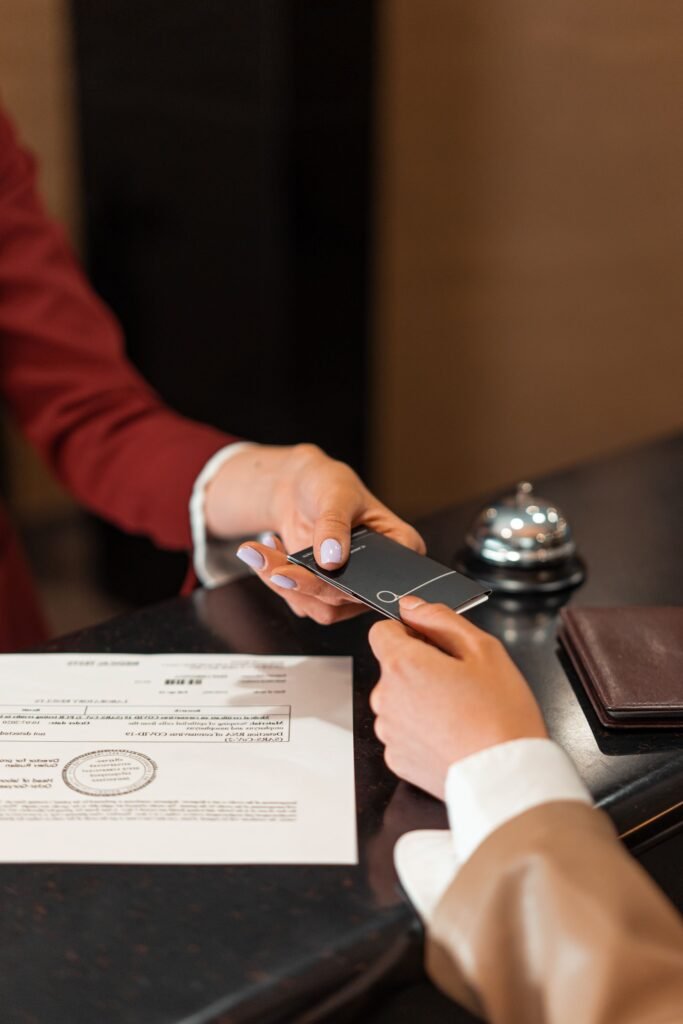
Morgan Fairhurst and Matt Baguley did what most of us do on vacation: they signed for things. Lunch, dinner, drinks by the pool, all charged to the room at a hotel in Marrakech in June 2025. By day three or four they started wondering what the tab looked like. Their guess was about £600. The real bill came to roughly £900 to £950, and it showed up as a three-page PDF they struggled to match to anything they remembered doing.
The two friends, both 26 and based in the UK, told UNILAD Tech that the shock led to a startup. StayPay, built by two founders who can’t code, using AI “vibe coding” tools, now has its first paying clients in Scotland. We checked the company, read its website, and looked at why a bill you sign for line by line can still surprise you at checkout. Then we put together a routine that stops it happening to you.
The short version
- The founders guessed £600 and were billed about £900 to £950, so the final tab came in 50% to 58% above their guess.
- StayPay Ltd is real: registered in England on November 28, 2025, with Fairhurst and Baguley as its two directors.
- The live product is a browser-based guest hub for Airbnb-style hosts. The hotel “live bill” feature is still on a waitlist.
- US and UK price rules now force resort and cleaning fees into the headline price. Neither covers the drinks you sign for during your stay.
- You can track it yourself: ask for an interim folio, turn on card alerts and check every line before you leave.
The £950 question: what the bill really was in dollars
UNILAD put the bill at “$1,200,” which is the low end. At the European Central Bank reference rate on October 30, 2026 (about $1.34 per pound), £900 to £950 works out to roughly $1,206 to $1,273. At the rate in mid-June 2025, when the trip happened ($1.36), it was closer to $1,222 to $1,290. Their £600 guess was about $804 today.
Either way, the gap was £300 to £350. On a trip they said already stretched their budget, that’s the difference between “pricey week” and “maybe we won’t come back.” UNILAD reports the bill left them doing exactly that kind of soul-searching, even though they’d enjoyed the stay.
Is StayPay legit? What we could verify
The company checks out. Companies House lists StayPay Ltd (company number 16879405) as an active private company incorporated on November 28, 2025, registered in Manchester and classed as software development. Matthew Baguley and Morgan Fairhurst are its only directors, both appointed that day, both born in 2000, which fits the “both 26” detail. Its first accounts aren’t due until August 2027, so there is no public revenue figure to check yet.
The Manchester link is real too. StayPay’s site lists Exchange as a backer, which describes itself as a free accelerator for tech, digital and creative founders at Campfield. That matches what the founders told UNILAD about getting advisors and technical help there.
Two small corrections to the original story. First, StayPay isn’t really an app you download. Its FAQ says it is “completely browser-based,” and guests open it through a QR code or link. Second, the pitch on usestaypay.com is aimed at hosts, not travelers. The headline reads “More revenue starts with better stays,” and the tagline is “Great stays pay.” Hosts get a dashboard to sell add-ons such as early check-in, late checkout and welcome packages, plus a guest guidebook, local recommendations and StayAI, a chatbot that answers questions from the property’s own information.
The feature that would have saved the founders in Marrakech is the hotel product. StayPay’s hotel page promises “real-time guest bill visibility,” split payments and digital checkout, connected to the hotel’s property management system (PMS). Right now it is a “Join the waitlist” button, and the homepage says PMS integrations are “coming soon.” The concierge partner and local business tiers are also marked “Coming Soon.” Read the pitch closely and you’ll also find the line that sums up the business model: a live bill “removing uncertainty while encouraging confident in-stay spending.”
Why room charges sneak up on you
The hotel trick here wasn’t a hidden fee. It was friction removal. Charge-to-room is designed so you never see a total while you’re spending. Each tab is small, you sign for it without opening a wallet, and the running sum lives in the hotel’s PMS, not on your phone. Your bank sees nothing until checkout, when it all lands as one charge. Add a currency you don’t think in, and you have the perfect setup for a bad guess.
The paperwork doesn’t help. Hotel folios list items by outlet code and timestamp, often with service charges and taxes on separate lines, so a three-page PDF is normal for a week of signing for things. Tying “POOL BAR 14:32” back to a specific afternoon is work most people skip until the total stings.
What the new fee laws fix (and what they don’t)
Regulators have spent the last two years going after a different problem: fees you can’t avoid that don’t appear in the advertised price. The US Federal Trade Commission’s Rule on Unfair or Deceptive Fees took effect on May 12, 2025 for live-event tickets and short-term lodging, which covers hotels and vacation rentals. Mandatory fees must be included in the total price, and that total must be the most prominent price shown. Taxes and optional extras can be left out. The rule doesn’t ban any fee. It bans hiding one.
The UK moved first. Since April 6, 2025, the Digital Markets, Competition and Consumers Act has banned drip pricing, and the Competition and Markets Authority’s guidance on unfair commercial practices (updated November 18, 2025 with price transparency guidance) treats resort fees and local taxes payable at a hotel as mandatory charges that belong in the headline price. Airbnb, meanwhile, made total price display the global default on April 21, 2025, showing fees before taxes in search results. It says almost 17 million guests had already used its optional toggle.
| Charge | Typical example | US: in headline price? | UK: in headline price? |
|---|---|---|---|
| Resort, destination or amenity fee | $15 to $50 a night (NerdWallet) | Yes, since May 2025 | Yes, since April 2025 |
| Rental cleaning or service fee | Mandatory fee per stay | Yes, if mandatory | Yes, if mandatory |
| Local or tourist tax | Per person, per night in many cities | No, government charges can be left out | Yes, per CMA guidance |
| Food and drink charged to the room | Pool bar, restaurant, room service | No, optional | No, optional |
| Minibar, spa, late checkout | Added during the stay | No, optional | No, optional |
Look at the bottom two rows. That’s where the Marrakech bill came from, and no headline price rule touches it. (Morocco is outside both laws anyway.) Resort fees haven’t gone away either. NerdWallet’s resort fee analysis, updated October 21, 2026, looked at 160 hotels with summer and fall check-ins. Only 30 charged one, but those averaged $33 a day. They’re just easier to see now.
How to keep your own running tab
You don’t need a startup to avoid a StayPay moment. You need about two minutes a day.
[ ] Ask: “Can I see my folio during the stay?” (app, email or front desk)
[ ] Ask for the resort fee and tourist tax in writing
[ ] Pay with a card that has instant purchase alerts
EVERY EVENING
[ ] Request an interim folio, or check the hotel app
[ ] Snap a photo of each signed check (date, outlet, total)
[ ] Log the day’s total in your budgeting app, in your home currency
CHECKOUT
[ ] Ask for the itemized folio before you pay, not after
[ ] Match each line to your photos; query anything unfamiliar on the spot
[ ] Keep the final PDF and your card receipt
Most front desks will print or email an interim folio on request. Big chains are pushing it into their apps: Hilton started letting elite members review their bill and pay with points in the Hilton Honors app on October 21, 2026, starting at 150 US hotels with more than 800 planned by the end of the year. If your hotel has nothing like that, a notes app and photos of each signed check do the job. Our roundup of the best travel apps of 2026 covers a few that handle expenses and currency conversion well.
If a charge is wrong, sort it out at the desk first. Hotels can reverse a folio line far faster than any bank. If that fails, go to your card issuer. Consumer advocate Christopher Elliott told Fox News: “If you can prove, in writing, that the rate is different, you can dispute your credit card charge.” In the US, the Fair Credit Billing Act generally gives you 60 days from the statement showing a billing error. In the UK, Section 75 makes your credit card provider jointly liable when something costing £100 to £30,000 goes wrong. Neither one covers “I drank more than I thought,” which is why the nightly check matters.
Built without code: the vibe coding angle
UNILAD calls vibe coding an “AI tool,” but it’s really a way of working. You describe what you want in plain language and let AI models write the code. The founders said learning it “definitely changed the trajectory of everything.” They’re in big company. Y Combinator CEO Garry Tan told CNBC in March 2025 that for about a quarter of YC’s winter 2025 batch, 95% of the code was written by AI. Investors are paying for it too: Lovable, one of the best-known tools, hit a $13.3 billion valuation this summer.
The catch for anything that touches money is that payments, billing integrations and guest data are where vibe-coded software gets tested hardest. StayPay’s terms of use, updated June 2026, already describe payments flowing through the platform to concierge partners. The hotel product will also need live hooks into property management systems built by vendors who aren’t known for speed. That’s a harder build than a guidebook, and it’s the part still on a waitlist.
Planning a trip with more connected travel tech? We also covered how to check whether your easyJet flight has Starlink Wi-Fi, which is one less thing to pay a hotel for when you land.
Sources and further reading
- UNILAD Tech: Two friends turn $1200 vacation bill nightmare into an app to help other travelers
- Companies House: STAYPAY LTD (16879405)
- StayPay: official website
- StayPay: For Hotels (live billing waitlist)
- Exchange: Manchester startup and tech accelerator at Campfield
- FTC: Rule on Unfair or Deceptive Fees to Take Effect on May 12, 2025
- GOV.UK (CMA): Unfair commercial practices guidance
- Airbnb Newsroom: Total price display is now standard for guests worldwide
- NerdWallet: How to Avoid Hotel Resort Fees (and Which Brands Are the Worst)
- Fox News: Hotel fees are draining Americans’ wallets
- HotelDig: Hilton Honors Launches Pay with Points During Digital Check Out
- Which?: Section 75 of the Consumer Credit Act
- CNBC: Y Combinator startups are fastest growing, most profitable in fund history because of AI
About this article: GeekBlog covers U.S. technology news, AI, phones, smartwatches and gaming. Every story is written and checked under our Editorial Policy. Spotted a mistake or have a story tip? Contact our editors.
