

For a year, the pitch for AI agents has sounded the same: tell your assistant what you want, and it books the ride, orders the dinner and handles the checkout. On Wednesday, Uber gave Wall Street a reality check. During its busiest week of October, the week of Halloween, only four rides were ordered through an AI agent.
Four. In a week when the company handled around 320 million trips and orders across Uber and Uber Eats. The number is small enough to be funny, but it is also one of the clearest data points yet on how far everyday behavior sits from the agent hype.
The short version
- Uber told analysts that just 4 rides came through AI agents in its peak October week
- Only 500 Uber Eats orders came from agents, against about 320 million total trips and orders
- DoorDash says it has received only a few hundred agent orders so far
- Uber’s CEO called it “very, very early and very limited traction,” while staying bullish
- Booking a ride in the Uber app takes about 50 seconds, which leaves an agent little room to save time
What Uber actually said
The figures came from Uber’s third-quarter earnings call. CFO Balaji Krishnamurthy told analysts that during the Halloween week, Uber and Uber Eats handled roughly 320 million trips and orders. Of those, four rides were booked through an AI agent, and 500 Uber Eats orders were placed by one.
CEO Dara Khosrowshahi described the traction plainly: “It is very, very early and very limited traction that we are seeing so far.” He added, “Listen, we hope that there will be more traction.” He also pointed out that the average time to book a ride in Uber’s own app is only about 50 seconds, and reordering a favorite meal takes about 90 seconds. If the manual route is already that quick, an agent has to be remarkably good to feel worth using.
Putting the numbers in proportion
One caution on the math: the 320 million figure covers both rides and food orders, so the comparison is a rough guide rather than an exact share. Even so, the gap is enormous.
It is not just Uber
DoorDash told investors last week that it has received only a few hundred orders from AI agents so far, since most customers still order through its app. Two of the biggest consumer delivery and mobility platforms are seeing the same thing, which makes it harder to argue the problem is one company’s design.
| Company | Reported agent activity | Context |
|---|---|---|
| Uber (rides) | 4 rides in the peak week | About 50 seconds to book in the app |
| Uber Eats | 500 orders in the peak week | About 90 seconds to reorder a favorite |
| DoorDash | A few hundred orders so far | Most customers still use the DoorDash app |
Why the hype and the habit do not match
The numbers arrive during a boom for personal AI. TechCrunch notes that Instinct, a personal AI startup founded last year, raised its latest round at a $10 billion valuation, and that Meta’s Muse became the top app in Apple’s U.S. App Store last month, topping 10 million users by Meta’s own count, with many using it to shop and transact. OpenAI, Anthropic, Google and SpaceXAI’s Grok all offer agents too. Plenty of attention, very little checkout traffic.
There are a few plausible reasons for the gap, and they are worth separating from what Uber has confirmed:
- Little time to save. Uber’s own point is that booking is already fast. Agents shine when a task is slow or fiddly, and a ride is neither.
- Trust. Letting software spend money for you is a big step. We saw how carefully companies handle that line in our piece on Claude Duet, the agent that texts you first but still will not spend your money without asking.
- Platform friction. Retailers are still deciding whether to welcome or block outside agents. Walmart is giving them their own profile, while Amazon is taking a harder line, as covered in Walmart gives AI shopping agents their own profile.
- Habit. People open the app they already know. Changing that takes more than a better assistant.
How to read these figures
- The numbers describe one week, and the week of Halloween is the high point for volume, not for agent use
- They count orders that went through an agent, not people who tried one and went back to the app
- The 320 million total mixes rides and food orders, so any percentage is approximate
- Reasons for low usage are analysis, not something Uber has confirmed
Uber is still betting on agents
Despite the thin numbers, Khosrowshahi stayed upbeat. “We think that is another opportunity to reach our platform. We think it will be a net positive in terms of demand on the ecosystem,” he said. He noted there are around eight major AI assistants today and expects more than 10 in time, adding that “every single AI system company is talking to us.”
That is a sensible stance. If agents become a new front door, a platform with a large driver network and brand wants to be listed in every one of them. Being available costs little, and the downside of being absent is large if habits do shift.
A related signal: companies are rationing AI
The same week, Bloomberg reported that Apple is cutting how much its engineering teams can spend on AI each day. According to the report, the daily cap dropped from $300 to $200 in October, some allowances may fall to $100, and outside engineering Apple is weighing limits as low as $25 a day. TechCrunch tied it to a short-lived “tokenmaxxing” wave, where companies pushed staff to use as much AI as possible before the bills arrived.
What to watch next
The real test is not whether the number of agent bookings rises from four, it almost certainly will. It is whether agents start winning tasks that are genuinely painful to do by hand, such as comparing options across several services or handling a trip with many steps. Simple repeat actions, like hailing a ride, may stay in the app for a long time. Next quarter’s call will show whether the curve bends, and whether other platforms are as willing to publish numbers this honest.
Sources and further reading
- TechCrunch: Almost no one uses AI agents to book their Uber, company says
- TechCrunch: Apple is reportedly cutting budgets for its internal AI usage
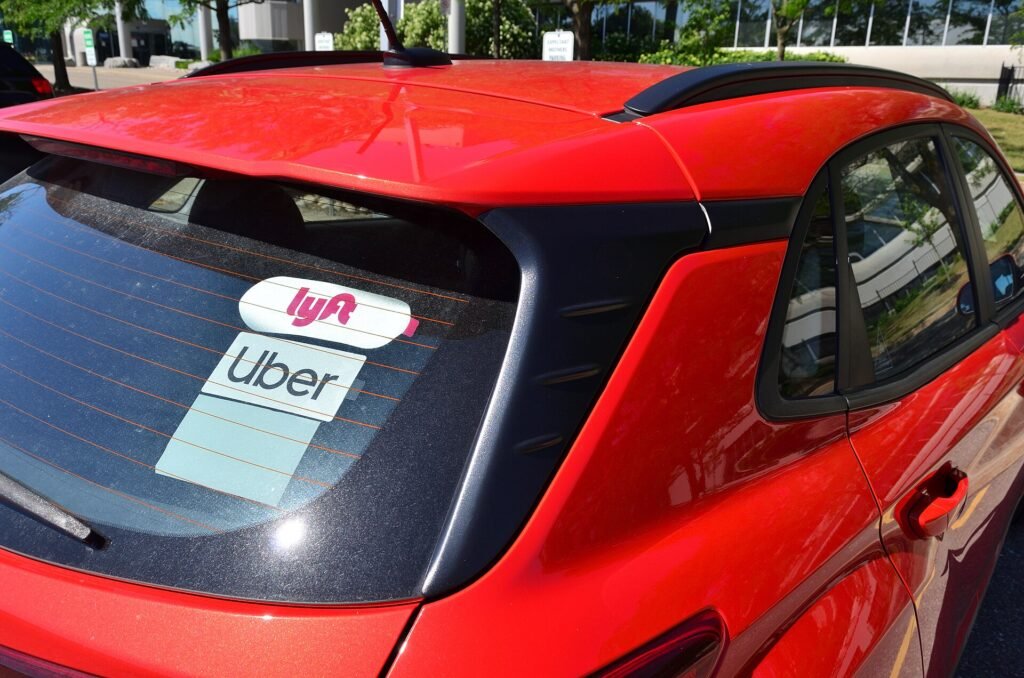
Featured image: rideshare car by Raysonho, released under CC0, via Wikimedia Commons.
About this article: GeekBlog covers U.S. technology news, AI, phones, smartwatches and gaming. Every story is written and checked under our Editorial Policy. Spotted a mistake or have a story tip? Contact our editors.
