

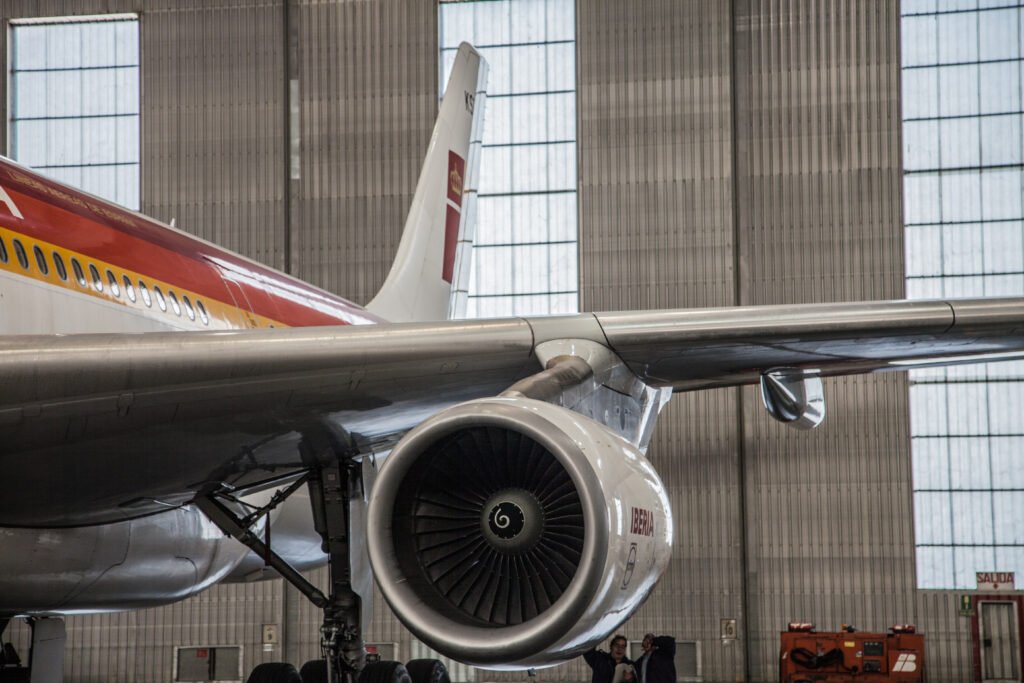
The AI boom has run into a very old problem: electricity. Building a data center takes a year or two. Getting a utility to connect it to the grid, or getting a new gas turbine delivered, can take far longer. So some builders have stopped waiting and started shopping in an unusual place, the aircraft boneyard.
As TechCrunch reported this week, data center developers are turning to retired jet engines, converted into stationary gas turbines that sit on a trailer and make power on site. The approach is less efficient and dirtier than the alternatives, yet it is spreading, because it solves the one thing money alone cannot buy right now: time.
The short version
- Large new gas turbines can come with waits of up to five years, and grid hookups are also slow
- Converted jet engines are called aeroderivative turbines, and each unit makes roughly 25 to 50 MW
- ProEnergy and FTAI Aviation are two of the main suppliers, with xAI and Crusoe among reported customers
- They burn more fuel and pollute more per unit of power than purpose-built power plant turbines
- Many are expected to stay on afterward as backup or grid support
Why jet engines, and why now
An AI data center filled with modern accelerators can draw as much power as a small city. Utilities are struggling to keep up. Interconnection queues stretch for years, and the factories that make big utility-scale turbines are booked solid. A developer who has already paid for land, chips and buildings does not want to watch them sit idle.
Jet engines are an attractive shortcut for a simple reason: they already exist. Airlines retire engines constantly, and the core of an engine like the CF6-80C2 or the CFM56 has plenty of life left once it leaves a wing. Strip it down, pair it with a power turbine and a generator, and you have a machine that burns natural gas to make electricity. The industry term is aeroderivative, meaning derived from aircraft technology.
Who is selling them
Two companies come up again and again in the coverage.
| Supplier | Product and source engine | Reported output | Notable details |
|---|---|---|---|
| ProEnergy | PE6000, built on retrofitted CF6-80C2 engine cores plus new aeroderivative parts | About 48 MW (one report says 50 MW) | xAI installed eight units in Mississippi. Crusoe ordered 13 in April. About 21 turbines sold across two data center projects totaling over 1 GW |
| FTAI Aviation | FTAI Power platform converting CFM56 engines | About 25 MW | Commercial production expected in 2026. A reported $1.5 billion supply agreement in July. Target of roughly 100 turbines a year. Conversion takes about a month to a month and a half |
| Mitsubishi and others | FT8 MOBILEPAC, derived from Pratt & Whitney engines; LM2500XPRESS units | Varies by model | One report says nearly 30 LM2500XPRESS units are being deployed in Texas for a major AI project |
A quick sanity check on those numbers: 21 turbines at about 48 MW each comes to roughly 1,000 MW, which lines up with the “over 1 GW” figure ProEnergy cites. The unit ratings come from company materials and press reports, so it is worth treating them as approximate until independent data appears.
The trade-offs nobody hides
Nobody pitching these machines claims they are the cleanest option. TechCrunch describes them as less efficient and less environmentally friendly than the turbines used in conventional power plants, and the Southern Environmental Law Center has been quoted raising pollution concerns. Because each unit makes less power and burns fuel less efficiently, you need more of them to match a single large plant, and that multiplies the emissions sources a neighborhood has to live with.
Weighing the bargain
- For: power in months instead of years, reused hardware instead of new builds, and modular units that can be added as the site grows
- Against: lower efficiency, more local air pollution per megawatt, and a dependence on natural gas supply on site
- Unknown: I could not find independent heat rate figures for the converted units, so efficiency claims here rest on reporting rather than measured data
A stopgap that may not stay a stopgap
Experts quoted in the coverage see this as a short-term play. Once a grid connection finally arrives, the on-site turbines can shift into other roles: backup power during outages, sales of electricity to the local utility, or supplementing the grid at peak times. That flexibility is part of why buyers are comfortable ordering them. The cost of being wrong is lower when the machine can change jobs.
It also fits a larger pattern. AI spending is forcing companies to rethink where they put money and what they will tolerate. We saw one human side of that in Microsoft’s buyout offer to 60,000 employees amid heavy AI investment, and one physical side in the fight over land, with police investigating the tree clearing for a Google data center in Finland. Jet engine power is the same story from a third angle: the industry is moving faster than the infrastructure beneath it, and it is improvising.
What to watch next
- Air permits. Local regulators decide how many of these units a site may run, and how fast.
- Conversion supply. FTAI’s plan for about 100 turbines a year only works if there are enough retired engines to convert.
- Turbine lead times. If waits for new utility-scale turbines ease, the case for repurposed engines weakens.
- Grid timelines. Faster interconnection would take away the main reason these machines exist.
The takeaway is not that jet engines are a clever hack. It is that the limiting factor for AI right now is not chips or capital, it is power, and when power is scarce, people will burn almost anything that spins.
Sources and further reading
- TechCrunch: Data centers are turning to old jet engines as the wait for power grows
- Data Center Dynamics: ProEnergy repurposes jet engines to power data centers
- GV Wire: Old, polluting jet engines are being scavenged to power data centers
- The Register: Grounded jet engines take off again as datacenter generators
Featured image: CFM56-5C4 engine by Kiko Alario Salom, licensed CC BY 2.0, via Wikimedia Commons.
About this article: GeekBlog covers U.S. technology news, AI, phones, smartwatches and gaming. Every story is written and checked under our Editorial Policy. Spotted a mistake or have a story tip? Contact our editors.
