

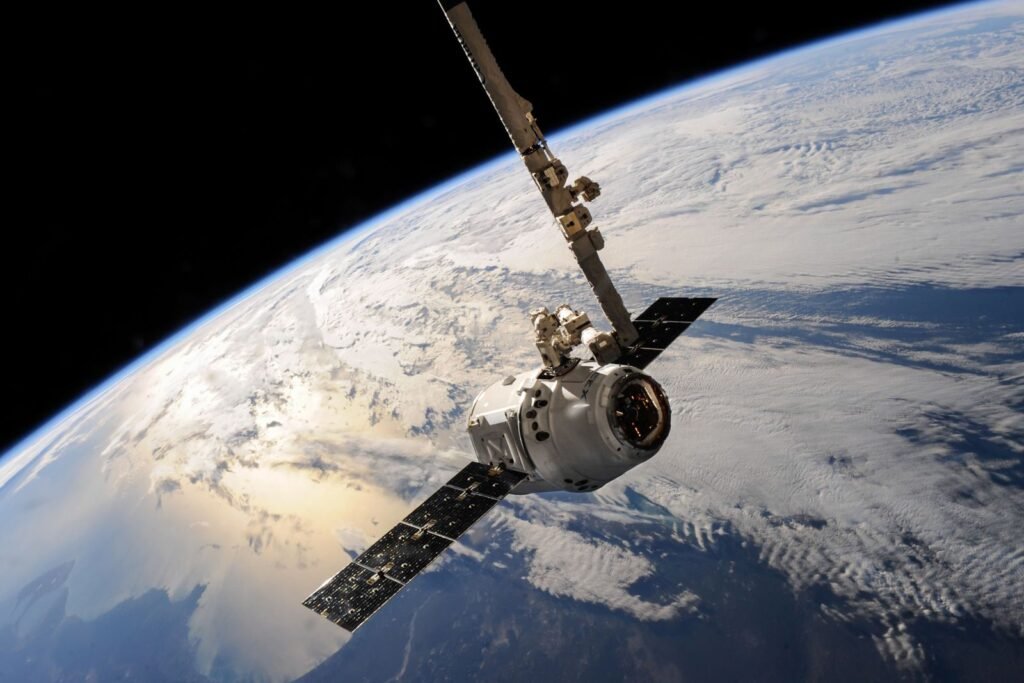
After almost 22 years in orbit, NASA’s Neil Gehrels Swift Observatory is coming home today, and not in one piece. The 3,200-pound telescope is expected to plunge into Earth’s atmosphere on Wednesday, November 4, ending a mission that was originally supposed to last two years.
NASA confirmed the date in a mission update this week, and UNILAD Tech picked up the story this morning. The headline numbers sound a little alarming: a spacecraft the weight of a small car, an uncontrolled fall, and a 1 in 2,100 chance that someone somewhere gets hurt. Read the details, though, and the picture is calmer, and more interesting, than the headline suggests.
The short version
- The U.S. Space Force predicted re-entry at about 3:30 a.m. EST on November 4, with an uncertainty of 11 hours either way.
- Most of Swift will burn up. Some parts are expected to survive.
- Because of Swift’s low orbit inclination, surviving fragments can only land between 20.6 degrees north and 20.6 degrees south latitude.
- NASA puts the chance of anyone being harmed at roughly 1 in 2,100. For any single person, the odds are vanishingly small.
- Science operations ended in October after a $30 million rescue attempt failed over the summer.
When exactly is it coming down?
Nobody can say to the minute, and that’s normal. As of Monday, the Space Force predicted re-entry at roughly 3:30 a.m. Eastern, which is 8:30 a.m. UTC, with a window of plus or minus 11 hours. That puts the earliest possible time on Tuesday evening U.S. time and the latest around 2:30 p.m. Eastern on Wednesday.
The reason for the wide window is the atmosphere itself. At these altitudes, drag depends on how puffed up the upper atmosphere is, which changes with solar activity, and on how the spacecraft happens to be tumbling. A small change in either one shifts the moment of re-entry by an hour or more, and at orbital speed that hour is worth tens of thousands of miles of ground track. At the time of writing, NASA had not published a confirmation that Swift had re-entered, and the agency says it will keep updating predictions with the Space Force.
Source: NASA. Latitude limits from NASA’s November 2 re-entry update. Dots mark example land areas inside the belt.
Why the debris zone is so narrow
The single most useful number in NASA’s update is 20.6 degrees. Swift was launched into a low-inclination orbit, meaning its path tilts only about 20.6 degrees from the equator. A satellite can never pass over a latitude higher than its inclination, so neither can anything that falls off it. That rules out the continental United States, Europe, China, Japan, Russia and most of the planet’s population centers.
What’s left is the tropics: a belt that takes in Mexico and Central America, the Caribbean, the northern part of South America, a wide stretch of Africa, the Arabian Peninsula, India, Southeast Asia and the top of Australia. It’s still a lot of people. But most of that belt is water, and that’s where any surviving hardware is most likely to end up.
What “1 in 2,100” actually means
The figure NASA quotes is the chance that anyone, anywhere on Earth, is hurt by a surviving fragment. It isn’t your personal risk. Spread across the billions of people who live inside that belt, the chance that you in particular are struck works out to something like one in several trillion.
It’s still a higher number than NASA likes. The agency’s debris guidelines ask that new spacecraft keep the casualty risk from an uncontrolled re-entry below 1 in 10,000. Swift was never designed to be steered into a remote ocean at the end of its life, and it has no propulsion system that could do it now. Its risk sits in the same range as two famous re-entries from 2011 that ended without injuries.
| Spacecraft | Year | Stated casualty risk | Outcome |
|---|---|---|---|
| UARS (NASA) | 2011 | 1 in 3,200 | Fell into the remote Pacific, no injuries |
| ROSAT (Germany) | 2011 | About 1 in 2,000 | Came down over the Bay of Bengal, no injuries |
| Swift (NASA) | 2026 | About 1 in 2,100 | Re-entry expected November 4 |
| NASA guideline for new missions | Today | Below 1 in 10,000 | Target for spacecraft designed now |
No one has ever been confirmed killed by falling space debris. The closest call on record is still Lottie Williams, an Oklahoma woman who was brushed on the shoulder by a light piece of rocket material in 1997 and walked away unhurt.
How Swift ended up here
Swift launched on November 20, 2004, at an altitude of roughly 360 to 375 miles (about 585 to 604 kilometers). For most of its life that was plenty high. Then the Sun got busy. The current solar cycle turned out stronger than forecasts, and extra solar activity heats and expands the upper atmosphere, which means more drag on everything in low orbit. Swift lost altitude much faster in the last two years than in the previous twenty. Scientists have even started using thousands of Starlink satellites as sensors for exactly this kind of atmospheric drag.
NASA tried to buy time. It paid about $30 million for LINK, a robotic servicer built by Katalyst Space Technologies in roughly nine months, which launched in July to grab Swift and lift it higher. The servicer lost two of its three reaction wheels within weeks and burned the propellant it needed for the boost just to stop spinning. We covered how the rescue fell apart, and NASA’s decision to switch the telescope back on anyway, back in October.
Swift’s final science observation came in October. UNILAD reports that operations officially ended on October 20, with the spacecraft down to about 171 miles. After Swift dropped into its own safe mode, NASA shut it down and left it to gravity.
What 22 years of Swift bought us
Swift was built to chase gamma-ray bursts, the most powerful explosions in the universe, which usually mark the birth of a black hole or the collision of two neutron stars. These bursts are brief, sometimes over in seconds, so Swift was designed to spot one with a wide-field detector and then swing its X-ray and ultraviolet telescopes onto the spot on its own, without waiting for anyone on the ground. That speed is where the name comes from.
Launched …………… Nov 20, 2004 (Delta II)
Planned mission …….. 2 years
Actual mission ……… ~22 years
Instruments ………… 3 (gamma-ray, X-ray, UV/optical)
Bursts caught ………. 2,000+ (about 100 a year)
Mass ………………. ~3,200 lb
Science ends ……….. Oct 2026
Re-entry …………… Nov 4, 2026 (predicted)
Over time, Swift became something bigger than a burst hunter. It turned into astronomy’s on-call responder, pointing at supernovas, flaring stars, stars being torn apart by black holes, and even comets and asteroids in our own solar system, and sending alerts so other telescopes could follow up. It was named after principal investigator Neil Gehrels, who led the mission until his death in 2017.
That rapid-response role is the real loss here. Bigger and newer telescopes exist, but none of them combines a wide-field gamma-ray monitor with fast, autonomous pointing in quite the same way. Some short-lived cosmic events will now be caught later, or located less precisely, until something replaces it.
Can you watch it come down?
Probably not. Re-entry happens fast, and it happens wherever the spacecraft is when drag wins, which is likely to be over water and possibly in daylight. If Swift does break up over a populated area at night, the most anyone is likely to see is a slow-moving fireball streaking across the sky for a minute or so. If you live inside the belt and find something unusual that you think fell from space, don’t touch it. Report it to local authorities.
Sources and further reading
- NASA: NASA’s Swift Observatory to Re-Enter Atmosphere
- UNILAD Tech: NASA issues update as spacecraft faces fiery re-entry today after 22 years in space
- Discover: NASA’s Swift Observatory is headed for a fiery re-entry
- Wikipedia: Neil Gehrels Swift Observatory
About this article: GeekBlog covers U.S. technology news, AI, phones, smartwatches and gaming. Every story is written and checked under our Editorial Policy. Spotted a mistake or have a story tip? Contact our editors.
