

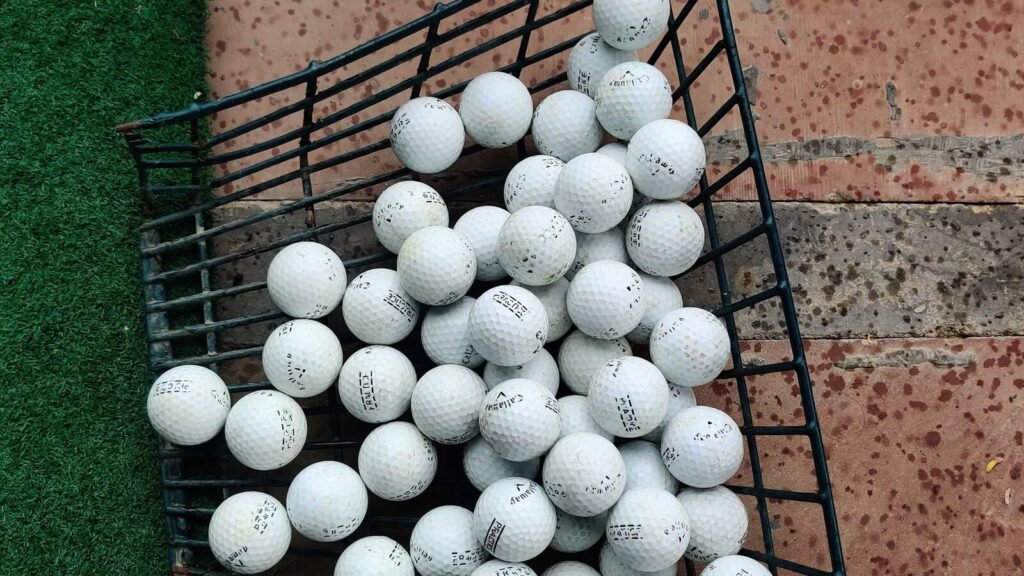
Store golf balls indoors at normal room temperature, in a dry place, and leave them in the sleeves or the box. That is the whole answer, and it is also the manufacturer’s answer. The mistakes worth avoiding are the two most common ones: leaving a dozen in the trunk of a car through a freezing winter or a hot summer, and stashing them in an unheated garage or a damp basement where the temperature swings every day.
Modern golf balls are not fragile, and this is where a lot of range talk goes wrong. A ball is a solid polymer core with one or more mantle layers and an ionomer or urethane cover. There is no wound rubber thread and no liquid center to degrade the way there was in earlier eras. What actually changes performance is the temperature of the ball at the moment you hit it, and what actually ends a ball’s life is physical damage. Storage matters because of the first thing and because bad storage accelerates the second.
What cold really does to a golf ball
The materials in the core and cover stiffen as they cool. Titleist describes it plainly: when a ball gets too cold, the materials inside lose some resiliency, which reduces initial velocity off the clubface. Less resilience means less energy returned at impact, which means less ball speed and less carry. The same idea runs the other way with excessive heat, which also degrades performance.
None of that is permanent. A cold ball that warms back up behaves like a normal ball again. That is the single most useful fact in this whole article, because it means the winter storage question is mostly about avoiding damage rather than about preserving some fragile performance property.
How much distance the cold actually costs
Titleist publishes a rule of thumb: a 1.5% loss for every 20°F drop in temperature. The company illustrates it with a 200 yard shot losing about 3 yards on a 50°F day compared with a 70°F day. Applying that rule to a 200 yard baseline gives you a useful sense of scale.
| Air and ball temperature | Drop from 70°F | Approximate carry on a 200 yard shot |
|---|---|---|
| 70°F | Baseline | 200 yards |
| 50°F | 20°F | About 197 yards |
| 30°F | 40°F | About 194 yards |
Three yards per 20 degrees is smaller than most players assume, and it is worth putting next to the other cold weather effects. Denser cold air adds drag, you are wearing more clothing, and the ground is not releasing the way it does in July. The ball is a minor contributor to the total. Anyone telling you that a winter round costs two clubs because of the ball alone is describing the weather, not the equipment.
Heat, sun and humidity
Heat is the more damaging direction over time. A car trunk in summer sun can sit far above ambient air temperature for hours, day after day. Repeated cycling like that is harder on the cover and the bond between layers than a single cold night ever is. Direct sunlight through a window adds ultraviolet exposure on top of the heat, which is why a box of balls left on a sunny shelf yellows before anything else on that shelf does.
Humidity is a smaller concern for the ball itself, since the cover is a sealed polymer, but it is a real concern for everything around it. A damp basement rusts the box staples, softens the cardboard, and grows mildew on any ball that went in with grass and dirt still on it. If your storage spot ever smells musty, it is the wrong spot.
Where to put them
| Location | Verdict | Why |
|---|---|---|
| Closet or spare room inside the house | Best | Stable temperature, no sun, low humidity, no daily cycling |
| Conditioned basement | Fine | Works if it is dry. Use a sealed bin, not an open box on the floor |
| Unheated garage or shed | Avoid | Large daily swings, freezing nights, condensation on the balls |
| Car trunk | Worst | The extremes Titleist specifically warns against, repeated all season |
| Attic | Avoid | Summer attic temperatures are the highest in the house by a wide margin |
Keep them in the original sleeves and box if you have it. The packaging keeps light off them, keeps them from rubbing against each other, and keeps the model and number together so you know what you are pulling out in April. A clear plastic bin with a lid does the same job for loose balls and is easier to stack.
Do golf balls expire?
Manufacturers do not print an expiration date on a box of golf balls, and there is no shelf life stamped on the packaging the way there is on food. What has genuinely changed is construction. Today’s balls use a solid core with an ionomer or urethane cover, which removed the components most prone to degrading on a shelf. A ball kept indoors in its box is not the part of your equipment you should be worrying about.
What ends a ball is damage, not age. Scuffs from a cart path, a crescent cut from a wedge groove, a flat spot from a tree, or a cover that has gone dull and chalky from sun and heat. Those you can see. When you open the box in spring, inspect rather than count the years: run a thumb over the cover, look at it in good light, and bounce it on a hard floor next to a new one. A ball that sounds and bounces the same and looks clean is fine to play.
Water balls, range balls and shag bags
Balls recovered from ponds are a separate case. The cover is sealed, but a ball that has sat submerged for a long period has been under pressure in water for weeks or months, and there is no way to tell from the outside how long that was. If you play them, play them where losing one does not matter, and do not use them as a baseline when you are comparing anything. Store them apart from your good balls so they do not get mixed in.
Range balls and shag bag balls take a beating by design and live in a bag that is often damp. Empty the bag at the end of the season, dry everything, and store the bag open rather than zipped shut. The same rule applies to the half dozen loose balls rattling around the bottom of your golf bag, which is where mildew starts if the bag spends the winter in a garage.
The off season checklist
One. Gather every ball from the bag, the cart, the trunk and the shag bag into one place.
Two. Wash them in warm water with a little dish soap, rinse, and dry them completely on a towel.
Three. Sort into three piles: new or near new, playable but marked, and damaged. Bin the damaged ones now rather than rediscovering them in spring.
Four. Put the good ones back in sleeves or a lidded bin, label it, and put it on a closet shelf inside the house.
Five. Keep the marked ones in a separate container for winter practice and shag work.
Six. In spring, bring everything to room temperature before the first round if it has been anywhere cold, and inspect before you tee one up.
Frequently asked questions
Can I store golf balls in the garage over winter?
Not ideally. An unheated garage swings through wide daily temperature ranges and often dips below freezing, and condensation forms on cold surfaces when warm air arrives. None of that ruins a ball outright, but it is the opposite of the stable indoor storage manufacturers recommend, and it invites mildew on anything stored with them.
Does freezing a golf ball permanently damage it?
A night below freezing does not wreck a modern ball. The materials stiffen while cold and recover as the ball warms. Repeated deep cycling over months is a different matter, and it is unnecessary risk for zero benefit, so keep them inside instead.
Should I warm my golf balls before a cold round?
Play with balls that are at room temperature to start. Titleist suggests carrying two balls in cold weather and rotating them, keeping the one you are not using in a warm pocket. Do not put balls on a heater or in a microwave, which can damage the cover and is banned under the Rules of Golf as artificially altering playing characteristics.
How long can I keep unopened golf balls?
There is no published expiration date. Kept indoors, dry, out of sunlight and in the box, a sleeve of balls stays serviceable for years. The variable that matters is storage conditions rather than the calendar, so a box in a closet outlasts a box in a trunk by a wide margin.
Do lake balls play differently?
They can, and you cannot tell how long any given one was underwater. Treat recovered balls as practice stock, keep them separate from your good ones, and do not draw conclusions about your distances from a round played with them.
The bottom line
Wash them, dry them, box them, and put them on a shelf inside the house. That covers everything the manufacturers actually recommend, and it costs nothing. The trunk of the car is the one habit worth breaking, because it delivers both extremes on repeat for months at a time.
Then stop thinking about it. Cold costs about three yards per 20 degrees on a 200 yard shot by the manufacturer’s own rule of thumb, which is far less than the clothing, the air and the ground are costing you. If you want the primary sources, read the Titleist guidance on temperature and ball performance and the USGA overall distance test procedure.
About this article: GeekBlog covers U.S. technology news, AI, phones, smartwatches and gaming. Every story is written and checked under our Editorial Policy. Spotted a mistake or have a story tip? Contact our editors.
